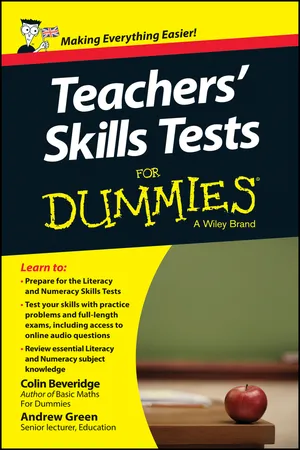
If you're preparing for the newly revised Numeracy and Literacy Skills Tests, Teacher's Skills Tests For Dummies is your one-stop for both exams, providing you with subject-matter review, revision and practice tests you need to tackle the tests with confidence and succeed. Written by expert authors in Maths, English, and Education (with the credentials to prove it), Teacher's Skills Tests For Dummies provides you with:
- A review of the key maths and English concepts you need to know to do well
- Full length practice tests and tons of additional practice questions
- Online accessible audio tests for spelling and mental arithmetic — to better prepare you for the actual test
- Tips and tricks (along with mistakes to avoid) to become a better test taker
With this book — and a bit of work on your part — you'll be positioned to pass your skills tests and gain that coveted place on a teacher-training course.
- English
- ePUB (mobile friendly)
- Available on iOS & Android
eBook - ePub
Teacher's Skills Tests For Dummies
About this book
Information
Part I
Getting Started with the Skills Tests


In this part …
- Learn to leap through the right hoops to become a teacher.
- Find out exactly what you need to know to sit and pass the Skills Tests.
- Sit down and study: perfect your revision technique and get mentally prepared.
- Keep yourself calm, stay motivated and succeed!
Chapter 1
Receiving Your Ticket to the Classroom
In This Chapter

Like just about anything worthwhile in life, becoming a teacher takes work and needs you to fulfil several requirements. One of these, whether you like it or not, is that you have to pass your Professional Skills Tests.
You may be a superb sports coach, a maestro in the music studio, an excellent exponent for English literature or a genius in the geography classroom. You may be able to inspire your pupils with enthusiasm for equilateral triangles, devotion to design technology or passion for the painting processes of Jackson Pollock. You may, in other words, be God’s gift to the teaching profession, but without passing your Skills Tests you aren’t going to reach even the first rung of the teaching ladder.
In this chapter, we lead you through a quick tour of the paths that you can take to become a teacher, providing information about what’s required of you along the way. We also explain why you have to pass the Professional Skills Tests before you can enter a course of Initial Teacher Education (ITE).
Tracing the Routes to Becoming a Teacher
As the rather unpleasant saying goes, ‘there’s more than one way to skin a cat’. Likewise, you have more than one way into the teaching profession (and fortunately they’re all less messy and less damaging to the poor felines). Your task is to find the way that best suits you and your circumstances. If you’ve yet to make that decision, this section can help.
Passing the early stations en route to Teaching Central
No matter which route you take to becoming a teacher – and we outline plenty in this section – you encounter a number of common stops along the way:
- GCSEs: Having a Grade C or better at GCSE (or equivalent qualifications from other countries) in English and Maths has long been a pre-entry requirement for teacher-education courses.
- Professional Skills Tests: You’re reading this book, of course, because you need to pass the Literacy and Numeracy Skills Tests to be accepted onto a teacher-training course.
- A degree: To be a teacher, you require a university degree. You either need to hold a degree in advance of deciding that you want to become a teacher, or to earn one as part of your ITE.
- Qualified Teacher Status (QTS): To achieve QTS, you have to demonstrate to the university or school leading the training that you meet the Teaching Standards established by the Department of Education. At that point, the university or school recommends you for QTS to the Teaching Agency (TA), which is the body that awards the status (check out the Teaching Standards at https://www.gov.uk/government/publications/teachers-standards).


Pursuing an undergraduate degree
If you don’t have a university degree and you want to train as a teacher, you can pursue a degree and work towards QTS (which we define in the preceding section) at the same time at university.
- Bachelor of Arts (BA)/Bachelor of Science (BSc) courses with QTS: These courses provide an honours degree in a particular academic subject (such as English, Maths or Physical Education) alongside working towards QTS. Regular assessed school placements spread over the duration of the degree programme allow you to explore the pedagogic (that is, the theoretical and practical) approaches appropriate to the teaching of the academic subject in the school context.
- Bachelor of Education (BEd) courses: These programmes are honours courses in education. They’re available for primary and secondary education, but given the usual requirement for secondary teachers to possess degree-level knowledge in a particular National Curriculum subject, BEd qualifications (which don’t provide such a specialist focus) are much more common for primary education.
These two courses typically take three or four years to complete.
As with other undergraduate courses, you apply for entry to these programmes via the Universities and Colleges Applications Service (UCAS) at www.ucas.ac.uk.
Taking a postgraduate path
You have two options available if you have a degree in hand and decide that teaching is for you:
- University-based training: Led primarily by university and academic tutors.
- School-based training: Led primarily by a Training School.
These models involve a close partnership between universities and schools, because a balance of academic learning about education and pedagogy and practical application of these subjects through classroom experience is important. Teachers working in schools and university lecturers in education provide different but complementary perspectives on the work of the teacher.
University-based routes
Postgraduate routes into teaching via a higher education institution (HEI) generally allow you to obtain a Postgraduate Certificate in Education (PGCE) with recommendation for QTS.

A PGCE is an academic qualification that’s often studied for and assessed alongside QTS. It allows students to explore philosophies and purposes of education, theories of how teachers teach and learners learn, the history of academic subjects and the ideas underpinning subject pedagogies.
PGCEs are awarded in two forms, though both require that you’ve already completed your first degree (usually in the subject you want to teach):
- Professional level: PGCEs at this level are assessed according to undergraduate criteria.
- Masters level: PGCEs at this level are assessed according to postgraduate criteria and carry Masters-level credits. These credits can be really useful if you want to go on to complete a full Masters in Education at a later date.
To gain access to most programmes you need a good honours degree (2:2 or higher), although the TA has sought...
Table of contents
- Cover
- Title Page
- Table of Contents
- Introduction
- Part I: Getting Started with the Skills Tests
- Part II: Literacy Skills
- Part III: Numeracy Skills
- Part IV: Timed Practice Tests
- Part V: The Part of Tens
- About the Authors
- Cheat Sheet
- More Dummies Products
Trusted by 375,005 students
Access to over 1.5 million titles for a fair monthly price.
Study more efficiently using our study tools.
Frequently asked questions
Yes, you can cancel anytime from the Subscription tab in your account settings on the Perlego website. Your subscription will stay active until the end of your current billing period. Learn how to cancel your subscription
No, books cannot be downloaded as external files, such as PDFs, for use outside of Perlego. However, you can download books within the Perlego app for offline reading on mobile or tablet. Learn how to download books offline
Perlego offers two plans: Essential and Complete
- Essential is ideal for learners and professionals who enjoy exploring a wide range of subjects. Access the Essential Library with 800,000+ trusted titles and best-sellers across business, personal growth, and the humanities. Includes unlimited reading time and Standard Read Aloud voice.
- Complete: Perfect for advanced learners and researchers needing full, unrestricted access. Unlock 1.5M+ books across hundreds of subjects, including academic and specialized titles. The Complete Plan also includes advanced features like Premium Read Aloud and Research Assistant.
We are an online textbook subscription service, where you can get access to an entire online library for less than the price of a single book per month. With over 1.5 million books across 990+ topics, we’ve got you covered! Learn about our mission
Look out for the read-aloud symbol on your next book to see if you can listen to it. The read-aloud tool reads text aloud for you, highlighting the text as it is being read. You can pause it, speed it up and slow it down. Learn more about Read Aloud
Yes! You can use the Perlego app on both iOS and Android devices to read anytime, anywhere — even offline. Perfect for commutes or when you’re on the go.
Please note we cannot support devices running on iOS 13 and Android 7 or earlier. Learn more about using the app
Please note we cannot support devices running on iOS 13 and Android 7 or earlier. Learn more about using the app
Yes, you can access Teacher's Skills Tests For Dummies by Colin Beveridge,Andrew Green in PDF and/or ePUB format, as well as other popular books in Study Aids & Study Guides. We have over 1.5 million books available in our catalogue for you to explore.