Political Prelude: Industrial Democracy Betrayed, from Wilson to Hoover
Woodrow Wilson came to the US presidency in 1912 from the New Jersey governor’s office; before that he was president of Princeton University. Trained as a political scientist and historian, most comfortable behind a desk or a podium, Wilson was not to be confused with a labor hero. Still, his wartime policies would benefit those employed in war industries, inspire workers to demand workplace protections, and help grow trade union membership. He also supported some of the harshest policies against civil liberties and First Amendment rights in the twentieth century. The contradictory nature of Wilson’s policies played out most dramatically in the world of wartime workers.
On April 2, 1917, Wilson delivered a war message to Congress, arguing that the United States needed to join the war that had been raging in Europe since 1914 “to make the world safe for democracy.” In other words, Wilson claimed, US participation in the war was not about self-enrichment; it was driven by America’s responsibility to uphold democratic principles worldwide. One arena where this goal was tested was in US industries where workers made or harvested war materials and government footed the bill. With its vast purchasing power and its commitment to fight a war, the federal government was in a strong position to demand that corporate America – at least those companies wanting lucrative government contracts – abide by new wartime federal policies that guaranteed industrial workers new protections.
Previously when workers struck, government generally acted to protect business’s property through the use of court orders, mandating workers end their strike. Government officials also approved the use of state and federal force, sending in police or troops to “quell” strikes and get businesses back to business. Politicians agreed with industrialists that the legal and physical force used to end work stoppages was a small price to pay for companies being able to turn a profit. But in 1917, when one million workers in such war industries as copper, lumber, and meatpacking chose to withhold their labor in 4,500 strikes around the country, Wilson chose not to use the heavy hand of the state to crush them. Instead, he turned to his newly established Presidential Mediation Commission. The charge of the commission was to investigate labor conflicts in industries deemed vital to war production and recommend solutions. It was headed by Felix Frankfurter, a Jewish immigrant who grew up on the Lower East Side of Manhattan, taught law at Harvard University, and took an early interest in trade unionism, socialism, and communism. The commission, in its final report to the president on January 9, 1918, concluded that workers and management needed to develop a “collective relationship.” According to Frankfurter, both “autocracy and anarchy” were basic evils. But the “central cause” of war industry conflict was due to unequal power in the workplace when it came to settling industrial conflict. Workers needed representation in the workplace. To that end, commission members also recommended that employers set up grievance procedures before problems led to strikes and that government establish a maximum eight-hour work day and more coherent wartime labor policies.
For the first seven months that the United States was at war, agencies making and recommending labor policy proliferated, and at times worked at cross-purposes with one another, with their congressional critics, and with court rulings. To put a stop to the confusion and conflict, in January 1918 President Wilson issued an executive order that created the War Labor Administration, headed by Department of Labor Secretary William Wilson, and charged it with reorganizing war labor agencies. The most important war labor agency to emerge, composed of an equal number of labor and business representatives, was the War Labor Conference Board (later renamed the National War Labor Board), which established wartime labor principles intended to guide peaceful and plentiful production in war industries and eventually, enforce them. Frank Walsh, a public school dropout who taught himself enough law to pass the bar and had a staunch reputation as a working-person’s advocate, accepted appointment to the National War Labor Board (NWLB). He co-chaired with former President William Howard Taft, a man business leaders vainly pleaded with to defend their interests against labor’s encroachment. Taft was inclined to help them out, but Walsh and the country’s wartime productivity needs won out. A new relationship between labor and the state was in the cards.
Walsh and Taft oversaw an agency that miraculously turned the wish list of pro-labor reformers into government policy. The agency called for an eight-hour day, equal pay for women for equal work, the right to join a union, an end to employers’ union-busting activity, and support of a living wage. The right to join a union was a prized victory for workers because it suggested that government believed in the legitimacy of collective bargaining and saw it as a fair exchange for workers’ commitment to maintain high levels of war-related production. Collective bargaining rights allowed workers, under government protection, to advocate for better pay and treatment; and it forced employers to negotiate and then spell out their policies relating to pay, hours, and conditions of employment in a legally binding contract. If collective bargaining did not exist in a plant before the war, employers did not have to recognize unions during the war, but they did have to create shop committees of worker-elected representatives empowered to negotiate on all workers’ behalf – a process that looked a lot like collective bargaining. The NWLB created such worker-elected shop committees in 125 war-industry factories.
The idea of “industrial democracy,” which the NWLB made popular, carried with it the notion that war-production workers were patriots serving a vital national function and, as such, deserved fair treatment. (Not all war-industry workers benefited from “industrial democracy”; women who sewed for war industries from their homes were excluded from NWLB provisions, a hint of shortcomings in labor policies that used factory workers as their standard.) The new policies shifted power relations in war industries, supporting industrial war workers’ challenge to what had been management’s unilateral power. Under the protection of wartime agencies and supported by wartime propaganda, working people previously leery of identifying themselves as union members grew comfortable speaking as patriots in need of democracy.
The results were dramatic. During the war, one million new workers joined unions, and by 1920, five million workers belonged, more than double the prewar number. Union protection and government support resulted also in improved work conditions: by 1919 almost half of the nation’s workers enjoyed a 48-hour week and only one in four worked over 54 hours.
Ironically, at the same time Wilson was giving speeches and making government appointments that tied democratic rights to war work, he also supported policies that suppressed free speech, targeting those critical of capitalist business practices and US participation in the war. The federal Committee on Public Information (CPI), led by journalist, hyper-patriot, and war enthusiast George Creel, worked feverishly to unite a divided country behind an unpopular war. Press releases, posters, movies, advertisements, and over 70,000 public speakers manipulated Americans’ emotions and implored them to buy war bonds, conserve resources, enlist in the military, and report their antiwar neighbors to the Department of Justice. Creel used hyperbole and fear to build a more pro-war, anti-German society; rumors trumped facts in his war for Americans’ hearts.
The problem – for both Creel and Wilson – was that the public was divided over whether to participate in combat overseas. Wilson had won reelection in 1916 as “the man who kept us out of war,” but with government forces committed to bringing democracy to the world, Wilson needed unity of support at home. At first he hoped his government could wrestle critics’ support through the CPI’s propaganda, but quickly he fortified the CPI’s messages with federal legislation. CPI propaganda was emotionally manipulative, jingoistic, and urgent, but ultimately only suggestive; federal legislation, however, restricted civil liberties under the threat of the law. The Espionage Act of June 1917 and the Sedition Act of May 1918 banned antiwar mailings and authorized imprisoning those who spoke against the war. Under these laws, 900 people went to prison and the government deported hundreds more.
Government curtailment of civil liberties also negatively affected those who advocated for workers’ rights, especially those who connected workers’ problems and unnecessary wars to the same source, the profit-driven capitalist system. To these radicals, capitalism ravaged workers, whether in work or at war. Many with these beliefs joined the American Socialist Party, formed in 1901, since it was the only political party opposed to US participation in the war. Between 1901 and 1917, American Socialist Party members recruited members and successfully elected candidates to city, state, and national office. In the context of war, however, Wilson’s war goals chafed against socialists’ antiwar beliefs, so few were surprised when socialist leaders became federal targets.
Victor Berger of Wisconsin is a case in point. Before winning a seat in Congress, Berger was a socialist leader of the Milwaukee local of the International Typographical Union and editor of the city’s Federated Trades Council’s newspaper. Through his union activity and editorial capacity he appealed to those who joined craft unions affiliated with the American Federation of Labor (AFL), offering information on socialist principles. In 1918, with the country at war, Berger won reelection as a representative of his congressional district, but the federal government indicted him under the Espionage Act for his antiwar position. Regardless of the wishes of his constituents, the House refused to seat Berger in 1918 and again in 1920, when he re-won the seat. The Espionage Act also kept all major Socialist Party newspapers from circulating through the US Mail, preventing antiwar advocates from communicating and organizing; it also provided the basis for the Justice Department to indict 27 socialists.
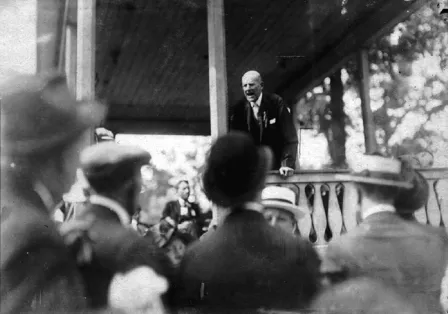
No socialist of the day was better known or more admired than Eugene V. Debs, the American Railway Union leader who in 1894 emerged into the national spotlight at the head of a strike against railway-car maker George Pullman. Imprisoned for his role in the conflict, Debs spent much of his jail time reading socialist writings and wondering why a government that presumably stood for democracy consistently protected the rights of big business over those of workers. Debs became convinced while in jail that neither the Democratic nor Republican Party represented working people, so, once released, he joined the Socialist Party and four times ran on its ticket for President of the United States. After winning almost one million votes in 1912, Debs ran again in 1920 from his prison cell, having been sent there this time for making what the government considered an antiwar speech. Delivered in Canton, Ohio’s Nimisila Park before a thousand supporters and a few federal agents, the speech was labeled in the Terre Haute Plain Dealer as “treasonably-inclined blatherskite.” In fact, it was a call to broaden citizens’ civic rights. Carefully choosing his words, since he was aware of the government’s crackdown on free speech, Debs questioned the morality of waging war on the backs of America’s workers, without their support:
They have always taught you that it is your patriotic duty to go to war and to have yourselves slaughtered at command. But in all of the history of the world you, the people, never had a voice in declaring war . . . The working class who fight the battles, the working class who make the sacrifices, the working class who shed the blood, the working class who furnish the corpses, the working class have never yet had a voice in declaring war . . . If war is right, let it be declared by the people – you, who have your lives to lose; you certainly ought to declare war, if you consider war a necessity.
The Supreme Court ruled that Debs had gone too far. Satisfied with the court’s ruling, Wilson told his cabinet, “Suppose every man in America had taken the same position Debs did. We would have lost the war and America would have been destroyed.” The broad, vocal movement that formed in Debs’s defense saw things differently. To them, American principles were already being destroyed by the government’s protection of capitalism and its willingness to send working-class people to fight in a war waged for its leaders’ profits. Government’s willingness to defy the Constitution and curtail free speech spoke volumes to them. Debs became a working-class hero because, though he did not need to, he aligned his fate with that of the oppressed.
Even more than members of the Socialist Party, those belonging to the Industrial Workers of the World (IWW) faced repression, even though their leaders did not take a formal stand against the war. Formed in 1905, the IWW was an organization determined to organize all workers, regardless of skill, gender, or race, into “One Big Union.” Their greatest successes came in the West among lumber workers, agricultural workers, miners, and seamen. During World War I, federal troops in Montana and Washington monitored railroads and utilities to prevent their destruction from German and other enemies. In 1917, troops expanded their patrols to places where IWW members were recruiting: copper mines, forests, and farms. In the West, often with the aid of local, self-styled patriots, federal troops used violence to break strikes, help strikebreakers cross picket lines, commit unlawful search and seizures, and detain vocal labor advocates. That summer, deputized vigilantes in Bisbee, Arizona, rounded up 1,200 striking copper miners and dropped them off in the middle of a New Mexico desert, and vigilantes in Butte, Montana, caught up with IWW member Frank Little and left him dangling by his neck from a railroad bridge.
Officials in Wilson’s government lent support to these people who took the law into their own hands, believing that strikes and labor militancy were acts of subversion rather than reflections of workers’ call for democratic rights. When Wilson tasked a federal judge with investigating the IWW in August 1917, the Justice Department leapt to the charge in its zeal to quiet labor unrest. On September 5, Justice agents raided every IWW headquarters in the nation and eventually convicted 184 members of espionage and sedition. A US attorney boasted that the government raids were intended to “put the IWW out of business,” which they nearly accomplished.
While World War I raged in Europe, government forces encouraging democracy in the workplace existed in tension with those bent on violating basic civil rights. The problem facing war industry workers was that the balance of forces was about to tip against them since government protection of their workplace rights was a temporary, wartime-emergency measure meant to last only as long as the war. When the conflict ended on November 11, 1918, so did pro-union, labor agreements and the public’s willingness to support them. Government repression continued, however. For example, through the fall and winter of 1919, in response to a coordinated bombing of US officials’ homes and offices in eight cities across the country, the US government acted in an heavy-handed, overzealous manner. Without concern for specific evidence linking individuals to the bombings, United States Attorney General A. Mitchell Palmer sent federal agents to seventy cities across the country to detain and deport people identified as communists or aliens with radical ties. The government held 10,000 people for questioning and deported 500. These Palmer raids and deportations sparked a “red scare” throughout the states, causing state officials to draft their own criminal syndicalism laws and to seek out “subversives.”
So, between 1919 and 1922, when prices soared and wages stagnated, it was without government protection and public support that workers fought to main...