The only security book to be chosen as a Dr. Dobbs Jolt Award Finalist since Bruce Schneier's Secrets and Lies and Applied Cryptography!
Adam Shostack is responsible for security development lifecycle threat modeling at Microsoft and is one of a handful of threat modeling experts in the world. Now, he is sharing his considerable expertise into this unique book. With pages of specific actionable advice, he details how to build better security into the design of systems, software, or services from the outset. You'll explore various threat modeling approaches, find out how to test your designs against threats, and learn effective ways to address threats that have been validated at Microsoft and other top companies.
Systems security managers, you'll find tools and a framework for structured thinking about what can go wrong. Software developers, you'll appreciate the jargon-free and accessible introduction to this essential skill. Security professionals, you'll learn to discern changing threats and discover the easiest ways to adopt a structured approach to threat modeling.
Provides a unique how-to for security and software developers who need to design secure products and systems and test their designs
Explains how to threat model and explores various threat modeling approaches, such as asset-centric, attacker-centric and software-centric
Provides effective approaches and techniques that have been proven at Microsoft and elsewhere
Offers actionable how-to advice not tied to any specific software, operating system, or programming language
Authored by a Microsoft professional who is one of the most prominent threat modeling experts in the world
As more software is delivered on the Internet or operates on Internet-connected devices, the design of secure software is absolutely critical. Make sure you're ready with Threat Modeling: Designing for Security.
This part of the book is for those who are new to threat modeling, and it assumes no prior knowledge of threat modeling or security. It focuses on the key new skills that you'll need to threat model and lays out a methodology that's designed for people who are new to threat modeling.
Part I also introduces the various ways to approach threat modeling using a set of toy analogies. Much like there are many children's toys for modeling, there are many ways to threat model. There are model kits with precisely molded parts to create airplanes or ships. These kits have a high degree of fidelity and a low level of flexibility. There are also numerous building block systems such as Lincoln Logs, Erector Sets, and Lego blocks. Each of these allows for more flexibility, at the price of perhaps not having a propeller that's quite right for the plane you want to model.
In threat modeling, there are techniques that center on attackers, assets, or software, and these are like Lincoln Logs, Erector Sets, and Lego blocks, in that each is powerful and flexible, each has advantages and disadvantages, and it can be tricky to combine them into something beautiful.
Part I contains the following chapters:
Chapter 1: Dive In and Threat Model! contains everything you need to get started threat modeling, and does so by focusing on four questions:
What are you building?
What can go wrong?
What should you do about those things that can go wrong?
Did you do a decent job of analysis?
These questions aren't just what you need to get started, but are at the heart of the four-step framework, which is the core of this book.
Chapter 2: Strategies for Threat Modeling covers a great many ways to approach threat modeling. Many of them are “obvious” approaches, such as thinking about attackers or the assets you want to protect. Each is explained, along with why it works less well than you hope. These and others are contrasted with a focus on software. Software is what you can most reasonably expect a software professional to understand, and so models of software are the most important lesson of Chapter 2. Models of software are one of the two models that you should focus on when threat modeling.
Chapter 1 Dive In and Threat Model!
Anyone can learn to threat model, and what's more, everyone should. Threat modeling is about using models to find security problems. Using a model means abstracting away a lot of details to provide a look at a bigger picture, rather than the code itself. You model because it enables you to find issues in things you haven't built yet, and because it enables you to catch a problem before it starts. Lastly, you threat model as a way to anticipate the threats that could affect you.
Threat modeling is first and foremost a practical discipline, and this chapter is structured to reflect that practicality. Even though this book will provide you with many valuable definitions, theories, philosophies, effective approaches, and well-tested techniques, you'll want those to be grounded in experience. Therefore, this chapter avoids focusing on theory and ignores variations for now and instead gives you a chance to learn by experience.
To use an analogy, when you start playing an instrument, you need to develop muscles and awareness by playing the instrument. It won't sound great at the start, and it will be frustrating at times, but as you do it, you'll find it gets easier. You'll start to hit the notes and the timing. Similarly, if you use the simple four-step breakdown of how to threat model that's exercised in Parts I-III of this book, you'll start to develop your muscles. You probably know the old joke about the person who stops a musician on the streets of New York and asks “How do I get to Carnegie Hall?” The answer, of course, is “practice, practice, practice.” Some of that includes following along, doing the exercises, and developing an understanding of the steps involved. As you do so, you'll start to understand how the various tasks and techniques that make up threat modeling come together.
In this chapter you're going to find security flaws that might exist in a design, so you can address them. You'll learn how to do this by examining a simple web application with a database back end. This will give you an idea of what can go wrong, how to address it, and how to check your work. Along the way, you'll learn to play Elevation of Privilege, a serious game designed to help you start threat modeling. Finally you'll get some hands-on experience building your own threat model, and the chapter closes with a set of checklists that help you get started threat modeling.
Learning to Threat Model
You begin threat modeling by focusing on four key questions:
What are you building?
What can go wrong?
What should you do about those things that can go wrong?
Did you do a decent job of analysis?
In addressing these questions, you start and end with tasks that all technologists should be familiar with: drawing on a whiteboard and managing bugs. In between, this chapter will introduce a variety of new techniques you can use to think about threats. If you get confused, just come back to these four questions.
Everything in this chapter is designed to help you answer one of these questions. You're going to first walk through these questions using a three-tier web app as an example, and after you've read that, you should walk through the steps again with something of your own to threat model. It could be software you're building or deploying, or software you're considering acquiring. If you're feeling uncertain about what to model, you can use one of the sample systems in this chapter or an exercise found in Appendix E, “Case Studies.”
The second time you work through this chapter, you'll need a copy of the Elevation of Privilege threat-modeling game. The game uses a deck of cards that you can download free from threatmodelingbook.com/resources. You should get two–four friends or colleagues together for the game part.
You start with building a diagram, which is the first of four major activities involved in threat modeling and is explained in the next section. The other three include finding threats, addressing them, and then checking your work.
What Are You Building?
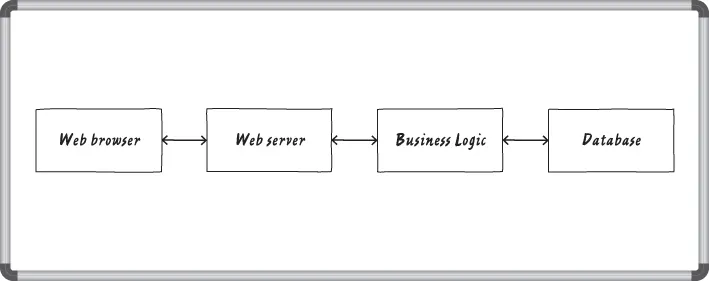
Diagrams are a good way to communicate what you are building. There are lots of ways to diagram software, and you can start with a whiteboard diagram of how data flows through the system. In this example, you're working with a simple web app with a web browser, web server, some business logic and a database (see Figure 1.1).
Figure 1.1 A whiteboard diagram
Some people will actually start thinking about what goes wrong right here. For example, how do you know that the web browser is being used by the person you expect? What happens if someone modifies data in the database? Is it OK for information to move from one box to the next without being encrypted? ...
Table of contents
Cover
Table of Contents
Title Page
Copyright Page
Credits
About the Author
About the Technical Editor
Acknowledgments
Introduction
Part I: Getting Started
Part II: Finding Threats
Part III: Managing and Addressing Threats
Part IV: Threat Modeling in Technologies and Tricky Areas
Part V: Taking It to the Next Level
APPENDIX A:
APPENDIX B:
APPENDIX C: APPENDIX CAttacker Lists
APPENDIX D:
APPENDIX ECase Studies
GlossaryGlossary
BibliographyBibliography
IndexIndex
End User License Agreement
Trusted by 375,005 students
Access to over 1.5 million titles for a fair monthly price.
Study more efficiently using our study tools.
Frequently asked questions
Yes, you can cancel anytime from the Subscription tab in your account settings on the Perlego website. Your subscription will stay active until the end of your current billing period. Learn how to cancel your subscription
No, books cannot be downloaded as external files, such as PDFs, for use outside of Perlego. However, you can download books within the Perlego app for offline reading on mobile or tablet. Learn how to download books offline
Perlego offers two plans: Essential and Complete
Essential is ideal for learners and professionals who enjoy exploring a wide range of subjects. Access the Essential Library with 800,000+ trusted titles and best-sellers across business, personal growth, and the humanities. Includes unlimited reading time and Standard Read Aloud voice.
Complete: Perfect for advanced learners and researchers needing full, unrestricted access. Unlock 1.5M+ books across hundreds of subjects, including academic and specialized titles. The Complete Plan also includes advanced features like Premium Read Aloud and Research Assistant.
Both plans are available with monthly, semester, or annual billing cycles.
We are an online textbook subscription service, where you can get access to an entire online library for less than the price of a single book per month. With over 1.5 million books across 990+ topics, we’ve got you covered! Learn about our mission
Look out for the read-aloud symbol on your next book to see if you can listen to it. The read-aloud tool reads text aloud for you, highlighting the text as it is being read. You can pause it, speed it up and slow it down. Learn more about Read Aloud
Yes! You can use the Perlego app on both iOS and Android devices to read anytime, anywhere — even offline. Perfect for commutes or when you’re on the go. Please note we cannot support devices running on iOS 13 and Android 7 or earlier. Learn more about using the app
Yes, you can access Threat Modeling by Adam Shostack in PDF and/or ePUB format, as well as other popular books in Computer Science & Cyber Security. We have over 1.5 million books available in our catalogue for you to explore.