The Nano-Micro Interface
Bridging the Micro and Nano Worlds
- English
- ePUB (mobile friendly)
- Available on iOS & Android
The Nano-Micro Interface
Bridging the Micro and Nano Worlds
About this book
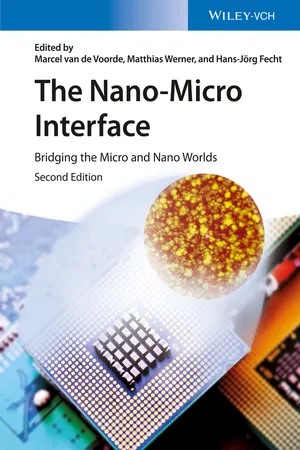
Controlling the properties of materials by modifying their composition and by manipulating the arrangement of atoms and molecules is a dream that can be achieved by nanotechnology. As one of the fastest developing and innovative -- as well as well-funded -- fields in science, nanotechnology has already significantly changed the research landscape in chemistry, materials science, and physics, with numerous applications in consumer products, such as sunscreens and water-repellent clothes. It is also thanks to this multidisciplinary field that flat panel displays, highly efficient solar cells, and new biological imaging techniques have become reality.
This second, enlarged edition has been fully updated to address the rapid progress made within this field in recent years. Internationally recognized experts provide comprehensive, first-hand information, resulting in an overview of the entire nano-micro world. In so doing, they cover aspects of funding and commercialization, the manufacture and future applications of nanomaterials, the fundamentals of nanostructures leading to macroscale objects as well as the ongoing miniaturization toward the nanoscale domain. Along the way, the authors explain the effects occurring at the nanoscale and the nanotechnological characterization techniques. An additional topic on the role of nanotechnology in energy and mobility covers the challenge of developing materials and devices, such as electrodes and membrane materials for fuel cells and catalysts for sustainable transportation. Also new to this edition are the latest figures for funding, investments, and commercialization prospects, as well as recent research programs and organizations.
Frequently asked questions
- Essential is ideal for learners and professionals who enjoy exploring a wide range of subjects. Access the Essential Library with 800,000+ trusted titles and best-sellers across business, personal growth, and the humanities. Includes unlimited reading time and Standard Read Aloud voice.
- Complete: Perfect for advanced learners and researchers needing full, unrestricted access. Unlock 1.4M+ books across hundreds of subjects, including academic and specialized titles. The Complete Plan also includes advanced features like Premium Read Aloud and Research Assistant.
Please note we cannot support devices running on iOS 13 and Android 7 or earlier. Learn more about using the app.
Information
Part I
Nanotechnology Research Funding and Commercialization Prospects – Political, Social, and Economic Context for the Science and Application of Nanotechnology
1
A European Strategy for Micro- and Nanoelectronic Components and Systems1
1.1 Introduction
- attracting and channelling investments in support of a European roadmap for industrial leadership in micro- and nanoelectronics;
- setting up an EU-level mechanism to combine and focus support to micro- and nanoelectronics R&D&I by member states, the EU, and the private sector;
- taking measures to strengthen Europe's competitiveness towards a global-level-playing field regarding state aid, to support business development and SMEs, and to address the skills gap.
1.2 Why are Micro- and Nanoelectronics Essential for Europe?
1.2.1 An Important Industry with a Significant Potential for Growth and a Massive Economic Footprint
- The global turnover of the sector alone was around €230 billion in 2012 [3]. The value of products comprising micro- and nanoelectronic components represents around €1600 billion of value worldwide.
- Despite the recent financial and economic setbacks, the worldwide market for micro- and nanoelectronics has grown by 5% per year since 2000. Further growth of at least the same magnitude is predicted for the remaining part of the current decade.
- The pace of innovation in the field is one of the main drivers behind the high growth rates of the whole digital sector which today has a total value of around €3000 billion worldwide [4].
- In Europe, micro- and nanoelectronics is responsible for 200 000 direct and more than 1 000 000 indirect jobs [5] and the demand for skills is unceasing.
- The impact of micro- and nanoelectronics on the whole economy is estimated at 10% of the worldwide GDP [6].
1.2.2 A Key Technology for Addressing the Societal Challenges
1.3 A Changing Industrial Landscape for Micro- and Nanoelectronics
1.3.1 Technology Progress Opens New Opportunities
1.3.2 Escalating R&D&I Costs and a More Competitive R&D&I Environment
1.3.3 New Business and Production Models
1.3.4 Equipment Manufacturers Own Key Elements of the Value Chain
Table of contents
- Cover
- Related Titles
- Title Page
- Title Page
- Copyright
- Foreword
- Acknowledgement
- List of Contributors
- The Nano–Micro Interface: Bridging the Micro and Nano Worlds
- Part I: Nanotechnology Research Funding and Commercialization Prospects – Political, Social, and Economic Context for the Science and Application of Nanotechnology
- Part II: Development of Micro and Nanotechnologies
- Part III: Nanoelectronics and SystemIntegration
- Part IV: Biomedical Technologies and Nanomedicine
- Part V: Energy and Mobility
- Part VI: Process Controls and Analytical Techniques
- Part VII: Creative Strategies Connecting Nanomaterials to the Macroscale World
- Part VIII: Visions for the Future
- Index
- EULA