- English
- ePUB (mobile friendly)
- Available on iOS & Android
eBook - ePub
Non-volatile Memories
About this book
Written for scientists, researchers, and engineers, Non-volatile Memories describes the recent research and implementations in relation to the design of a new generation of non-volatile electronic memories. The objective is to replace existing memories (DRAM, SRAM, EEPROM, Flash, etc.) with a universal memory model likely to reach better performances than the current types of memory: extremely high commutation speeds, high implantation densities and retention time of information of about ten years.
Information
PART 1
Information Storage and the State of the Art of Electronic Memories
1
General Issues Related to Data Storage and Analysis Classification of Memories and Related Perspectives
Over the past few years, the massive increase in the volume of information has encouraged the search for ways to resolve issues related to data storage and processing. The technical means for resolving these problems go hand in hand with the improvement of read–write–erase speeds, a reduction in energy consumption of electronic memory devices as well as an increase in their storage capacity. A short description of the characteristics of the different types of memories, volatile or non-volatile, reveals the existence of a technological gap between the performance of extremely rapid volatile memories and non-volatile memories, the latter being used for storage, but too slow for handling large volumes of data. The search for universal memories capable of combining storage and processing capabilities for data-use is a new field of research in the industry. In the years to come, this is expected to lead to the progressive replacement of current systems by new generations of memories with qualification characteristics equivalent to those of “Storage Class Memories” (SCMs).
1.1. Issues arising from the flow of digital information
Information storage and the continuous increase in the volume of information circulating in the world are topics that preoccupy large bodies responsible for political anticipation and decision-making. A recent report by the International Data Corporation (IDC), “The Digital Universe in 2020” [GAN 12], indicates that the volume of digital information in the world decupled between 2006 and 2011, increasing from 180 to 1,800 Exabytes (EBs)1, and should reach an astounding 40,000 EBs by 2020, the equivalent of 5,200 Gigabytes (GBs) per human being.
This trend is not expected to slow down – the authors of the report estimate that the volume of digital information will double every two years from 2012 to 2020 – thus leading de facto to the consideration of issues in energy consumption inherent in the running of large servers that, for obvious reasons, are now preferably located close to centers of electrical energy production and distribution, a tendency emphasized by the recent boom in “Cloud Computing” [MEL 11].
Since the 1990s, digital technologies have taken over from analog technologies. In 2007, 99.9% of telecommunications were carried-out digitally. As of the early 2000s, the majority of information was also stored in digital mode, representing 94% of all stored information in 2007 [HIL 11].
This irreversible and ultra-fast increase in the global flux of information with, in addition to this, a strong demand for increasingly powerful computers, requires an extreme miniaturization of electronic components and memories. The end of the applicability of Moore’s Law2 is considered as imminent, and new solutions must be found to resolve issues related to information storage.
This question has already been considered by many bodies, and a very general prospective has been developed over the years with a view to the possible replacement of current components (transistors and memories), essentially founded on silicon-based technology, by new systems based on materials capable of increasing the integration density of components in the electronic circuits so as to improve energy efficiency while promoting high operational reliability.
1.2. Current electronic memories and their classification
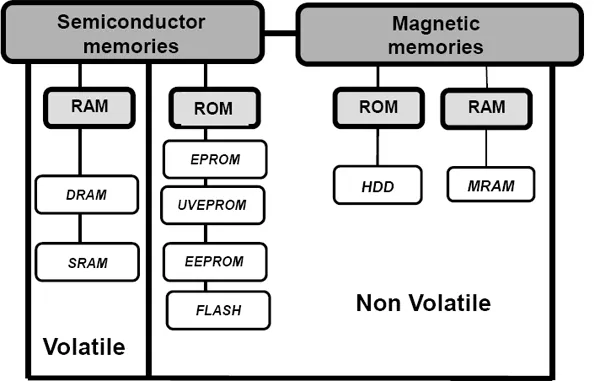
Computers and information storage currently depend on the use of two kinds of memories: volatile and non-volatile (Figure 1.1).
Volatile memories (essentially Dynamic Random Access Memory (DRAM) and Static Random Access Memory (SRAM)), which are used to run computers, have very short execution times but, unfortunately, the conservation of data with time (retention) requires either periodical refreshing (DRAMs) or a constant power supply (SRAMs), both of which are costly in terms of energy.
Non-volatile memories, consisting mainly of hard drives (Hard Disk Drives (HDDs)) and more recently Flash memories (NOR and NAND) have retention times that are convenient for the requirements of information storage. At rest, they do not require a power supply but have read–write and erase times that are too long for logic operations. They are used for storage and are classified as Read Only Memory (ROM) memories. Magnetic memories (MRAM) are also non-volatile and very fast, and can be addressed in random access.
Among volatile memories, DRAMs and SRAMs are the main memories used to run logic operations. DRAMs have very short retention times (at the ms level or less) and therefore require periodical refreshing. SRAMs conserve information when they are connected to a power supply, and lose this information when the power is off. This last type of memory, for which write, read and erase tasks are very rapid (a few nanoseconds), is mostly used in computers as cache memory3.
Non-volatile memories, which have very high retention times, must be considered as peripheral components of the computer that do not take part in logic functions. They are used for reading information that is archived, and hence are referred to as ROM.
Within this first and very general definition, a distinction is made between memories used to store information that is considered as programmed just once, and can be read without any possible modification – One Time Programmable Read Only Memory (OTPROM) or Write One Time Read Many (WORM) – and those where the information can also be indefinitely conserved, but this time, with the possibility of modifying it when required – EPROM memories, i.e. ROM memories that can be erased and reprogrammed.
Figure 1.1. Classification of the main current types of volatile and non-volatile memories. Adapted from Jeong et al. [JEO 12]
The first memories of the latter type, known as UV-EPROM, which appeared on the market in the 1970s, could be erased by exposing the entire device to prolonged UV irradiation. In the 1980s the first memories appeared that could be written and erased electronically (Electrically Erasing PROM (EEPROM)) but that could also conserve the information indefinitely, therefore providing an advantageous replacement for UV-EPROM.
Flash memories, first produced in the 1980s by Toshiba, and a few years later by INTEL (1988), were derived from EEPROM memories. These memories are in fact an assembly of EEPROMs that, depending on their connection mode (parallel or series), lead to NOR Flash and NAND Flash memories. In the past few years, these memories have been the object of considerable industrial development and are considered as future storage memories, capable of competing with magnetic hard drives.
Their common feature is the local appearance or disappearance of an electrical charge trapped in a “floating” electrode, designated as a storage “node”, and corresponding to processes involving “charge storage nodes” [ZHI 12].
The magnetic storage of information is without doubt the oldest procedure4. Magnetic hard drives (HDD) rely on a process in which the memory effect is due to the recognition of magnetic microdomains that can be reversibly created and erased. They constitute exceptional non-volatile memories that have the advantage of allowing periodical and almost indefinite writing and erasure of data, and are able to conserve it for as long as the rotating disk is functional. The most significant event that can lead to the loss of data is a mechanical incident that crashes the read–write head onto the rotating disk, which unfortunately, like any catastrophe, occurs without warning and not infrequently. Contrary to HDDs, for which access to data is sequential, MRAM magnetic memories operate by random access and no longer have any mechanical parts, but require greater space, due to the number of leads necessary for the magnetic field, and have a higher energy consumption, for which reasons they are restricted to specific applications (see Chapter 2, section 2.4.5).
1.3. Memories of the future
For a long time the electronic memory industry was dominated by the production of DRAMs and HDDs, and it is only recently, with the beginning and the intrusion into everyday life of portable devices of all kinds, that the share in the market of Flash memories (Solid State Drives (SSD)) has considerably increased compared to that of HDDs.
It is admitted, however, that the scale reduction of floating gate Flash memories beyond the 16 nm scale will be difficult to achieve without a significant increase in their manufacturing costs [BUR 13].
The ambition to develop ever more powerful yet less power-hungry calculators, while remaining within reasonable costs, implies that either great progress has to be made in the conception of storage hard drives or that new approaches for data storage must be considered.
It is this research effort toward new technologies that has led the industry to select a limited group of systems capable of combining the dynamic characteristics of DRAMs with storage characteristics close to those of HDDs.
The International Technology Roadmap for Semiconductors5 (ITRS) in its 2010 editions (Emerging Research Materials, [HUT 10, ITR 11]) suggests new paths in research for the elaboration of electronic memories s...
Table of contents
- Cover
- Contents
- Title page
- Copyright
- Acknowledgments
- Preface
- PART 1: Information Storage And the State of the Art of Electronic Memories
- PART 2: The Emergence of New Concepts: The Inorganic NEMS, PCRAM, ReRAM and Organic Memories
- Conclusion
- Bibliography
- Index
Trusted by 375,005 students
Access to over 1.5 million titles for a fair monthly price.
Study more efficiently using our study tools.
Frequently asked questions
Yes, you can cancel anytime from the Subscription tab in your account settings on the Perlego website. Your subscription will stay active until the end of your current billing period. Learn how to cancel your subscription
No, books cannot be downloaded as external files, such as PDFs, for use outside of Perlego. However, you can download books within the Perlego app for offline reading on mobile or tablet. Learn how to download books offline
Perlego offers two plans: Essential and Complete
- Essential is ideal for learners and professionals who enjoy exploring a wide range of subjects. Access the Essential Library with 800,000+ trusted titles and best-sellers across business, personal growth, and the humanities. Includes unlimited reading time and Standard Read Aloud voice.
- Complete: Perfect for advanced learners and researchers needing full, unrestricted access. Unlock 1.5M+ books across hundreds of subjects, including academic and specialized titles. The Complete Plan also includes advanced features like Premium Read Aloud and Research Assistant.
We are an online textbook subscription service, where you can get access to an entire online library for less than the price of a single book per month. With over 1.5 million books across 990+ topics, we’ve got you covered! Learn about our mission
Look out for the read-aloud symbol on your next book to see if you can listen to it. The read-aloud tool reads text aloud for you, highlighting the text as it is being read. You can pause it, speed it up and slow it down. Learn more about Read Aloud
Yes! You can use the Perlego app on both iOS and Android devices to read anytime, anywhere — even offline. Perfect for commutes or when you’re on the go.
Please note we cannot support devices running on iOS 13 and Android 7 or earlier. Learn more about using the app
Please note we cannot support devices running on iOS 13 and Android 7 or earlier. Learn more about using the app
Yes, you can access Non-volatile Memories by Pierre-Camille Lacaze,Jean-Claude Lacroix in PDF and/or ePUB format, as well as other popular books in Technology & Engineering & Materials Science. We have over 1.5 million books available in our catalogue for you to explore.