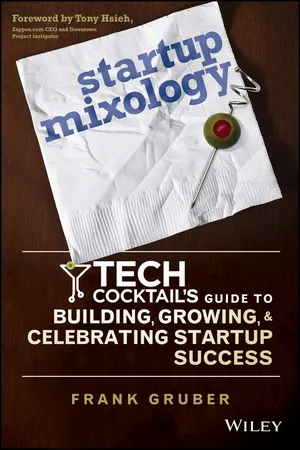
Shake up the market with these key ingredients to a successful startup
Entrepreneurship starts with an idea and a dream: a dream of a better world for others, and a life less ordinary for yourself. These days, more people than ever are full of world-changing ideas and, thanks to technology, have the means to bring them to life. But many ideas remain just ideas, and many dreams just dreams.
Startup Mixology is first and foremost a book about turning your ideas into action. From the cofounder of media company Tech Cocktail, a veteran entrepreneur and investor who was named one of the most connected people in tech, this book covers the basic "ingredients" of winning entrepreneurship. No abstract theories here — it shows you how to tackle everything from idea generation to launch to marketing to funding and how to start getting things done.
Once you've taken that first step, the journey has only begun. Startup Mixology tells it like it is — and it's not easy! You'll learn about the harsh reality of starting up: what happens when you offend your customers, get no attention, or run out of money. These are the stories you don't always hear in the media.
In the end, Startup Mixology is an optimistic book. You can do this — and you can have fun doing it, too. Every chapter also shows you how to enjoy the journey along the way - because if you don't, what's the point of it all? From cake baking to workations to llama parades, you'll learn how entrepreneurs around the world stay sane, reduce stress, and celebrate the positive. This may seem fluffy, but it's actually one of the biggest secrets of successful startups.
Inside, you'll find the stories of companies like MakerBot, WordPress, Zappos, Basecamp, Uber, and more. Hear in their own words how they survived the startup phase, and learn from the straightforward and conversational Frank Gruber, who has met thousands of entrepreneurs and watched them grow their businesses.
In many ways, entrepreneurship will be the most difficult undertaking of your career. But if you can find the right balance of hard work, support, and celebration, it can also be the most rewarding. Startup Mixology takes you through the whole process from start to finish, so you can begin the incomparable journey of turning your great ideas into great startups.
My 10-year journey from college to starting up taught me how to think like an entrepreneur and embrace the startup life, a life that I am firmly planted in and thankful for every day. My story may be different from yours, but you'll probably recognize some elements and be able to learn from my mistakes and my observations.
After growing up in the cornfields of northern Illinois dreaming of a baseball career, I realized in college that it wasn't meant to be, so I decided to jump into computer technology. My computer technology degree from Purdue University landed me a summer internship my junior year with a consulting company in what was then the Sears Tower in downtown Chicago. I was getting paid $20 an hour for the summer, which at the time was a lot for a college student who looked more like a 15-year-old.
The internship turned into a full-time opportunity and I took it. It wasn't the Chicago Cubs, but the Internet boom was still young and I was close to home and my favorite sports teams. I learned a number of things working at a fast-paced, scrappy technology consulting business. The first was that you don't have to actually have a product to sell it. We sold work that was not yet created off the idea that we could create it in just a short time. This was a new concept to me and one that has helped me sell our Tech Cocktail vision not based on where we've been but on where we're going.
It wasn't until the spring after September 11, 2001, that I learned the hardest lesson. The company wasn't doing as well as it previously had, and there was a cash-flow shortage, so they had to lay off nearly the entire team, including me and many of the colleagues I had helped hire. It was a sad day. I remember walking home in the cold Chicago rain. Getting laid off from my first job out of college taught me a very important lesson: there is no security in working for someone else. I had been raised believing that if you go out and work really hard, you can get a good job, build a career, and everything will fall into place. What they don't tell you is that some of the companies you work for may also need to make changes to survive, at your expense. You might not get a shot at building the career you imagined no matter how hard you work.
But I still wasn't a rebel yet, so I went to work for a larger corporation, the Tribune Company, with the sense that it would be more secure. It had been around almost a hundred years, and I had grown up visiting the iconic Tribune Tower across from the Wrigley Building on Michigan Avenue. It was a Chicago media icon. So when I landed a job with the Tribune, I was sure I had found the place I was going to build a career—not to mention, they owned the Chicago Cubs. This meant I could see more Cubs games than ever before. I loved working at the Tribune and walking into the tower every day. It was a dream come true for me. But even though Tribune Company adapted early to get newspapers online, I started to realize that they were not aggressive enough—startups like Yahoo! and AOL were land-grabbing for niche industry news eyeballs online, and companies such as Craigslist and Google devastated the online classified and display advertising space.
While still at Tribune, I started my own personal blog called Somewhat Frank to review startups and better understand blogging, and I started to see things that needed improvement in the fast-paced blogosphere. And I was a developer, so I was in an interesting position. I realized I could literally develop a product to solve a problem, launch it via my blog, and acquire new users instantly. So I did just that.
At the time, spam blogs, or splogs, were a problem. I noticed that popular entrepreneur, investor, and blogger Mark Cuban, also the owner of the Dallas Mavericks, had been posting in the blogosphere about it. He was hot on the topic of splogs because he had invested in a blog search engine called IceRocket, which was getting infiltrated by spam blogs. Sploggers were churning out thousands of landing pages filled with ads for popular search terms, polluting the Web.
When I realized this, I sprang into action. A friend of mine and I spent our nights after work creating a simple product called Splog Reporter, with the mission of helping clean up the blogosphere one splog at a time. The term splog hadn't existed more than a few days earlier, and we had already built a product to help tackle it. It took off! Within days, I started getting interviews and Splog Reporter was covered by the Wall Street Journal, Wired, and a number of other publications—even the Toronto Star picked up the story.
Splog Reporter lasted only about three months before we had to pull the plug. I realized that in order to really help IceRocket and other blog search engines clean up their indexes, while creating a sustainable business, I would have to build a comprehensive search engine, which was a bit out of scope for my first venture. It was a good decision, as Google then added their own blog search engine, crushing the competition, as it would have done to Splog Reporter.
Although short-lived, Splog Reporter had two pretty big impacts on me. First, I got to connect with Mark Cuban—that was a pretty memorable experience. Being mentioned in the same Wall Street Journal article as him was amazing. Second, Splog Reporter was my own little startup 101 course. It was a huge aha moment for me. I started to see problems as opportunities to build something. I now knew that with my coding abilities, I could launch a product, get users, and make lots of noise. I had a voice. What did I need my day job for, again? Oh, that's right: to make money to pay my mortgage, student loans, and car payment. But this was when I realized I could do it—I could startup.
All these experiences, and a few others I'll get to, rewired my brain from believing I needed someone else to give me a stable job to being excited about venturing out on my own. I learned that you don't have to follow the old ways and rules—rules that were making traditional companies struggle. I was finally ready to start Tech Cocktail, which is how I came to write this book and share my stories with all of you.
So what lessons can we learn from my story? Let's dive in and look at what it means to think like an entrepreneur and how to make sure you have the right mind-set to build a startup. Although not everyone is comfortable with the uncertainty or adventure that comes with entrepreneurship—or has the vision it takes to create something from nothing—it's possible to train your brain to be more alert to opportunities, question rules, and constantly be in learning mode. Just being aware of this mode of thinking should help you better understand your own thought patterns and slowly and gradually shift them to the creative but focused, risk-taking but prudent, optimistic but failure-embracing attitude of the entrepreneur.
See Problems as Opportunities
Thinking entrepreneurially starts with thinking a little differently. Most people get caught up with self-imposed barriers that blind them to what's possible. This type of thought might start out with, “I'd like to, but I can't because…” Entrepreneurs don't allow their minds to be shut off by these types of “I'd like to but…” statements. They understand there may be potential barriers, but they're able to look past them. They see barriers as adventures, as the beginning of something big, and as the means to make something amazing happen.
Vision
I've witnessed two types of entrepreneurs: those who love the process of entrepreneurship, no matter the product or service (they just love the challenge), and those with a strong background in a particular field who see a way to improve it. The former is a creator, someone who probably couldn't fathom the idea of working for someone else and may be a lifelong serial entrepreneur. The latter often has a stronger vision, as this person knows the field better than anyone else and sees something that no one else can.
Do you have a strong vision for a better world? The vision that has propelled Tech Cocktail is to help entrepreneurs gain visibility locally and nationally and enjoy their startup life journey. To do that, we provide them with connections, community, and resources (news, reports, events, and more).
Think Less; Act More
The idea of going out and getting started is encapsulated in slogans such as “Just do it,” made popular by Nike. Sayings such as “Get shit done” or “Ready, fire, aim” (also the name of a book by Michael Masterson) have helped make these ideas more mainstream in the startup world. I always like to use “just start” as a battle cry for anyone sitting on the fence about the best time to unleash his or her idea into the world.
Saras Sarasvathy, an asso...
Table of contents
Cover
Title Page
Copyright
Dedication
Foreword
Introduction
Part 1: Getting Started
Part 2: Product
Part 3: Team and People
Part 4: Sales and Marketing
Part 5: Money
Part 6: Growth and Change
Conclusion
Acknowledgments
References
Index
End User License Agreement
Trusted by 375,005 students
Access to over 1.5 million titles for a fair monthly price.
Study more efficiently using our study tools.
Frequently asked questions
Yes, you can cancel anytime from the Subscription tab in your account settings on the Perlego website. Your subscription will stay active until the end of your current billing period. Learn how to cancel your subscription
No, books cannot be downloaded as external files, such as PDFs, for use outside of Perlego. However, you can download books within the Perlego app for offline reading on mobile or tablet. Learn how to download books offline
We are an online textbook subscription service, where you can get access to an entire online library for less than the price of a single book per month. With over 1.5 million books across 990+ topics, we’ve got you covered! Learn about our mission
Look out for the read-aloud symbol on your next book to see if you can listen to it. The read-aloud tool reads text aloud for you, highlighting the text as it is being read. You can pause it, speed it up and slow it down. Learn more about Read Aloud
Yes! You can use the Perlego app on both iOS and Android devices to read anytime, anywhere — even offline. Perfect for commutes or when you’re on the go. Please note we cannot support devices running on iOS 13 and Android 7 or earlier. Learn more about using the app
Yes, you can access Startup Mixology by Frank Gruber in PDF and/or ePUB format, as well as other popular books in Business & Entrepreneurship. We have over 1.5 million books available in our catalogue for you to explore.