- English
- ePUB (mobile friendly)
- Available on iOS & Android
eBook - ePub
About this book
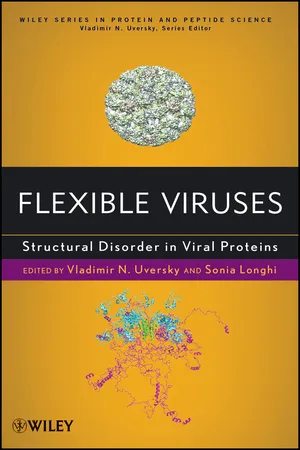
This book provides up-to-date information on experimental and computational characterization of the structural and functional properties of viral proteins, which are widely involved in regulatory and signaling processes. With chapters by leading research groups, it features current information on the structural and functional roles of intrinsic disorders in viral proteomes. It systematically addresses the measles, HIV, influenza, potato virus, forest virus, bovine virus, hepatitis, and rotavirus as well as viral genomics. After analyzing the unique features of each class of viral proteins, future directions for research and disease management are presented.
Information
Chapter 1
Do Viral Proteins Possess Unique Features?
1.1 Introduction
Many proteins (or protein regions) are intrinsically disordered. They lack unique 3D structures in their native, functional states under physiological conditions in vitro (Wright and Dyson, 1999; Uversky et al., 2000; Dunker et al., 2001, 2002a,b; Tompa, 2002, 2003; Uversky, 2002a,b, 2003; Minezaki et al., 2006). The major functions of such proteins and regions are signaling, recognition, and regulation activities (Wright and Dyson, 1999, 2009; Dunker et al., 2002a,b; 2005; 2008a,b; Dyson and Wright, 2005; Uversky et al., 2005; Radivojac et al., 2007; Dunker and Uversky, 2008; Oldfield et al., 2008; Tompa et al., 2009). Owing to these crucial functional roles, intrinsically disordered proteins (IDPs) are highly abundant in all species. According to computational predictions, typically 7–30% prokaryotic proteins contain long disordered regions of more than 30 consecutive residues, whereas in eukaryotes the amount of such proteins reaches 45–50% (Romero et al., 1997, 2001; Dunker et al., 2001; Ward et al., 2004; Oldfield et al., 2005a,b; Feng et al., 2006). Furthermore, almost 70% of proteins in the PDB (which is biased to structured proteins) have intrinsically disordered regions (IDRs), which are indicated by missing electron density (Obradovic et al., 2003). Numerous disordered proteins have been shown to be associated with cancer (Iakoucheva et al., 2002), cardiovascular disease (Cheng et al., 2006), amyloidoses (Uversky, 2008a), neurodegenerative diseases (Uversky, 2008b), diabetes, and other human diseases (Uversky et al., 2008), an observation that was used to introduce the “disorder in disorders” or D2 concept (Uversky et al., 2008).
Recently, we showed also that IDPs are abundant in the human diseasome (Midic et al., 2009), a framework that systematically linked the human disease phenome (which includes all the human genetic diseases) with the human disease genome (which contains all the disease-related genes) (Goh et al., 2007). This framework was constructed from the analysis of two networks, a network of genetic diseases, the “human disease network,” where two diseases are directly linked if there is a gene that is directly related to both of them, and a network of disease genes, the “disease gene network,” where two genes are directly linked if there is a disease to which they are both directly related (Goh et al., 2007). Our analysis revealed that there were noticeable differences in the abundance of intrinsic disorder in human disease-related as compared to disease-unrelated proteins (Midic et al., 2009). Furthermore, various disease classes were significantly different with respect to the content of disordered proteins.
Furthermore, we have shown that intrinsic disorder is highly abundant in proteins of the parasitic protozoa (Mohan et al., 2008). Since viruses are common infectious pathogens, here, we summarize some literature data on the abundance of intrinsic disorder in viruses and explore the functional roles of intrinsic disorder in these intriguing “organisms at the edge of life.”
Viruses are the most abundant living entities (Breitbart and Rohwer, 2005). For example, 1 mL of natural water contains up to 2.5 × 10⁸ viral particles (Bergh et al., 1989), and the total number of viral particles exceeds the number of cells by at least an order of magnitude (Sano et al., 2004; Edwards and Rohwer, 2005). They are common parasitic organisms that live in the infected cells of Eukarya, Archaea, and Bacteria (or even inside other viruses) and produce virions to disseminate their genes (Breitbart and Rohwer, 2005; Edwards and Rohwer, 2005; Lawrence et al., 2009). Viruses do not have a defined cellular structure and are structurally very simple consisting of two or three parts. This includes two common components found in all viruses, DNA- (double-stranded or single-stranded) or RNA-based genes, and a protein coat protecting the genetic material (this proteinaceous coat is known as the capsid), and a lipid-based envelope surrounding some of the viruses when they are outside the host cells. In addition to the capsid proteins, some complex viruses also contain the so-called nonstructural proteins that assist in the construction of their capsid and viral regulatory and accessory proteins. Furthermore, enveloped viruses contain several integral membrane proteins, and matrix proteins forming the so-called matrix, another biologically active proteinaceous coat located right beneath the envelope.
Historically, there is no uniform opinion on whether the viruses are a form of life or just simple nonliving organic structures that interact with living organisms, or are yet the “organisms at the edge of life” (Rybicki, 1990). This difference in opinion originates from the facts that although viruses possess genes, evolve by natural selection, and reproduce by creating multiple copies of themselves through self-assembly, they do not have a defined cellular structure, as well as they lack their own metabolism, require a host cell to make new products, and therefore cannot reproduce outside the host cell (Holmes, 2007).
In the evolutionary history of life, the origin of viruses is unclear. Currently, there are three major hypotheses for virus origin (Forterre, 2006):
1. Coevolution or the virus first hypothesis (here, viruses appeared simultaneously with the cells early in the history of earth and since that time are dependent on cellular life for many millions of years);
2. Cellular origin or vagrancy hypothesis (here, viruses evolved from pieces of pieces of RNA or DNA (e.g., plasmids, pieces of naked DNA that can move between, or transposons, pieces of DNA that replicate and move around to different positions within the genes) that “escaped” from the genes of a larger organism);
3. Regressive or degeneracy hypothesis (here, viruses originally were small cells that parasitized larger cells and that, with time, lost all the genes unused because of their parasitism).
It is suggested that RNA viruses may have originated in the nucleoprotein world (which followed the RNA world) by escaping or reduction from the primordial RNA-containing cells, whereas DNA viruses (at least some of them) might have evolved directly from RNA viruses (Forterre, 2006). Irrespective of the virus origin hypothesis, the facts that viruses infect cells from the three domains of life, Archaea, Bacteria, and Eukarya, share homologous features, and have probably existed since living cells first evolved (Iyer et al., 2006), clearly suggest that viruses originated very early in the evolution of life (Koonin et al., 2006). This antiquity of viruses can explain why most viral proteins have no homologs in cellular organisms or have only distantly related ones (Forterre, 2006).
Importantly, viruses are suggested to play a number of crucial roles in the general evolution of life. For example, they are responsible for the so-called horizontal gene transfer, a process by which an organism incorporates genetic material from another organism without being the offspring of that organism, which increases genetic diversity (Canchaya et al., 2003). In fact, 3–8% of the human genome is suggested to be composed of fragments of viral DNA. Furthermore, since it is believed that some DNA replication proteins originated in the virosphere and were later transferred to cellular organisms, viruses could play a vital role in the invention of DNA and DNA replication mechanisms and therefore could serve as crucial drives of the origin of the eukaryotic nucleus, and even of the formation of the three domains of life (Forterre, 2006).
Since viruses are believed to play a major role in the evolution of life, and since they are very different from all other life forms on earth, recently, a division was proposed to biological entities into two groups of organisms, namely, ribosome-encoding organisms, which include eukaryotic, archaeal, and bacterial organisms, and capsid-encoding organisms, which include viruses (Raoult and Forterre, 2008). Therefore, viruses are defined now as capsid-encoding organisms, which contain proteins and nucleic acids, self-assemble in the nucleocapsids, and use a ribosome-encoding organism for the completion of their life cycle (Raoult and Forterre, 2008).
This chapter illustrates some structural peculiarities of viral proteins and discusses the role of intrinsic disorder in their functions.
1.2 Classification and Functions of Viral Proteins
Viral genomes are typically rather small ranging in size from 6 to 8 proteins (e.g., human papilloma virus (HPV)) to ∼1000 proteins (e.g., Acanthamoeba polyphaga mimivirus (APMV)). Functionally, viral proteins are grouped into structural, nonstructural (NS), regulatory, and accessory proteins. For example, there are eight major proteins encoded by HPV. Proteins E1 and E2 are involved in viral replication as well as in the regulation of early transcription. E1 binds to the origin of replication and exhibits ATPase as well as helicase activity (Ustav and Stenlund, 1991; Hughes and Romanos, 1993), whereas E2 forms a complex with E1, facilitating its binding to the origin of viral replication (Mohr et al., 1990; Ustav and Stenlund, 1991; Frattini and Laimins, 1994). Furthermore, E2 acts as a transcription factor that positively and negatively regulates early gene expression by binding to specific E2 recognition sites within the upstream regulatory region (URR) (Cripe et al., 1987; Gloss et al., 1987). E4 is the most highly expressed protein in the productive life cycle of HPVs, and it plays a number of important roles in promoting the differentiation-dependent productive phase of the viral life cycle (Wilson et al., 2005; Brown et al., 2006; Davy et al., 2006). The E5 protein has weak transforming capabilities in vitro (Leechanachai et al., 1992; Straight et al., 1993), supports HPV late functions (Fehrmann et al., 2003; Genther et al., 2003), and disrupts MHC class II maturation (Zhang et al., 2003). Finally, L1 and L2 are the major and the minor capsid proteins, respectively.
Two early proteins (E6 and E7 oncoproteins) are mainly responsible for HPV-mediated malignant cell progression, leading ultimately to an invasive carcinoma. Proteins E6 and E7 function as oncoproteins in high risk HPVs, at least in part, by targeting the cell cycle regulators p53 and Rb, respectively. E7 has been shown to be involved in cellular processes such as cell growth and transformation (McIntyre et al., 1996), gene transcription (Massimi et al., 1997), apoptosis, and DNA synthesis, among other processes (Halpern and Münger, 1995). It interacts with many important proteins including the Rb tumor suppressor and its family members, p107 and p130 (Dyson et al., 1989), glycolytic enzymes (Zwerschke et al., 1999; Mazurek et al., 2001), histone deacetylase (Brehm et al., 1999), kinase p33CDK2, and cyclin A (Tommasino et al., 1993), as well as the cyclin-dependent kinase inhibitor p21cip1 protein (Jian et al., 1998). Furthermore, it has been shown that E7 also binds to a protein phosphatase 2A (PP2A) (Pim et al., 2005). Formation of this complex sequesters PP2A, inhibiting its interaction with protein kinase B (PKB) or Akt (which is one of the several second messenger kinases that are activated by cell attachment and growth factor signaling and that transmit signals to the cell nucleus to inhibit apoptosis and thereby increase cell survival during proliferation (Brazil and Hemmings, 2001)), thereby maintaining PKB/Akt signaling by inhibiting its dephosphorylation.
E6 primarily promotes tumorigenesis by stimulating cellular degradation of the tumor suppressor p53 via formation of a trimeric complex comprising E6, p53, and the cellular ubiquitination enzyme E6AP (Scheffner et al., 1990, 1993). Besides this crucial role in the regulation of p53 degradation, E6 displays numerous activities unrelated to p53. These include but are not limited to recognition of a variety of other cellular proteins: transcription coactivators p300/CBP (Patel et al., 1999; Zimmermann et al., 1999) and ADA3 (Kumar et al., 2002), transcription factors c-...
Table of contents
- Cover
- Title Page
- Series Page
- Copyright
- Preface
- Introduction to the Wiley Series on Protein and Peptide Science
- Contributors
- Chapter 1: Do Viral Proteins Possess Unique Features?
- Chapter 2: Functional Role of Structural Disorder in Capsid Proteins
- Chapter 3: Structural Disorder within the Nucleoprotein and Phosphoprotein from Measles, Nipah, and Hendra Viruses
- Chapter 4: Structural Disorder Within Sendai Virus Nucleoprotein and Phosphoprotein
- Chapter 5: Structural Disorder in Proteins of the Rhabdoviridae Replication Complex
- Chapter 6: Structural Disorder in Matrix Proteins of HIV-Related Viruses
- Chapter 7: Structural Disorder in Proteins From Influenza Virus
- Chapter 8: Making Order in the Intrinsically Disordered Regions of HIV-1 Vif Protein
- Chapter 9: Order From Disorder: Structure, Function, and Dynamics Of The HIV-1 Transactivator of Transcription
- Chapter 10: Intrinsically Disordered Domains of Sesbania Mosaic Virus Encoded Proteins
- Chapter 11: Intrinsic Disorder in Genome-Linked Viral Proteins VPgs OF POTYVIRUSES
- Chapter 12: Intrinsic Disorder in the Human Papillomavirus E7 Protein
- Chapter 13: The Semliki Forest Virus Capsid Protease is Disordered and Yet Displays Catalytic Activity
- Chapter 14: Core-Lations between Intrinsic Disorder and Multifaceted Activities in Hepatitis C Virus and Related Viruses
- Chapter 15: The NS5A Domain II Of HCV: Conservation of Intrinsic Disorder in Several Genotypes
- Chapter 16: Bacteriophage λ N Protein Disorder-Order Transitions upon Interactions with RNA OR Proteins
- Chapter 17: N-Terminal Extension Region of Hordeivirus Movement TGB1 Protein Consists of Two Domains with Different Content of Disordered Structure
- Index
- Color Plates
Trusted by 375,005 students
Access to over 1.5 million titles for a fair monthly price.
Study more efficiently using our study tools.
Frequently asked questions
Yes, you can cancel anytime from the Subscription tab in your account settings on the Perlego website. Your subscription will stay active until the end of your current billing period. Learn how to cancel your subscription
No, books cannot be downloaded as external files, such as PDFs, for use outside of Perlego. However, you can download books within the Perlego app for offline reading on mobile or tablet. Learn how to download books offline
Perlego offers two plans: Essential and Complete
- Essential is ideal for learners and professionals who enjoy exploring a wide range of subjects. Access the Essential Library with 800,000+ trusted titles and best-sellers across business, personal growth, and the humanities. Includes unlimited reading time and Standard Read Aloud voice.
- Complete: Perfect for advanced learners and researchers needing full, unrestricted access. Unlock 1.5M+ books across hundreds of subjects, including academic and specialized titles. The Complete Plan also includes advanced features like Premium Read Aloud and Research Assistant.
We are an online textbook subscription service, where you can get access to an entire online library for less than the price of a single book per month. With over 1.5 million books across 990+ topics, we’ve got you covered! Learn about our mission
Look out for the read-aloud symbol on your next book to see if you can listen to it. The read-aloud tool reads text aloud for you, highlighting the text as it is being read. You can pause it, speed it up and slow it down. Learn more about Read Aloud
Yes! You can use the Perlego app on both iOS and Android devices to read anytime, anywhere — even offline. Perfect for commutes or when you’re on the go.
Please note we cannot support devices running on iOS 13 and Android 7 or earlier. Learn more about using the app
Please note we cannot support devices running on iOS 13 and Android 7 or earlier. Learn more about using the app
Yes, you can access Flexible Viruses by Vladimir Uversky,Sonia Longhi in PDF and/or ePUB format, as well as other popular books in Biological Sciences & Biochemistry. We have over 1.5 million books available in our catalogue for you to explore.