Commodity Trader's Almanac is now Seasonal Sector Trades!
A precise seasonal investment strategy, backed by research and hard data
Seasonal Sector Trades: 2014 Q2 Strategies is a comprehensive strategy calendar detailing the trades to evaluate at key points in April, May, and June, based on historic tendencies and cycles. Concise and to the point, this report alerts readers to major trade opportunities by describing monthly price tendencies for each market, along with in-depth analysis of major trades and the underlying market conditions. The trading ideas are accompanied by data that allows for informed trading decisions, and precise dates are given for trades with the highest historic profitability percentages.
Virtually every market displays seasonal tendencies due to weather, harvest cycles, or even human behavior. None of these patterns are 100 percent accurate, but they do provide a framework for assessing opportunity and targeting potential trades. The culmination of years of painstaking research, Seasonal Sector Trades offers expert guidance backed by hard data. Readers will gain insight and actionable advice on the best trades of the season, covering stocks, bonds, currencies, energy, metals, grains, soft commodities, and meats. This report contains crucial information traders need to take advantage of seasonal trends, including features like:
Historical tendencies for all markets throughout the calendar year
Trades to monitor throughout each month
Precise entry and exits for trades with the best performance
Trading tips and strategies to maximize profits
A complete seasonal investment strategy can take years to research and compile. Markets must be monitored and analyzed, and their behavior must be correlated with outside factors. Along the way, opportunities are missed and money is lost. This report contains the results of all that work in an already-complete format. With high-level analysis and specialist insight, Seasonal Sector Trades is the industry's most authoritative guide to the seasonal tendencies of every major market.
It is impossible to predict the future. That is why we rely on seasonal and historical analysis to help us understand, or better yet, to remind us what price trends have occurred in the past and how often these trends perform. These patterns typically occur as a direct result of perennial supply-and-demand changes year after year. Every year has differences, from changes in monetary and fiscal policies to global macroeconomic situations to presidential-election-year cycles to extreme weather and other exogenous events.
After seven lucky years of developing and delivering the annual Commodity Trader's Almanac we transformed our annual opus into a new, digital-only quarterly report to provide more timely actionable trading analysis to traders and investors in stocks & bonds, energy, metals, grains, softs, meats, and currencies.
John has created a brand-new proprietary tool for the new publication: price projections based on seasonal expectations and recent trading activity. The proprietary algorithm delineates the price projections for each trade presented at the time of this writing through Q2 2014. Three different scenarios are displayed so that you can better gauge the quality of each seasonality's trade setup and decide if and how to execute with respect to technical, fundamental, and market sentiment readings at the time.
Our Q2 Outlook is followed by our full-year Seasonal Trading Strategy Calendar and 2014 Q2 Top Seasonal Sector Trades. Each of the three months of Q2 2014 begins with a concise description of the trading patterns of the seven major complexes: stocks & bonds, energy, metals, grains, softs, meats, and currencies. The complete history and considerations of each top trade are then detailed, including a spreadsheet of the trade, price projection chart, correlated ETF or stock idea and chart, and the seasonal trend.
To give you a window into How We Trade, we have included several real-world examples of how we incorporate seasonal trade setups with technical and fundamental analysis.
Use this report as a reference guide and to compare current events against history. We have included the data, which allows the reader to distinguish which years had predominantly bigger price moves to compare where current prices and trends are against past historic data.
There are a great many tables and charts presented in this report, all including important data. For an up-close view of them, go to www.wiley.com/go/seasonalsectortrades (see end of report for more information). There you can also sign up to get notices about the next issue.
May all your trade executions be profitable!
Jeffrey A. Hirsch and John L. Person
Price Projections within Seasonal Expectations
The purpose of Seasonal Sector Trades is to enhance and improve upon the work and analysis originally provided in the Commodity Traders Almanac. Many years ago, when we first began that publication, trading in commodities was becoming a more mainstream investment product. However, as exchange-traded funds (ETFs) took shape traders and investors began to lose focus on the seasonal supply-and-demand changes that many commodity markets demonstrated throughout the year. In addition, what we brought to the table and introduced investors to for the very first time in a publication was the various ETFs and stocks that held a tight correlation to the seasonal price swings of an underlying commodity product.
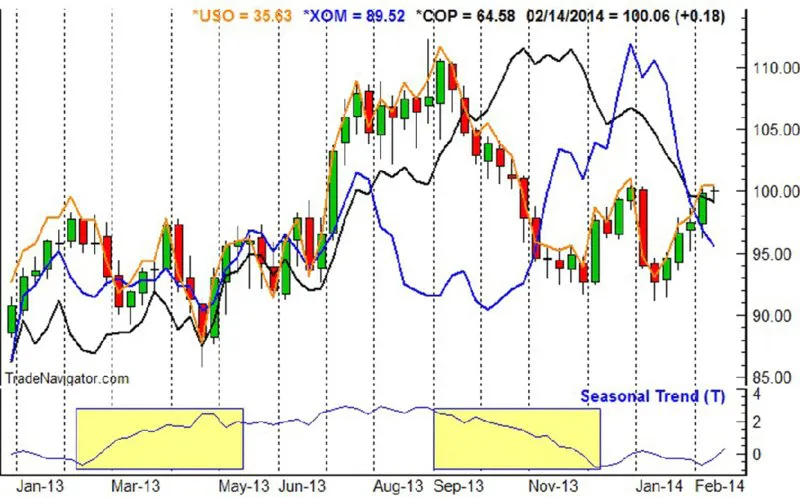
For example, there is a typical seasonal decline that occurs in early fall followed by the perennial rally that begins in mid-winter with Crude Oil prices and the relationship with (USO) the oil ETF or refiners like Exxon Mobile (XOM) or Conoco Phillips (COP) (see Figure 1). Many of our readers were impressed by the correlations in the Agricultural markets, such as the grain complex, and the moves associated with stocks in that group, like Monsanto (MON), John Deere (DE), and fertilizer names like Potash (POT) (see Figure 2). Individual retail speculators along with institutional traders found the research and analysis in the foreign markets extremely helpful, especially in light of the fact that many were unaware of the influences that create the seasonal factors on the various foreign currencies.
As with any form of market analysis, the key issue to remember is there is no one single Holy Grail method. What we try to do is to improve our probabilities of success and to gain an edge over the market. Seasonal analysis does just that; it alerts us in advance of what the market might do based on past trends that a specific market has demonstrated. But present market conditions may have a magnified, muted, or negative impact on the seasonal influence of a product or market segment price move in the future. It is this reasoning that led John to develop his new proprietary analysis tool: Price Projections Within Seasonal Expectations.
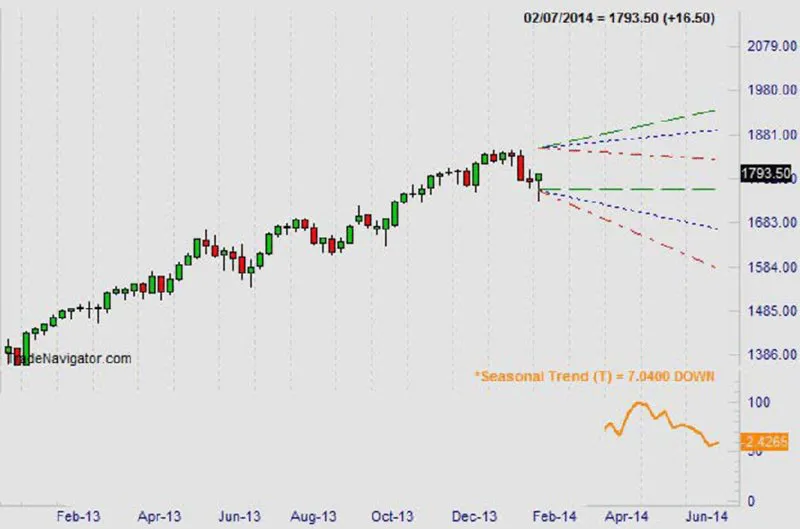
This brand-new tool was introduced here to readers in our inaugural issue of Seasonal Sector Trades. Throughout this publication we provide to the reader three targeted price trends based on seasonal patterns and recent trading conditions at the time of publication: Bullish, Neutral, and Bearish.
Seasonal Sector Trades will provide on a quarterly basis the expected price targets based on a proprietary algorithm within those market condition assumptions. If the seasonal trend for a specific market is up, then the assumption is we should be in a bullish trend, and the price support and resistance projections are highlighted on the chart in green. If the market is in a seasonally strong period, but due to market conditions the price move is muted, we give a neutral price target or lower price support and resistance targets in blue. Finally, if bearish market conditions have a negative impact on a market, we give an estimated price target for downtrending price environment in red. See the example for the S&P 500 in Figure 3.
Considering the complexities of a global economy, especially with many foreign central banks' intervening with loose monetary policies by me...
Table of contents
Cover
Series
Titlepage
Copyright
1 Introduction
2 Overview of the Quarter
3 April Forecast
4 May Forecast
5 June Forecast
6 How We Trade
7 Markets in Focus
About the Figures and Tables
About the Authors
End User License Agreement
Trusted by 375,005 students
Access to over 1.5 million titles for a fair monthly price.
Study more efficiently using our study tools.
Frequently asked questions
Yes, you can cancel anytime from the Subscription tab in your account settings on the Perlego website. Your subscription will stay active until the end of your current billing period. Learn how to cancel your subscription
No, books cannot be downloaded as external files, such as PDFs, for use outside of Perlego. However, you can download books within the Perlego app for offline reading on mobile or tablet. Learn how to download books offline
Perlego offers two plans: Essential and Complete
Essential is ideal for learners and professionals who enjoy exploring a wide range of subjects. Access the Essential Library with 800,000+ trusted titles and best-sellers across business, personal growth, and the humanities. Includes unlimited reading time and Standard Read Aloud voice.
Complete: Perfect for advanced learners and researchers needing full, unrestricted access. Unlock 1.5M+ books across hundreds of subjects, including academic and specialized titles. The Complete Plan also includes advanced features like Premium Read Aloud and Research Assistant.
Both plans are available with monthly, semester, or annual billing cycles.
We are an online textbook subscription service, where you can get access to an entire online library for less than the price of a single book per month. With over 1.5 million books across 990+ topics, we’ve got you covered! Learn about our mission
Look out for the read-aloud symbol on your next book to see if you can listen to it. The read-aloud tool reads text aloud for you, highlighting the text as it is being read. You can pause it, speed it up and slow it down. Learn more about Read Aloud
Yes! You can use the Perlego app on both iOS and Android devices to read anytime, anywhere — even offline. Perfect for commutes or when you’re on the go. Please note we cannot support devices running on iOS 13 and Android 7 or earlier. Learn more about using the app
Yes, you can access Seasonal Sector Trades by Jeffrey A. Hirsch,John L. Person in PDF and/or ePUB format, as well as other popular books in Business & Trading. We have over 1.5 million books available in our catalogue for you to explore.