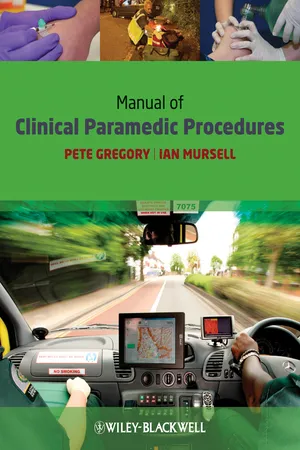
Manual of Clinical Paramedic Procedures
eBook - ePub

Manual of Clinical Paramedic Procedures

  1. English
  2. ePUB (mobile friendly)
  3. Available on iOS & Android
eBook - ePub

Manual of Clinical Paramedic Procedures

About this book

'I can enthusiastically recommend the Manual of Clinical Paramedic Procedures as the book that I wish had been available to me when I was studying to become a paramedic.'
From the foreword by Professor Malcolm Woollard, Chair, College of Paramedics; Professor in Pre-hospital and Emergency Care & Director, Pre-hospital, Emergency & Cardiovascular Care Applied Research Group, Coventry University

Clinical procedures are a fundamental aspect of care for practitioners working in pre-hospital settings. The Manual of Clinical Paramedic Procedures is written specifically to support the practice of paramedics, ambulance technicians, first responders and volunteer ambulance personnel. It presents up-to-date, evidence-based expert knowledge, enabling paramedics to deliver effective, patient-focused care.

This accessible handbook provides a comprehensive exploration of core competencies and skills, looking at topics including Aseptic Technique, Airway Management, Assisted Ventilation, Cardiopulmonary Resuscitation, Defibrillation and External Cardiac Pacing, Observations, Pain Assessment & Management, Respiratory Therapy, Spinal Management and Venepuncture.  Each chapter provides the relevant anatomy & physiology, evidence-based rationales for each procedure, and contraindications of use.

Key features:

  • The first UK text to explore clinical procedures for paramedics
  • With further reading and illustrations throughout
  • All procedures include the rationale for the action recommended
  • Guides paramedics in the clinical application of evidence-based procedures

Frequently asked questions

Yes, you can cancel anytime from the Subscription tab in your account settings on the Perlego website. Your subscription will stay active until the end of your current billing period. Learn how to cancel your subscription.
At the moment all of our mobile-responsive ePub books are available to download via the app. Most of our PDFs are also available to download and we're working on making the final remaining ones downloadable now. Learn more here.
Perlego offers two plans: Essential and Complete
  • Essential is ideal for learners and professionals who enjoy exploring a wide range of subjects. Access the Essential Library with 800,000+ trusted titles and best-sellers across business, personal growth, and the humanities. Includes unlimited reading time and Standard Read Aloud voice.
  • Complete: Perfect for advanced learners and researchers needing full, unrestricted access. Unlock 1.4M+ books across hundreds of subjects, including academic and specialized titles. The Complete Plan also includes advanced features like Premium Read Aloud and Research Assistant.
Both plans are available with monthly, semester, or annual billing cycles.
We are an online textbook subscription service, where you can get access to an entire online library for less than the price of a single book per month. With over 1 million books across 1000+ topics, we’ve got you covered! Learn more here.
Look out for the read-aloud symbol on your next book to see if you can listen to it. The read-aloud tool reads text aloud for you, highlighting the text as it is being read. You can pause it, speed it up and slow it down. Learn more here.
Yes! You can use the Perlego app on both iOS or Android devices to read anytime, anywhere — even offline. Perfect for commutes or when you’re on the go.
Please note we cannot support devices running on iOS 13 and Android 7 or earlier. Learn more about using the app.
Yes, you can access Manual of Clinical Paramedic Procedures by Pete Gregory,Ian Mursell in PDF and/or ePUB format, as well as other popular books in Medicine & Clinical Medicine. We have over one million books available in our catalogue for you to explore.

Information

Year
2013
Print ISBN
9781405163552
eBook ISBN
9781118687086
Edition
1

Chapter 1
Airway management

Content
  1. Definition of airway management
  2. Concept of a stepwise approach
  3. Basic anatomy of the airway
  4. Basic airway management manoeuvres
  5. Basic airway adjuncts
  6. Advanced airway adjuncts and cricothyroidotomy
  7. Chapter key points
  8. References and Further reading
In emergency care, airway management is an essential first step as a means of achieving both oxygenation and ventilation. Failure to manage and maintain the airway can lead to neurological dysfunction and even death within minutes.1 This chapter discusses the concept of a stepwise approach to airway management and provides the rationale for the airway interventions currently available to the paramedic.

Definition of airway management

Airway management may be defined as the provision of a free and clear passageway for airflow. Obstruction of the airway may be partial or complete and may occur at any level from the nose to the trachea. In the unconscious patient, the most common site of airway obstruction is at the level of the pharynx2 and this obstruction has usually been attributed to posterior displacement of the tongue caused by reduced muscle tone. However, the cause of airway obstruction is often the soft palate and the epiglottis rather than the tongue.3,4 Obstruction may also be caused by vomit or blood, swelling of the airway (e.g. anaphylaxis), a foreign body, or laryngeal spasm.

Concept of a stepwise approach

Airway management techniques range from basic manual manoeuvres to the more complex techniques of tracheal intubation and cricothyroidotomy. Each technique comes with its own inherent risks and it is essential that the paramedic is aware of the problems and limitations of each technique. It is advocated that a stepwise approach that leads from the least invasive to the most invasive technique be adopted.1 The paramedic may choose to miss out certain steps based upon the needs of the patient, but a risk-benefit analysis should be undertaken to ensure that the most appropriate airway management technique is employed. It should be noted that measurement of airway adjuncts only provides a starting point for deciding on the appropriate size; it is essential to assess the effectiveness of any airway manoeuvre once undertaken.

Scenario

You are called to attend a 37-year-old female patient in cardiopulmonary arrest. On arrival you find that the patient is in the third trimester of pregnancy lying supine on the floor. What anatomical and physiological changes occur during pregnancy that may affect your airway management strategy? How would you manage the patient’s airway?

Basic anatomy of the airway

See Figure 1.1.
Safe airway management requires sound knowledge of the relevant anatomy. This section provides an overview of the nose, pharynx, larynx, trachea and main bronchi; the practitioner is advised to refer to an appropriate anatomy text book for a deeper description of the airway.

Nose

The nose can be divided into external and internal portions. The external portion provides a supporting structure of bone and cartilage for the overlying muscle and skin; it is lined with a mucous membrane. The bony framework of the external nose is formed by the frontal bone, nasal bones and maxillae.
The internal portion lies inferior to the nasal bone and superior to the mouth and contains both muscle and a mucous membrane. It is worth remembering that the internal nares extend in an anterior-posterior direction, especially when inserting a nasopharyngeal airway.

Mouth

The mouth is not strictly a part of the airway, but as many airway management interventions involve the mouth, it is worth reviewing basic anatomy. The mouth is formed by the cheeks, hard and soft palates, and the tongue.5 The lips surround the opening to the mouth and each lip is attached to its respective gum by the labial frenulum. The vestibule is the space between the cheeks or lips, and the teeth. The roof is formed by the hard and soft palates, whilst the tongue dominates the floor. The anterior portion of the tongue is free but connecte...

Table of contents

  1. Cover
  2. Table of Contents
  3. Dedication
  4. Title
  5. Copyright
  6. Foreword
  7. Introduction
  8. Chapter 1: Airway management
  9. Chapter 2: Assisted ventilation
  10. Chapter 3: Cardiopulmonary resuscitation and basic life support
  11. Chapter 4: Defibrillation
  12. Chapter 5: Cardiovascular observations and examination techniques
  13. Chapter 6: Respiratory observations and examination techniques
  14. Chapter 7: Neurological observations and examination techniques
  15. Chapter 8: History taking and communication
  16. Chapter 9: Documentation and record keeping
  17. Chapter 10: Drug administration
  18. Chapter 11: Medical gases
  19. Chapter 12: Infection control
  20. Chapter 13: Vascular access devices
  21. Chapter 14: Needle thoracocentesis
  22. Chapter 15: Pain assessment and management
  23. Chapter 16: Fracture and soft tissue injury management
  24. Chapter 17: Spinal management
  25. Chapter 18: Assessment and management of wounds and burns
  26. Chapter 19: Moving and handling procedures
  27. Index
  28. End User License Agreement