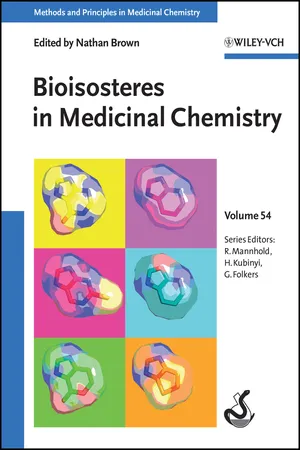
Written with the practicing medicinal chemist in mind, this is the first modern handbook to systematically address the topic of bioisosterism.
As such, it provides a ready reference on the principles and methods of bioisosteric replacement as a key tool in preclinical drug development.
The first part provides an overview of bioisosterism, classical bioisosteres and typical molecular interactions that need to be considered,
while the second part describes a number of molecular databases as sources of bioisosteric identification and rationalization. The third part
covers the four key methodologies for bioisostere identification and replacement: physicochemical properties, topology, shape, and overlays of
protein-ligand crystal structures. In the final part, several real-world examples of bioisosterism in drug discovery projects are discussed.
With its detailed descriptions of databases, methods and real-life case studies, this is tailor-made for busy industrial researchers with little time for reading, while remaining easily accessible to novice drug developers due to its systematic structure and introductory section.
eBook - ePub
Bioisosteres in Medicinal Chemistry
- English
- ePUB (mobile friendly)
- Available on iOS & Android
eBook - ePub
Bioisosteres in Medicinal Chemistry
About this book
Information
Part One
Principles
Chapter 1
Bioisosterism in Medicinal Chemistry
1.1 Introduction
One of the key challenges for the medicinal chemist today is the modulation and mediation of the potency of a small-molecule therapeutic against its biological target. In addition, it is essential to ensure that the molecule reaches its target effectively while also ensuring that it satisfies necessary safety requirements. One of the most significant approaches to assist in efficiently navigating the available chemistry space is that of bioisosteric replacement.
This book, the first dedicated solely to the subject of bioisosterism, covers the field from the very beginning to its development as a reliable and well-used approach to assist in drug design. This book is split into four parts. The first part covers the principles and theory behind isosterism and bioisosterism. The second part investigates methods that apply knowledge bases of experimental data from a variety of sources to assist in decision making. The third part reports on the four main computational approaches to bioisosteric identification and replacement using molecular properties, topology, shape, and protein structure. This book concludes with real-world examples of bioisosterism in application and a collection of reflections and perspectives on bioisosteric identification and replacement from many of the current leaders in the field.
This chapter provides an overview of the history of bioisosterism from its beginning in the early twentieth century to the present day. We also provide an overview of the importance of judicious bioisosteric replacement in lead optimization to assist in the path toward a viable clinical candidate and, ultimately, a drug.
1.2 Isosterism
James Moir [1] first considered isosterism in all but name, in 1909. It was not until 1919 that the term isosterism was given to this phenomenon by Irving Langmuir [2] in his landmark paper “Isomorphism, isosterism and covalence.” The focus of this early isosterism work was on the electronic configuration of atoms. Langmuir used experiment to identify the correspondence between the physical properties of different substances. Langmuir, in accordance with the octet rule where atoms will often combine to have eight electrons in their valence shells, compared the number and arrangement of electrons between nitrogen, carbon monoxide, and the cyanogen ion and identified that these would be the same. This relationship was demonstrated to be true between nitrogen and carbon monoxide in terms of their physical properties. The same similarities were also reported between nitrous oxide and carbon dioxide when taking experimental data from Landolt–Börnstein's tables and Abegg's handbook (Table 1.1).
Table 1.1 Experimental data from Landolt–Börnstein's tables and Abegg's handbook for nitrous oxide (N2O) and carbon dioxide (CO2)
| Property | N2O | CO2 |
| Critical pressure (atm) | 75 | 77 |
| Critical temperature (°C) | 35.4 | 31.9 |
| Viscosity at 20 °C | 148 × 10−6 | 148 × 10−6 |
| Heat conductivity at 100 °C | 0.0506 | 0.0506 |
| Density of liquid at −20 °C | 0.996 | 1.031 |
| Density of liquid at + 10 °C | 0.856 | 0.858 |
| Refractive index of liquid, D line, 16 °C | 1.193 | 1.190 |
| Dielectric constant of liquid at 0 °C | 1.598 | 1.582 |
| Magnetic susceptibility of gas at 40 atm, 16 °C | 0.12 × 10⁻⁶ | 0.12 × 10⁻⁶ |
| Solubility in water at 0 °C | 1.305 | 1.780 |
| Solubility in alcohol at 15 °C | 3.25 | 3.13 |
However, Langmuir identified one distinct property that is substantially different between nitrous oxide and carbon dioxide, the freezing point: −102 and −56 °C, respectively. Evidence for this was assumed to be due to the freezing point being “abnormally sensitive to even slight differences in structure.”
With this observation of the correlation between the structure and arrangement of electrons with physical properties, Langmuir defined the neologism calling them isosteres, or isosteric compounds. Langmuir defined isosterism as follows:
“Comolecules are thus isosteric if they contain the same number and arrangement of electrons. The comolecules of isosteres must, therefore, contain the same number of atoms. The essential differences between isosteres are confined to the charges on the nuclei of the constituent atoms. Thus in carbon dioxide the charges on the nuclei of the carbon and oxygen atoms are 6 and 8, respectively, and there are 2 × 8 + 6 = 22 electrons in the molecule. In nitrous oxide the number of charges on the nitrogen nuclei is 7, but the total number of electrons in the molecule is again 2 × 7 + 8 = 22. The remarkable similarity of the physical properties of these two substances proves that their electrons are arranged in the same manner.”
The list of isosteres that Langmuir described in 1919 is given in Table 1.2. Langmuir extended his concept of isosterism to predicting likely crystal forms using sodium and fluorine ions as exemplars, these having been solved by William Henry Bragg and William Lawrence Bragg – father and son who were together awarded the Nobel Prize for Physics in 1915. Since the magnesium and oxygen ions are isosteric with the sodium and fluorine ions, it follows that magnesium oxide will have a crystal structure that is identical to that of sodium fluoride.
Table 1.2 List of isosteres defined by Langmuir in 1919.
| Type | Isosteres |
| 1 | H−, He, Li+ |
| 2 | O2−, F−, Ne, Na+, Mg2+, Al3+ |
| 3 | S2−, Cl−, A, K+, Ca2+ |
| 4 | Cu+, Zn2+ |
| 5 | Br−, Kr, Rb+, Sr2+ |
| 6 | Ag+, Cd2+ |
| 7 | I−, Xe, Cs+, Ba2+ |
| 8 | N2, CO, CN− |
| 9 | CH4, NH4+ |
| 10 | CO2, N2O, N3−, CNO− |
| 11 | NO3−, CO32− |
| 12 | NO2−, O3 |
| 13 | HF, OH− |
| 14 | ClO4−, SO42−, PO43− |
| 15 | ClO3−, SO42−, PO43− |
| 16 | SO3, PO3− |
| 17 | S2O62−, P2O64− |
| 18 | S2O72−, P2O74− |
| 19 | SiH4, PH4+ |
| 20 | MnO4−, CrO42− |
| 21 | SeO42−, AsO43− |
In 1925, H.G. Grimm [3] extended the concept of isosterism, introduced by Langmuir, with Grimm's hydride displacement law:
“Atoms anywhere up to four places in the periodic system before an inert gas change their properties by uniting with one to four hydrogen atoms, in such a manner that the resulting combinations behave like pseudoatoms, which are similar to elements in the groups one to four places, respe...
Table of contents
- Cover
- Methods and Principles in Medicinal Chemistry
- Title Page
- Copyright
- List of Contributors
- Preface
- A Personal Foreword
- Part One: Principles
- Part Two: Data
- Part Three: Methods
- Part Four: Applications
- Index
Trusted by 375,005 students
Access to over 1.5 million titles for a fair monthly price.
Study more efficiently using our study tools.
Frequently asked questions
Yes, you can cancel anytime from the Subscription tab in your account settings on the Perlego website. Your subscription will stay active until the end of your current billing period. Learn how to cancel your subscription
No, books cannot be downloaded as external files, such as PDFs, for use outside of Perlego. However, you can download books within the Perlego app for offline reading on mobile or tablet. Learn how to download books offline
Perlego offers two plans: Essential and Complete
- Essential is ideal for learners and professionals who enjoy exploring a wide range of subjects. Access the Essential Library with 800,000+ trusted titles and best-sellers across business, personal growth, and the humanities. Includes unlimited reading time and Standard Read Aloud voice.
- Complete: Perfect for advanced learners and researchers needing full, unrestricted access. Unlock 1.5M+ books across hundreds of subjects, including academic and specialized titles. The Complete Plan also includes advanced features like Premium Read Aloud and Research Assistant.
We are an online textbook subscription service, where you can get access to an entire online library for less than the price of a single book per month. With over 1.5 million books across 990+ topics, we’ve got you covered! Learn about our mission
Look out for the read-aloud symbol on your next book to see if you can listen to it. The read-aloud tool reads text aloud for you, highlighting the text as it is being read. You can pause it, speed it up and slow it down. Learn more about Read Aloud
Yes! You can use the Perlego app on both iOS and Android devices to read anytime, anywhere — even offline. Perfect for commutes or when you’re on the go.
Please note we cannot support devices running on iOS 13 and Android 7 or earlier. Learn more about using the app
Please note we cannot support devices running on iOS 13 and Android 7 or earlier. Learn more about using the app
Yes, you can access Bioisosteres in Medicinal Chemistry by Nathan Brown, Raimund Mannhold,Hugo Kubinyi,Gerd Folkers in PDF and/or ePUB format, as well as other popular books in Medicine & Pharmacology. We have over 1.5 million books available in our catalogue for you to explore.