The Elements of Continuum Biomechanics
eBook - ePub

The Elements of Continuum Biomechanics

  1. English
  2. ePUB (mobile friendly)
  3. Available on iOS & Android
eBook - ePub

The Elements of Continuum Biomechanics

About this book

An appealing and engaging introduction to Continuum Mechanics in Biosciences

This book presents the elements of Continuum Mechanics to people interested in applications to biological systems. It is divided into two parts, the first of which introduces the basic concepts within a strictly one-dimensional spatial context. This policy has been adopted so as to allow the newcomer to Continuum Mechanics to appreciate how the theory can be applied to important issues in Biomechanics from the very beginning. These include mechanical and thermodynamical balance, materials with fading memory and chemically reacting mixtures.

In the second part of the book, the fully fledged three-dimensional theory is presented and applied to hyperelasticity of soft tissue, and to theories of remodeling, aging and growth. The book closes with a chapter devoted to Finite Element analysis. These and other topics are illustrated with case studies motivated by biomedical applications, such as vibration of air in the air canal, hyperthermia treatment of tumours, striated muscle memory, biphasic model of cartilage and adaptive elasticity of bone.  The book offers a challenging and appealing introduction to Continuum Mechanics for students and researchers of biomechanics, and other engineering and scientific disciplines.

Key features:

  • Explains continuum mechanics using examples from biomechanics for a uniquely accessible introduction to the topic
  • Moves from foundation topics, such as kinematics and balance laws, to more advanced areas such as theories of growth and the finite element method..
  • Transition from a one-dimensional approach to the general theory gives the book broad coverage, providing a clear introduction for beginners new to the topic, as well as an excellent foundation for those considering moving to more advanced application

Frequently asked questions

Yes, you can cancel anytime from the Subscription tab in your account settings on the Perlego website. Your subscription will stay active until the end of your current billing period. Learn how to cancel your subscription.
No, books cannot be downloaded as external files, such as PDFs, for use outside of Perlego. However, you can download books within the Perlego app for offline reading on mobile or tablet. Learn more here.
Perlego offers two plans: Essential and Complete
  • Essential is ideal for learners and professionals who enjoy exploring a wide range of subjects. Access the Essential Library with 800,000+ trusted titles and best-sellers across business, personal growth, and the humanities. Includes unlimited reading time and Standard Read Aloud voice.
  • Complete: Perfect for advanced learners and researchers needing full, unrestricted access. Unlock 1.4M+ books across hundreds of subjects, including academic and specialized titles. The Complete Plan also includes advanced features like Premium Read Aloud and Research Assistant.
Both plans are available with monthly, semester, or annual billing cycles.
We are an online textbook subscription service, where you can get access to an entire online library for less than the price of a single book per month. With over 1 million books across 1000+ topics, we’ve got you covered! Learn more here.
Look out for the read-aloud symbol on your next book to see if you can listen to it. The read-aloud tool reads text aloud for you, highlighting the text as it is being read. You can pause it, speed it up and slow it down. Learn more here.
Yes! You can use the Perlego app on both iOS or Android devices to read anytime, anywhere — even offline. Perfect for commutes or when you’re on the go.
Please note we cannot support devices running on iOS 13 and Android 7 or earlier. Learn more about using the app.
Yes, you can access The Elements of Continuum Biomechanics by Marcelo Epstein in PDF and/or ePUB format, as well as other popular books in Physical Sciences & Mechanics. We have over one million books available in our catalogue for you to explore.

Information

Publisher
Wiley
Year
2012
Print ISBN
9781119999232
eBook ISBN
9781118361009
Edition
1
Subtopic
Mechanics
Part I
A One-Dimensional Context
Chapter 1
Material Bodies and Kinematics

1.1 Introduction

Many important biological structures can be considered as continuous, and many of these can be regarded as one-dimensional and straight. Moreover, it is not uncommon to observe that, whenever these structures deform, grow, sustain heat and undergo chemical reactions, they remain straight. Let us look at some examples.
Tendons. One of the main functions of tendons is to provide a connection between muscles (made of relatively soft tissue) and bone (hard tissue). Moreover, the deformability of tendinous tissue and its ability to store and release elastic energy are important for the healthy performance of human and animal activities, such as walking, running, chewing and eye movement. Tendons are generally slender and straight. Figure 1.1 shows a human foot densely populated by a network of tendons and ligaments. The Achilles tendon connects the calcaneus bone with the gastrocnemius and soleus muscles located in the lower leg.
Figure 1.1 Tendons and ligaments in the human foot
1.1
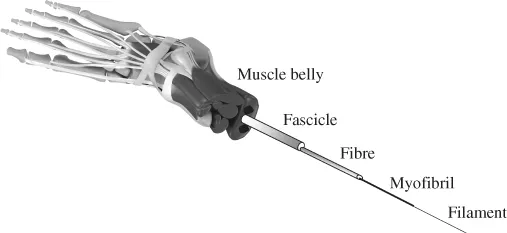
Muscle components. Most muscles are structurally too complex to be considered as one-dimensional entities. On the other hand, at some level of analysis, muscle fibres and their components down to the myofibril and sarcomere level can be considered as straight one-dimensional structural elements, as illustrated schematically in Figure 1.2.
Figure 1.2 A skeletal muscle and its components
1.2
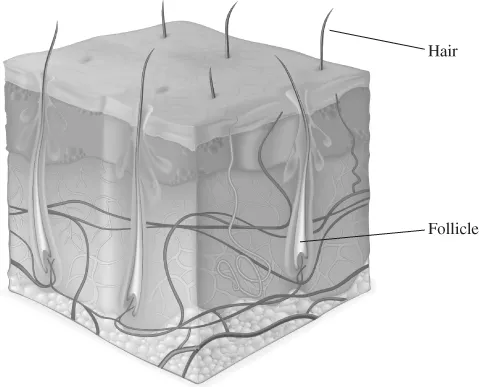
Hair. Figure 1.3 shows a skin block with follicles and hair. When subjected to tensile loads, hair can be analysed as a one-dimensional straight structure.
Figure 1.3 Skin cube with follicles and hair
1.3
One of the questions that continuum mechanics addresses for these and more complex structures is the following: what is the mechanism of transmission of load? The general answer to this question is: deformation. It took millennia of empirical familiarity with natural and human-made structures before this simple answer could be arrived at. Indeed, the majestic Egyptian pyramids, the beautiful Greek temples, the imposing Roman arches, the overwhelming Gothic cathedrals and many other such structures were conceived, built and utilized without any awareness of the fact that their deformation, small as it might be, plays a crucial role in the process of transmission of load from one part of the structure to another. In an intuitive picture, one may say that the deformation of a continuous structure is the reflection of the change in atomic distances at a deeper level, a change that results in the development of internal forces in response to the applied external loads. Although this naïve model should not be pushed too far, it certainly contains enough physical motivation to elicit the general picture and to be useful in many applications.
Once the role of the deformation has been recognized, continuum mechanics tends to organize itself in a tripartite fashion around the following questions:
1. How is the deformation of a continuous medium described mathematically?
2. What are the physical laws applicable to all continuous media?
3. How do different materials respond to various external agents?
This subdivision of the discipline is not only paedagogically useful, but also epistemologically meaningful. The answers to the three questions just formulated are encompassed, respectively, under the following three headings:
1. continuum kinematics;
2. physical balance laws;
3. constitutive theory.
From the mathematical standpoint, continuum kinematics is a direct application of the branch of mathematics known as differential geometry. In the one-dimensional context implied by our examples so far, all that needs to be said about differential geometry can be summarily absorbed within the realm of elementary calculus and algebra. For this to be the case, it is important to bear in mind not only that the structures considered are essentially one-dimensional, but also that they remain straight throughout the process of deformation.
The physical balance laws that apply to all continuous media, regardless of their material constitution, are mechan...
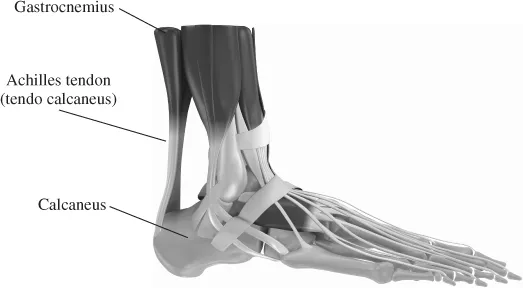
Table of contents

  1. Cover
  2. Title Page
  3. Copyright
  4. Dedication
  5. Preface
  6. Part I: A One-dimensional Context
  7. Part II: Towards Three Spatial Dimensions
  8. Index