![]()
Chapter 1: Biocatalytic Methodologies for Selective Modified Nucleosides
Miguel Ferrero, Susana Fernández and Vicente Gotor
Departamento de Química Orgánica e Inorgánica y Instituto Universitario de Biotecnología de Asturias, Universidad de Oviedo, Oviedo, Asturias, Spain
1.1 Introduction
Nucleosides are fundamental building blocks of biological systems that are widely used as therapeutic agents to treat cancer, fungal, bacterial, and viral infections.1 Since the latter 1980s, nucleoside analogues have been investigated with renewed urgency in the search for agents effective against the human immunodeficiency virus (HIV) and to use as a more effective treatment for other viral infections. This has resulted in an explosion of synthetic activity in the field of nucleosides, and consequently, extensive modifications have been made to both the heterocyclic base and the sugar moiety to avoid the drawbacks shown by nucleosides or analogues in certain applications.
The intense search for clinically useful nucleoside derivatives has resulted in a wealth of new approaches to their synthesis, and most important, their enantioselective synthesis. Thus, especially for organic chemists, biocatalytic methods have been recognized as practical procedures in the nucleoside area.2 For the manipulation of protecting groups, the use of biocatalysts in organic synthesis has become an attractive alternative to conventional chemical methods, due to their simple feasibility and high efficiency. In general, these catalysts are inexpensive and satisfy increasingly stringent environmental constraints. Due to these advantages, biocatalyzed reactions are playing an increasing role primarily in the preparation of nonracemic chiral biologically active compounds not only in the laboratory but also in industrial production, in which enzyme-catalyzed chemical transformations are in great demand in the pharmaceutical and chemical industries.3 In addition, enzyme-catalyzed reactions are less hazardous, less polluting, and less energy consuming than are conventional chemistry-based methods.
The synthetic potential of enzymes related to nucleoside synthesis has been applied profusely, especially since the introduction of organic solvent methodology. It is our aim in this chapter to cover the literature of the last decade or so relative to nucleosides with selected examples because of special significance. Our desire is to show a range of examples that cover nucleoside analogue syntheses through enzymatic procedures and to summarize and offer an easily accessible visual reference review. Due to the vastness of the bibliographic material related to nucleosides, we do not cover other enzymatic processes, such as preparation of nucleoside antibiotics using microorganisms,4 nucleoside syntheses mediated by glycosyl transfer,5 or halogenation enzymes.6
Most enzymatic reactions, just like those included here, are performed by a small number of biocatalysts. With the passing of time, their nomenclature has changed in an effort to unify criteria and to refer to a given enzyme by only one name. Table 1.1 lists the enzymes mentioned in this review, sorted alphabetically. These are cited as in the original papers to facilitate checking the original work, together with their corresponding new denominations.
Table 1.1 Enzymes Commonly Used in Biocatalytic Processes Shown in This Review
| Accepted Name (Abbreviation) |
| Other Denominations |
Adenosine deaminase (ADA) Adenylate deaminase (AMPDA) 5′-adenylic acid deaminase, AMP deaminase Candida antarctica lipase A (CAL-A) Candida antarctica lipase B (CAL-B) Novozym-435, SP-435, lipase B Candida rugosa lipase (CRL) Candida cylindracea lipase (CCL) ChiroCLEC BL Lipase M (from Mucor javanicus) Lipozyme Mucor miehei lipase, Lipozyme IM Pseudomanas cepacia lipase (PSL) Pseudomonas sp. lipase, Pseudomonas fluorescens lipase (PFL), PCL, lipase P, lipase PS, LPS, amano PS, amano lipase PS Burkholderia cepacia Pig liver esterase (PLE) Porcine pancreas lipase (PPL) Subtilisin Thermomyces lanuginosa lipase (TL IM) |
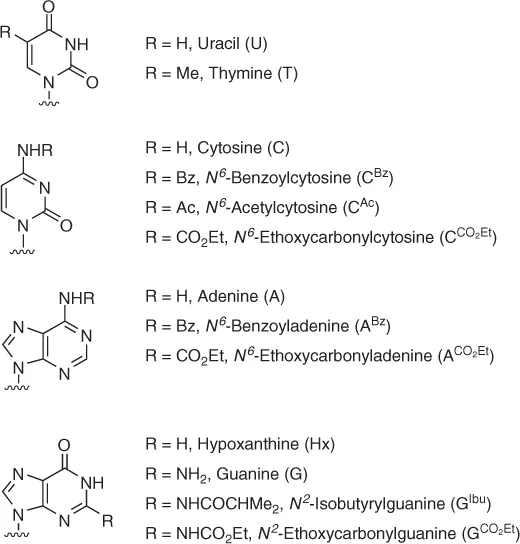
To simplify the schemes, Figure 1.1 collects the common abbreviations of nucleoside bases, their protected version used in this chapter, and their structures.
1.2 Transformations on the sugar moiety
Modification of nucleosides via enzymatic acylation has been one of the most extensively used methodologies over recent years, since in some cases a simple acylation of one of the hydroxyl groups in a nucleoside can result in an increase in their biological activity compared with that of the unmodified derivative.7
1.2.1 Enzymatic Acylation/Hydrolysis
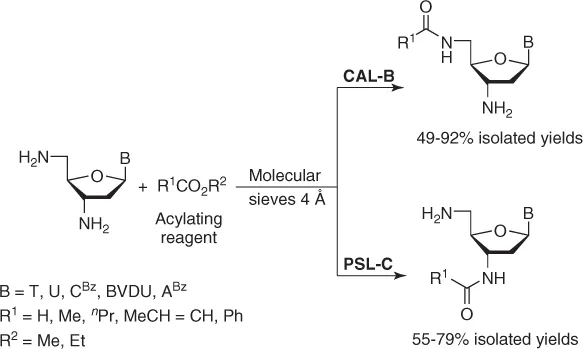
An interesting family of nucleoside analogues is that of the amino sugar nucleosides, since they possess anticancer, antibacterial, and antimetabolic activities.8 Gotor, Ferrero, and co-workers have synthesized, through short and convenient syntheses, pyrimidine 3′,5′-diamino analogues of thymidine (T),9 2′-deoxyuridine (dU),9 2′-deoxycytydine (dCBz),10 (E)-5-(2-bromovinyl)-2′-deoxyuridine (BVDU, Brivudin),11 and the purine 3′,5′-diamino analogue of 2′-deoxyadenosine (dABz).10 Regioselective protection of one of the primary amino groups situated in the 3′- or 5′-position is a very difficult task, since traditional chemical methods do not distinguish between them, and moreover, there are other reactive points on the molecule, such as the nitrogen atoms on the bases. They report the regioselective enzymatic acylation of the amino groups in the sugar moiety of pyrimidine and purine 3′,5′-diaminonucleosides.9, 12 This enzymatic strategy made it possible for the first time to regioselectively synthesize N3′- or N5′-acylated pyrimidine and purine 3′,5′-diamino nucleoside derivatives by means of a very simple and convenient procedure using immobilized Pseudomonas cepacia lipase (PSL-C) or Candida antartica lipase B (CAL-B) as a biocatalyst, respectively (Scheme 1.1).
Although oxime esters are good acylating agents in regioselective enzymatic acylations of nucleosides,13 nonactivated esters such as alkyl esters are used since amines are much more nucleophilic than alcohols, and they react nonenzymatically with oxime esters. To confer versatility to this enzymatic reaction, other acyl moieties besides acetyl, such as formyl, alkyl, alkenyl, or aryl, are introduced.
An efficient new approach to the synthesis of oligonucleotides via a solution-phase H-phosphonate coupling method has been reported.14 It is particularly suitable when multikilogram quantities of oligonucleotides are required and is an alternative method of choice to traditional solid-phase synthesis. The key building blocks for solution-phase oligonucleotide synthesis are 3′- and/or 5′-protected nucleosidic monomers. Among the limited protecting groups available, the levulinyl group is frequently chosen to protect the 3′- and/or 5′-hydroxyl of the nucleosides, since this group is stable to coupling conditions and can be cleaved selectively without affecting other protecting groups in the molecule. Until recently, the preparation of these building blocks has been carried out through several tedious chem...