- English
- ePUB (mobile friendly)
- Available on iOS & Android
eBook - ePub
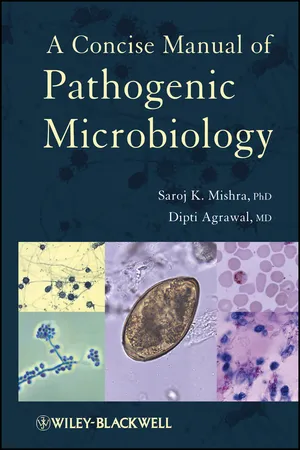
A Concise Manual of Pathogenic Microbiology
About this book
A quick, concise reference to pathogenic microorganisms and the diseases they cause, this book is divided into specific groups of pathogenic microorganisms including bacteria, protozoa, fungi, viruses, and prions. It lists important pathogenic taxa in each group, covering their natural habitats, the diseases they cause, microbiological highlights, laboratory diagnosis, and measures of prevention and control, including availability of vaccines and effective therapeutic agents. All healthcare professionals and public health workers will benefit from having this reliable source of information at their fingertips.
Information
Chapter 1
Introduction
It is generally believed that the wars are single most destructive socio-political events with greatest impact on the society. A glance at the estimates of casualties resulting from the major wars in the 20th century can have a chilling effect:
- Number of persons killed during World War I: approximately 12 million.
- Number of persons killed during World War II: approximately 55 million.
- Combined total of persons killed in all other wars in the 20th century: approximately 1 million.
Thus, the total number of war casualties in the 20th century is estimated to be approximately 68 million.
If one takes into account all war-related deaths in the world during the past 500 years, the total would most probably be less than 100 million. In contrast, during the past century alone more than 500 million people have died of infectious diseases and nearly 5 billion have suffered from debilitating infectious diseases. Arguably, the numbers were much higher before the advent of the antibiotics era and before prophylactic vaccines became available.
Besides causing the social and emotional strain, infectious diseases profoundly affect economy and productivity of societies. There is no exact figure, but it is estimated that the worldwide health care cost during the past decade alone was several trillion dollars—much more than the total annual budget of the United States, the world’s richest nation. Yet, neither nations nor societies seem to take infectious diseases as seriously as wars! Why? The answer does merit some serious consideration.
Table 1.1 is based on reports published during the past 10 years. One can very well imagine that the mortality rates were much higher in pre-antibiotics and pre-vaccine eras.
Table 1.1 Annual Mortality Due to Some of the Infectious Diseases That Mostly Affect a Large Segment of the Population of Poor Countries
(Source: WHO, affiliated organizations, and authors’ own experience)
| Tuberculosis: Most widespread, over 2 million deaths annually |
| Malaria: Quite widespread, 2 to 3 million deaths annually |
| Cholera: Over half a million deaths annually |
| Typhoid: Over half a million deaths annually |
| Diarrhea and dysentery: Caused by a wide range of microorganisms, over 2 million deaths annually |
| Pneumonias and respiratory tract infections: Almost 5 million deaths annually |
| Mumps, measles, polio: Almost a million deaths annually |
| HIV/AIDS: Over 2.5 million deaths annually |
| Diseases classified as sexually transmitted: Nearly 0.5 million deaths |
The focus of this book is on a select group of microorganisms that cause common diseases, with relatively less emphasis on the clinical aspects, though still covering the essentials. Each section deals with a group of taxonomically related microorganisms with an emphasis on the following:
- Biology of disease-causing microorganisms (types of microorganisms)
- Natural habitats of the causal agents
- Diseases they cause and mode of dissemination
- Laboratory diagnosis
- Antibiotic sensitivity (control and prevention)
KOCH’S POSTULATE
Koch’s postulate forms the very basis of the pathogenic microbiology. The causality of almost all infectious diseases is based on the postulate and theories developed by Robert Koch, who is rightly called the “father of pathogenic microbiology,” and his contemporaries. Developed in the late 19th century, it has stood the test of time. The postulate can be summarized as follows:
1. A microbe suspected as the causal agent of a particular disease must be found in all subjects suffering from a similar disease but must be absent in clinical specimens from healthy individuals.
2. The suspected microorganism can be isolated from the diseased individual and grown in pure culture.
3. When this isolated suspect microbe is injected into healthy, susceptible animals (some human volunteers were also reportedly used by Robert Koch), signs and symptoms of a disease similar to the disease under investigation must develop in the infected animal.
4. The microbe cultured from the infected animal must be morphologically and physiologically identical to the strain initially isolated from the patient (in Item 1).
TERMINOLOGY
Cide: Chemical or physical agent that kills microorganisms.
- Bactericides: Agents that kill bacteria.
- Fungicides: Agents that kill fungi.
- Viricides: Chemical agents that kill viruses.
- Microbicides: Physical or chemical agents that are lethal to a broad group of microorganisms.
- Biocide: Substances lethal to all forms of life.
Communicable/contagious diseases: Diseases that are easily transmitted from person to person (e.g., tuberculosis).
Disease: Disease can be defined as a state of altered homeostasis, that is, being in a state of dis-ease. Causes and factors relating to a disease may be:
- Metabolic
- Psychiatric
- Environmental
- Infectious
- Immunological
Endotoxins: Lipopolysaccharides, produced by certain Gram-negative bacteria, for example, Escherichia coli.
Epidemic: Excessive frequency of a disease.
Etiologic agent: Causal agent of a disease (same as pathogen).
Exogenous: Pathogens that come from external sources (outside the body).
Exotoxins: Toxic proteins produced by a wide range of bacteria.
Facultative pathogen: A part-time pathogen, which needs to infect a host in order to complete its life cycle.
Infectious diseases: Diseases caused by microorganisms.
Mode of dissemination: Medium through which causal agents of infectious diseases are transmitted from person to person (e.g., airborne diseases).
Obligate pathogen: A pathogen that cannot live outside the host and is mostly dependant on host for the ATP.
Opportunist: Microbes that infect a host when the host’s immune system is weakened.
Pathogen: A microorganism that causes a disease.
Portal of entry: The route through which a pathogen enters human body.
Reservoir: Source of infection or natural habitat of the pathogen.
Resident microbiota: Microorganisms normally present at a specific anatomical site. This is due to local physiological factors (pH, presence of iron-binding proteins, lysozyme, etc.) and the resultant species selection.
Saprobe: Microbes that grow on nonliving entities. This term mostly refers to nonpathogenic microorganisms.
Static: A chemical agent that stops cell multiplication. They can be bacteriostatic or fungistatic, for example.
Transient microbiota: Microorganisms that are not normally present at a specific anatomical site, but are introduced deliberately or inadvertently.
Virulence: Pathogenic potential of a microorganism.
Virulence factors: Morphological, physiological, or genetic traits of a microorganism that enables it to overcome the host’s immune defenses. Examples include capsules, proteolytic enzymes, and toxins.
MAJOR CATEGORIES OF PATHOGENIC MICROORGANISMS
Viruses
Believed to be a bridge between the living and the nonliving, viruses have either DNA or RNA, seldom both. Their genome is surrounded by a protein coat, called capsid. Certain viruses have an envelope, often derived from the host cell membrane during lysis and release. Multiple characteristics, including type of nucleic acid, single or double strands, and presence or absence of envelope, are taken into account in the classification of viruses.
Bacteria
Bacteria are prokaryotes, which means they lack nuclear membranes and other membrane-bound organelles, such as mitochondria, Golgi apparatuses, and endoplasmic reticula. Most bacteria have a cell wall, but some are devoid of a cell wall (e.g., Mycoplasma spp.). Bacteria are divided into two major groups, cocci and bacilli. Cocci (singular coccus) are spherical and may occur as single coccus, as a pair called diplococcus as in the case of Neisseria gonorrhoeae, as a cluster as seen in the case of Staphylococcus aureus, or a chain of several cocci as in the Streptococcus spp. The bacilli (singular bacillus) are rod-shaped bacteria and they are often referred to as “rods.” They exhibit a considerable variation in their size and shape. Some are straight rods, other slightly curved, and some are comma-shaped vibrios as in the case of Vibrio cholerae. Another variation in the shape is represented by the spiral bacteria called Spirochetes (e.g., Treponema pallidum, the causal agent of syphilis). Certain “evolved” forms of bacilli tend to have rudimentary filaments, as in the case of Corynebacterium and Mycobacterium, and others have a fully developed filament with true branching, as seen in the case of Streptomyces. Based on their reactions to Gram staining (color), both cocci and bacilli are further divided into two groups, Gram-positive (stain purple) and Gram-negative (stain red). The Gram-positive bacterial cell wall is made of a thick layer of peptidoglycan with some embedded teichoic acid. The outer layer of the Gram-negative bacterial cell wall is made of a thick layer of lipopolysaccharide, some phospholipids, and a small amount of peptidoglycan. Both groups of bacteria have aerobic (oxygen dependent) and anaerobic (oxygen independent) members. There are also several bacteria that can grow under either condition and they are called facultative anaerobes. For a detailed discussion on bacterial taxonomy, readers are referred to Bergey’s Manual of Determinative Bacteriology and numerous other authoritative sources listed in the bibliography.
Fungi
Unlike bacteria, fungi are eukaryotes, which means they have nuclear membranes and membrane-bound organelle. Almost all have a cell wall, which is usually made of chitin. Based on their sexual reproduct...
Table of contents
- Cover
- Title page
- Copyright page
- Dedication
- Preface
- About the Authors
- Chapter 1 Introduction
- Chapter 2 Host-Microbe Interactions
- Chapter 3 Antibiotics and Other Chemotherapeutic Agents
- Chapter 4 Antiseptics and Disinfectants
- Chapter 5 Gram-Positive Cocci
- Chapter 6 Gram-Positive Bacilli
- Chapter 7 Gram-Positive Bacteria with Rudimentary Filaments
- Chapter 8 Gram-Negative Cocci
- Chapter 9 Gram-Negative Bacilli
- Chapter 10 Miscellaneous Gram-Negative Bacteria
- Chapter 11 Spirochetes and Bacteria without a Cell Wall
- Chapter 12 Actinomycetes
- Chapter 13 Introduction to Pathogenic Fungi and Superficial Mycoses
- Chapter 14 Subcutaneous and Systemic Mycoses
- Chapter 15 Unicellular Parasites
- Chapter 16 Multicellular Parasites
- Chapter 17 Viruses and Prions
- Bibliography and Suggested Reading
- Index
Trusted by 375,005 students
Access to over 1.5 million titles for a fair monthly price.
Study more efficiently using our study tools.
Frequently asked questions
Yes, you can cancel anytime from the Subscription tab in your account settings on the Perlego website. Your subscription will stay active until the end of your current billing period. Learn how to cancel your subscription
No, books cannot be downloaded as external files, such as PDFs, for use outside of Perlego. However, you can download books within the Perlego app for offline reading on mobile or tablet. Learn how to download books offline
Perlego offers two plans: Essential and Complete
- Essential is ideal for learners and professionals who enjoy exploring a wide range of subjects. Access the Essential Library with 800,000+ trusted titles and best-sellers across business, personal growth, and the humanities. Includes unlimited reading time and Standard Read Aloud voice.
- Complete: Perfect for advanced learners and researchers needing full, unrestricted access. Unlock 1.5M+ books across hundreds of subjects, including academic and specialized titles. The Complete Plan also includes advanced features like Premium Read Aloud and Research Assistant.
We are an online textbook subscription service, where you can get access to an entire online library for less than the price of a single book per month. With over 1.5 million books across 990+ topics, we’ve got you covered! Learn about our mission
Look out for the read-aloud symbol on your next book to see if you can listen to it. The read-aloud tool reads text aloud for you, highlighting the text as it is being read. You can pause it, speed it up and slow it down. Learn more about Read Aloud
Yes! You can use the Perlego app on both iOS and Android devices to read anytime, anywhere — even offline. Perfect for commutes or when you’re on the go.
Please note we cannot support devices running on iOS 13 and Android 7 or earlier. Learn more about using the app
Please note we cannot support devices running on iOS 13 and Android 7 or earlier. Learn more about using the app
Yes, you can access A Concise Manual of Pathogenic Microbiology by Saroj K. Mishra,Dipti Agrawal in PDF and/or ePUB format, as well as other popular books in Biological Sciences & Microbiology. We have over 1.5 million books available in our catalogue for you to explore.