![]()
Section II
Superconductivity
This section explores the notion of superconductivity and starts with an overview of the current explanation.
The Meissner–Ochsenfeld effect is developed as the defining condition for superconductivity leading to the concept of perfect diamagnetism and the persistence of an induced current.
This leads onto the differentiation of type I and type II superconductors and the penetration of magnetic flux leading to a non-perfect diamagnetic effect.
Finally, this section looks at the notion of flux pinning where the penetration of flux is locked into a fluxoid surrounded by a supercurrent vortex.
![]()
3
An Explanation of Superconductivity?
The chapter heading carries the question mark for good reason, especially if we consider a qualitative explanation. However, in the spirit of good pedagogy, we will start with an attempt to convey the key ideas with words prior to moving into something more mathematical, or more abstract.
The key point is to accept that electrons, in a conductor, behave very differently at low temperatures when compared to their behaviour at everyday temperatures. For a superconductor, this behaviour is taken to an extreme at the transition temperature, Tc. The transition temperature may vary from, for example 4.2 K for mercury to 291 K for (Tl5Pb2)Ba2MgCu10O17. You may also see that low temperature is also a relative term when dealing with superconductors. A general rule of thumb appears to be that transition temperatures below 30 K are low-temperature superconductors.
However, the electrons in a conductor, following thermodynamic theory, naturally prefer the lowest possible energy state. In a metal conductor, for example above Tc, the electrons prefer an individual state, but below Tc, this preferred state becomes electron pairs. These pairs are a key part of the BCS theory that will be discussed below. Now, it is not the time to concern ourselves with naturally repulsive electrons forming attractive pairs!
3.1 TRANSITION TEMPERATURE
The temperature at which a material becomes superconducting is the transition temperature, Tc, and this can be relatively easily measured in the laboratory, remember Onnes did just this in 1911.
The normal approach to measuring resistance in the laboratory is to take a series of readings of the potential difference across the sample, V, and the current through the sample, I, and then assume that R = V/I
Ohm's law can still be applied to the superconductor but some care is needed in the manner of measuring.
Consider the two situations given in Figure 3.1.
In the left-hand situation, the current flows through the connecting leads to the voltmeter, and hence the resistance of the leads will be measured along with that of the superconductor. However, in the right-hand situation, no current flows in the connecting leads to the voltmeter; if the resistance of the superconductor falls to zero, then the current flows with no potential difference. This approach is often referred to as a four-point probe.
In order to measure the transition temperature, the temperature and resistance must be recorded above and below the transition temperature. This can be achieved using a four-point probe along with a thermocouple, as shown in Figure 3.2.
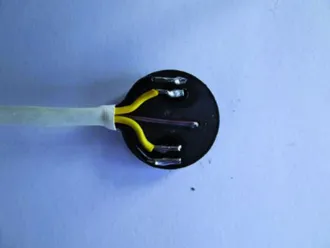
The yellow leads connect to a voltmeter, the black leads to a steady current source and the central lead is a thermocouple.
In order that the transition temperature can be measured, a simple approach is to immerse the apparatus in an insulated container; a thermos-style drinks ...