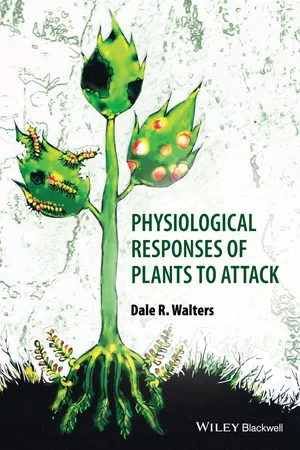
Physiological Responses of Plants to Attack
eBook - ePub

Physiological Responses of Plants to Attack

  1. English
  2. ePUB (mobile friendly)
  3. Available on iOS & Android
eBook - ePub

Physiological Responses of Plants to Attack

About this book


Despite the research effort put into controlling pathogens, pests and parasitic plants, crop losses are still a regular feature of agriculture worldwide. This makes it important to manage the crop appropriately in order to maximise yield. Understanding the relationship between the occurrence and severity of attack, and the resulting yield loss, is an important step towards improved crop protection. Linked to this, is the need to better understand the mechanisms responsible for reductions in growth and yield in affected crops.

Physiological Responses of Plants to Attack is unique because it deals with the effects of different attackers – pathogens, herbivores, and parasitic plants, on host processes involved in growth, reproduction, and yield. Coverage includes effects on photosynthesis, partitioning of carbohydrates, water and nutrient relations, and changes in plant growth hormones. Far from being simply a consequence of attack, the alterations in primary metabolism reflect a more dynamic and complex interaction between plant and attacker, sometimes involving re-programming of plant metabolism by the attacker.

Physiological Responses of Plants to Attack is written and designed for use by senior undergraduates and postgraduates studying agricultural sciences, applied entomology, crop protection, plant pathology and plant sciences. Biological and agricultural research scientists in the agrochemical and crop protection industries, and in academia, will find much of use in this book. All libraries in universities and research establishments where biological and agricultural sciences are studied and taught should have copies of this exciting book on their shelves

Trusted by 375,005 students

Access to over 1.5 million titles for a fair monthly price.

Study more efficiently using our study tools.

Information

Year
2015
Print ISBN
9781444333299
Edition
1
eBook ISBN
9781118783085

Chapter 1
The Interaction Between a Plant and Its Attacker

1.1 Introduction

Plants are the only higher organisms on the planet capable of converting energy from the Sun into chemical forms of energy that can be stored or used (Agrios, 2005). Not surprisingly therefore, plants are a source of food for a great many organisms. Indeed, directly or indirectly, plants are a source of nourishment for all humans and animals. Although plants have evolved a bewildering array of defences with which to ward off attack (Walters, 2011), many plants succumb to attack and suffer damage and disease as a result. This, in turn, can affect the growth and reproductive output of the plant, which can exert a significant effect on competitive ability and survival. In terms of crop production, damage and disease can affect the yield and quality of produce, with economic consequences to the farmer or grower. In this book, we examine the mechanisms responsible for the changes in plant growth, development and yield following attack by various organisms. Such knowledge is important because it can be useful in our attempts to protect crops from attack, as well as helping them to cope with the consequences of attack.
Plants that are attacked are likely to show visible signs of the encounter and the resulting after effects. Symptoms can be useful, not only in identifying an affected plant, but also in hinting at the cause of the problem and even the nature of the attacker. We look at symptoms in some detail later in this chapter, but let us turn our attention first to the attackers, because the nature of the attacker and the way it obtains food from the plant can exert a profound influence on the way the plant responds and the symptoms we observe.

1.2 Different types of attacker

The range of organisms that use plants as a source of food includes microorganisms, nematodes, insects, vertebrates and other plants. The major microorganisms attacking plants are fungi, bacteria and viruses, some of which can have devastating effects on plants. Herbivory by insects, invertebrates and vertebrates can also lead to considerable damage and plant death, while plants are not safe even from other plants, as some have evolved the parasitic habit, with serious economic consequences.

1.2.1 Microorganisms

Microorganisms can obtain food from plants by a number of routes. Some live on dead material, decomposing plant tissues and releasing nutrients that would otherwise remain unavailable to other organisms. These microbes are known as saprotrophs, and they subsist entirely on organic debris. Other microbes have developed the ability to infect plants, living as parasites, taking nourishment from the living plant but giving nothing back in return. If such parasitic microbes, as a result of their association with the host plant, also lead to disruptions in normal functioning of the plant, they are defined as pathogens, and the plant is said to be diseased. Some pathogens infect a living plant, but then kill all or part of their host rapidly, and survive on the dead plant tissues. These are known as necrotrophs, while those pathogens that infect the plant and then coexist with it for an extended period, causing little damage, are known as biotrophs. Although it might appear that biotrophy and necrotrophy represent absolute categories, they are actually at opposite ends of a continuum (Walters et al., 2008; Newton et al., 2010). At one end of the continuum are pathogens that require living host cells to survive, such as viruses and biotrophic fungi, for example powdery mildews and rusts, while at the other end are the necrotrophic pathogens such as damping-off fungi and soft rot bacteria. As one moves from one end of this continuum to the other, one encounters pathogens with intermediate characteristics. Some of these pathogens possess an initial biotrophic phase in their life cycle, during which they cause little, if any, damage to plant cells and tissues, but then move into a necrotrophic phase, where plant cells and tissues are killed. These pathogens have been termed hemibiotrophs and include the late blight pathogen Phytophthora infestans and the pathogenic bacterium Pseudomonas syringae. The triggers responsible for the transition between the biotrophic and necrotrophic phases in these pathogens are not known (Newton et al., 2010).

1.2.1.1 Fungi

The vegetative phase of fungi may be quite limited, occurring, for example, as single cells (yeasts) or may be more extensive. For most plant pathogenic fungi, vegetative growth is as filamentous hyphae, which grow by extension at the tips. These hyphae can form a network known as a mycelium, while the interconnected network of hyphae derived from one fungal propagule is known as a colony. The lifespan of the colony and its functional relationship with the growing hyphal tips vary depending on the fungus. Thus, in pathogenic fungi belonging to the genus Pythium, as hyphal tips grow and extend, the older parts of the colony die. In these fungi, sporulation occurs at the advancing edge of the colony. Although the hyphal lifespan in fungi such as Pythium is short, in other fungi, hyphae live for considerably longer. Good examples are the runner hyphae produced by the take-all fungus Gaeumannomyces graminis and rhizomorphs produced by the tree pathogen Armillaria mellea. These hyphae grow on plant surfaces or away from the host plant, exposing them to harsh environments. As a result, they possess thick, dark-coloured walls, enabling them to withstand desiccation and the vagaries of the aerial or soil environments. Indeed, the rhizomorphs produced by A. mellea are large, elaborate structures, with thick, pigmented walls. Runner hyphae and rhizomorphs allow the fungus to grow from one host plant to another, with nutrients transported from the older, established parts of the colony, to the expeditionary hyphae seeking new sources of nourishment. In contrast, colonies in biotrophic fungal pathogens such...

Table of contents

  1. Cover
  2. Title Page
  3. Copyright
  4. Dedication
  5. Preface
  6. Chapter 1: The Interaction Between a Plant and Its Attacker
  7. Chapter 2: Growth, Development and Yield of Infected and Infested Plants and Crops
  8. Chapter 3: Photosynthesis in Attacked Plants and Crops
  9. Chapter 4: Respiration in Plants Interacting with Pathogens, Pests and Parasitic Plants
  10. Chapter 5: Effects on Carbohydrate Partitioning and Metabolism
  11. Chapter 6: Water Relations of Plants Attacked by Pathogens, Insect Herbivores and Parasitic Plants
  12. Chapter 7: Mineral Nutrition in Attacked Plants
  13. Chapter 8: Hormonal Changes in Plants Under Attack
  14. Chapter 9: Bringing It Together: Physiology and Metabolism of the Attacked Plant
  15. Index
  16. End User License Agreement

Frequently asked questions

Yes, you can cancel anytime from the Subscription tab in your account settings on the Perlego website. Your subscription will stay active until the end of your current billing period. Learn how to cancel your subscription
No, books cannot be downloaded as external files, such as PDFs, for use outside of Perlego. However, you can download books within the Perlego app for offline reading on mobile or tablet. Learn how to download books offline
We are an online textbook subscription service, where you can get access to an entire online library for less than the price of a single book per month. With over 1.5 million books across 990+ topics, we’ve got you covered! Learn about our mission
Look out for the read-aloud symbol on your next book to see if you can listen to it. The read-aloud tool reads text aloud for you, highlighting the text as it is being read. You can pause it, speed it up and slow it down. Learn more about Read Aloud
Yes! You can use the Perlego app on both iOS and Android devices to read anytime, anywhere — even offline. Perfect for commutes or when you’re on the go.
Please note we cannot support devices running on iOS 13 and Android 7 or earlier. Learn more about using the app
Yes, you can access Physiological Responses of Plants to Attack by Dale Walters in PDF and/or ePUB format, as well as other popular books in Technology & Engineering & Agriculture. We have over 1.5 million books available in our catalogue for you to explore.