Chapter 2
Meals
Meals play a large part in family life. As parents, we have to think about what to feed the kids and when; we have to buy and prepare the food; and then we have to try to get the kids to eat what we’ve cooked! This aspect of daily life can take up significant amounts of time and can also cause considerable stress. But it doesn’t necessarily have to be that way. One of my biggest realisations as a parent has been that it’s worth the effort of taking time to plan meals. It has reduced the amount of time I spend on meals and has helped make mealtimes a more enjoyable part of the day.
Menu planning
Menu planning helps solve the dreaded question that arises at about 4 or 5 pm every day: ‘What’s for dinner?’ Before having kids, I would rarely give a thought to dinner until I arrived home from work. I would even make a quick trip to the supermarket to buy additional ingredients if I felt like having something special.
With several children, there’s no such thing as a quick trip to the supermarket. Nor is it always an easy job to cook with small children hanging off your hips and legs. As I mentioned at the start of the book, menu planning was one of the first projects I set myself when I decided to take a more prepared approach to organisation at home. It’s the best way to streamline a very repetitive task and create order during a busy part of the day.
Family menu plans can be as brief or as detailed as you like. A menu plan covers every day of the week and all the meals you intend to cook for the family. If you’re very eager, you can plan breakfast, lunch, dinner and snacks for the whole day. I’ve never found the need to go this far, so I just document what our evening meals will be each day of the week. Once I’ve chosen our meals I can easily prepare a shopping list to make sure I’ll have all the required ingredients on hand.
I plan the meals at the start of the week on the whiteboard on the fridge so what I want is defrosted by the time I get home from work. I cook a double lot of things like a casserole or spaghetti sauce using the slow cooker, then freeze half in small portions (quicker to defrost or just defrost as much as you need and fit[s] in the freezer better).
Marita Shepherd, mum of two
Why menu planning works
In essence, menu planning works because it saves you time. As with a lot of other tasks, the thought of sitting down and planning is actually worse than the deed itself. Once you get going you can quickly choose meals for your family. It actually takes a lot less time than if I were to consider the question, ‘What will we have for dinner?’ every single day.
Menu planning is another system that allows you to run on autopilot in the middle of busy days with the kids or at work. The hard work of thinking about what to cook has been done, so in the lead-up to mealtime it’s just a matter of referring to the meal plan and then cooking. The additional bonus of menu planning is it also helps with other areas of daily life.
• It saves money. By planning the meals for the week you can purchase all the ingredients you need at one time. No more rushed trips, where you end up buying much more than intended. Planning allows you to take advantage of supermarket specials by selecting meals that use ingredients which are on sale.
• It supports healthy eating. As you have the ingredients on hand and have already thought about what to cook, you’re much less likely to substitute your planned meal for takeaway or a less healthy home-cooked option (like toast!).
• It decreases stress levels. The late afternoon and early evening time with small children can be fraught with overtiredness, tears and whining. To then have to think of what to cook and perhaps even have to leave the house to purchase ingredients can really increase stress levels. Menu planning eliminates this source of stress from the equation.
• It supports regular eating as a family. If meal planning is left to the last minute, it can be very tempting to whip something up quickly for the kids and then have to organise a separate meal later for the adults. By having planned what to cook, you’re much more likely to sit and eat with the kids.
• It offers variety. Planning your family’s weekly meals means you can ensure efficient use of food yet still keep variety by using the same ingredients in different combinations.
An instant guide to menu planning
I’ve been menu planning regularly for about eight years and I’ve finetuned the process I use. I now menu plan on a monthly basis, but the process can be applied to any time frame. These are the steps I follow.
Step 1: decide on a daily theme
Choose a style or category of meal for each day of the week. This makes planning for periods longer than a week much easier and quicker. My standard categories are:
• pasta-based dishes
• meals with rice
• slow-cooker meals
• bulk meals (I use the leftovers from these for other meals)
• quick meals (up to 15 minutes of preparation)
• meals that my husband and the kids can cook
• meat and vegetables
• soups
• vegetarian.
We have a number of easy and quick meals that we do on the nights that I have been working, such as tacos or tuna mornay, so that the kids don’t have too long to wait between getting home and eating. I decide what meal we will be having the night before so that I can make sure I defrost the meat or buy any ingredients that we may need.
Leona Campitelli, mum of three
Once I’ve taken into account after-school activities, weather and weekend commitments, I allocate each of the categories to a day of the week.
• Monday: pasta-based dish (gymnastics from 4 pm to 5 pm)
• Tuesday: slow-cooker meal — cooking can be done earlier in the day (swimming from 5.30 pm to 6.00 pm)
• Wednesday: meal with rice (football training from 5.30 pm to 6.45 pm)
• Thursday: bulk meal (often by Friday I really don’t feel like cooking so a bulk meal on Thursday is good preparation)
• Friday: leftovers (football training from 4.30 pm to 5.30 pm)
• Saturday: meals that my husband or the kids can cook
• Sunday: meat and vegetables (football at 8.45 am and 11.00 am).
Step 2: consider seasons and specials
Fresh fruit and vegetables are always much tastier and cheaper when they’re in season. I find out which fruits and vegetables are in season and take this into consideration when selecting meals. I also use the supermarket catalogues for inspiration, checking out which key ingredients are on special and selecting meals that use them for our menu plan. I note these down to start the list of meals that I’ll choose from.
Step 3: get input from the family
My kids are quite used to my menu planning. When I have a monthly menu-planning session, I ask them to suggest up to four meals they’d like included.
There are three key benefits to involving the kids.
• They’re happier to eat the meals as they know their favourite meal is coming up too.
• It provides opportunities to talk about seasonal food; for example, why we don’t often eat casseroles in summer and which vegetables are in season.
• It means I have to choose fewer meals myself!
I also hunt down my husband to see whether he has any requests for our evening meals. I write everyone’s suggestions on my growing meal list.
Step 4: allocate the meals
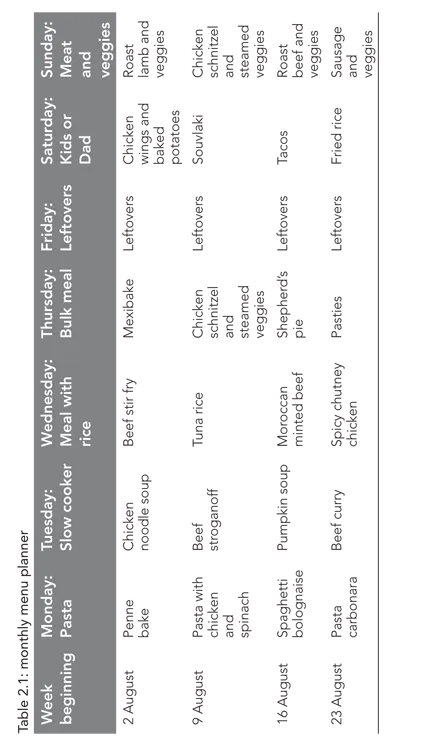
Now I have a comprehensive list of meals to choose from. I use a monthly template to slot meals against the relevant days so they fit into the daily categories I’ve selected. As mentioned earlier, you can plan for any time frame; however, I’ve found monthly to be the optimal period for our family. Having done this so many times now, I can plan our meals for the month in 35 minutes. The end result can be seen in table 2.1. You can download a monthly menu planning template at www.planningwithkids.com/resources.
Table 2.1: monthly menu planner
Shopping for growing families
Once I’ve created a menu plan, not only has this made mealtime easier, but the task of shopping for groceries has now been simplified too. The menu plan allows me to easily collate a shopping list to take to the supermarket.
Shopping lists
Shopping lists are the key to efficient shopping for our family. I have two ...