
- English
- ePUB (mobile friendly)
- Available on iOS & Android
eBook - ePub
IPv6 Deployment and Management
About this book
With the announcement in 2011 that the current Internet Protocol (IP), IPv4, has nearly run out, interest in IPv6 -- the latest IP version -- has grown substantially. This book describes IPv6 technology and its repercussions on organizations, including strategies and techniques for assessing the impact of deploying IPv6 on a network, discovering current IP assets, assessing network readiness, creating a plan to deploy IPv6 while retaining IPv4 connectivity, and for managing a dual protocol IPv4-IPv6 network. It is a must read for IP network engineers, managers, and those who work in IT.
Information
Chapter 1
IPv6 Deployment Drivers
1.1 The Internet: A Success Story
The Internet has come a long way. Invented in the late 1960s as a resilient interconnected network of networks for the U.S. Department of Defense, it has evolved into a global communications phenomenon. With the invention of the World Wide Web by Tim Berners-Lee, defining the hypertext linking of information over a network such as the Internet through the use of a web browser, this innovation of simple point-and-click user interface brought the Internet out of government and science laboratories and into ordinary people's lives. Email was the second key Internet application that contributed to the widespread adoption of Internet services during the mid-1990s. Today's Internet users generally find this ubiquitous availability of wide variety of information and applications indispensable in their day-to-day lives. If popular Internet applications like Facebook, YouTube, Twitter, Google, Blogger, shopping, and news sites, and even good old email were suddenly rendered unavailable, most people would not know what to do with themselves!
But the abundance of information and applications on the Internet is not universally available worldwide today. Figure 1-1 illustrates the statistics reported by Internet World Stats indicating the penetration of Internet users as a percentage of overall population in various regions of the world as of mid-2012. Just over one-third of the world's population has access to and use the Internet from work, home, mobile, or wireline. Penetration in North America is highest among the measured regions at more than 78% with Europe second at 63%. Among the Asian population, penetration is only about 28%.
Figure 1-1 Internet penetration by region [1].
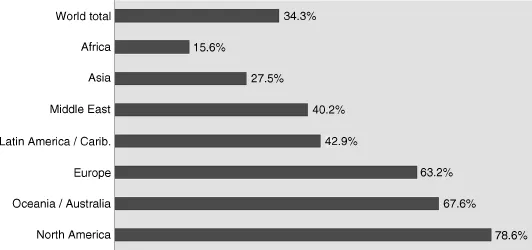
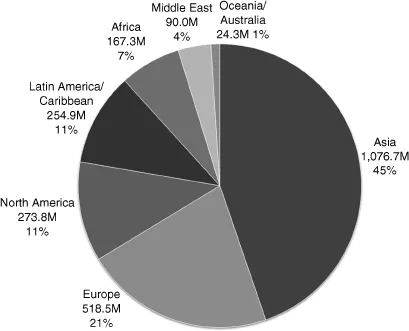
Looking at the same data from a raw numbers perspective, Figure 1-2 illustrates the distribution of Internet users throughout the world. Comparing Figures 1-1 and 1-2, note that while Internet penetration in Asia is less than 28%, the number of users in Asia tops 1 billion, representing 45% of global Internet users, estimated at 2.4 billion by Internet World Stats.
Figure 1-2 Worldwide Internet users by region [1].
With worldwide penetration of Internet users at just 34%, there seems to be plenty of room for an expanding Internet population. And with the likelihood of multiple devices required per user, this expansion will create accelerated demand for Internet Protocol (IP) addresses. But what circumstances would facilitate such expansion? A recent study by the World Bank concluded that in low- and middle-income countries, for every 10% increase in Internet penetration, the country's average economic growth increases by 1.12% as measured by gross domestic product (GDP) [2]. A 10% increase in broadband penetration yields an average GDP increase of 1.38%. The report also extols other socio-economic benefits for broadband deployment including higher employment, expanding entrepreneurial opportunities, providing social contacts, and delivering public information-based services. While some governments may desire to restrict free access to certain content or applications, the economic correlation to Internet growth is difficult to ignore.
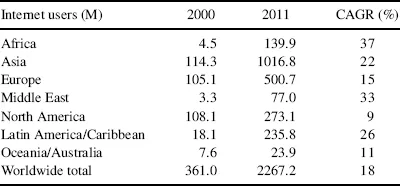
And trends leading up to the present time indicate strong growth over the last decade. Figure 1-3 illustrates growth in Internet users and penetration. These appear to be directly proportional. The compound annual growth rate (CAGR) over this time period, by region, is represented in Table 1-1 and averaged 18% worldwide.
Figure 1-3 Internet users history [1].
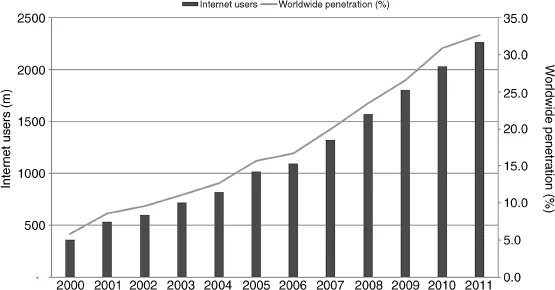
Table 1-1. Worldwide Internet User Growth per Region.
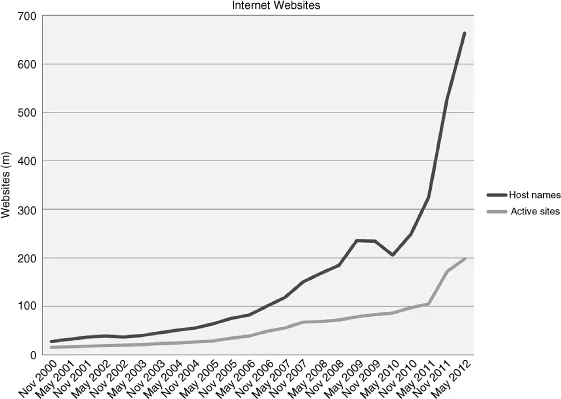
The number of content providers or “producers” on the Internet as measured by the number of new websites is also growing at an increasingly rapid rate according to Netcraft [3], an Internet research and security services firm. As of June 2012, the total number of discovered unique website hostnames reached nearly 700 million, while active (non-template, based solely on domain registration) sites approached 200 million as shown in Figure 1-4. Both metrics have increased at an accelerated rate over the past two years. New organizations beyond some point in time desiring to operate their own websites or hosting providers will eventually only have access to IPv6 address space for publishing web content.
Figure 1-4 Measured quantity of Internet websites [3].
1.1.1 Supply-Side Issues
Given this history of sustained growth of Internet users and content suppliers, the relatively modest penetration rates, and the economic benefits of broadband deployment and Internet access, it's reasonable to predict that Internet user and producer demand will continue to grow. Unfortunately, the currently available capacity of IPv4 addresses to support this growth is insufficient. With IPv4 address space depleted, for all intents and purposes, the only Internet Protocol available to support this demand is IPv6.
When the Internet Assigned Names and Numbers Authority (IANA) announced, on February 3, 2011, that it had allocated its last remaining IPv4 address space to the Regional Internet Registries (RIRs), that day was the beginning of the end of the Internet as we know it. Figure 1-5 illustrates the IP address space “food chain,” with IANA allocating base address blocks to RIRs. IANA is a department within the Internet Corporation for Assigned Names and Numbers (ICANN), which itself is a not-for-profit public-benefit corporation with participants from around the world. IANA is the centralized coordinating body for Internet domain names managing the Domain Name System (DNS) root and several other top-level domains, Internet number resources (IP addresses), and protocol assignments (protocol-specific parameters, e.g., Dynamic Host Configuration Protocol (DHCP) option number assignments).
Figure 1-5 The IP address space hierarchy [4].
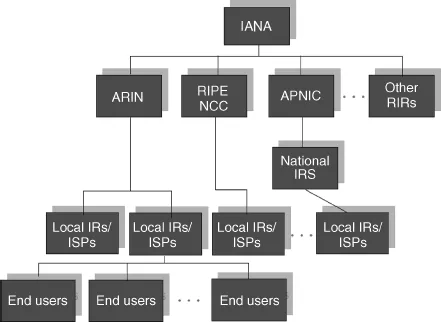
The RIRs are organizations responsible for allocation of address space within their respective global regions from their corresponding space allotments from IANA:
- AfriNIC (African Network Information Centre)—Africa region
- APNIC (Asia-Pacific Network Information Centre)—Asia-Pacific region
- ARIN (American Registry for Internet Numbers)—North America region including Puerto Rico and some Caribbean Islands
- LACNIC (Regional Latin-American and Caribbean IP Address Registry)—Latin America and some Caribbean Islands
- RIPE NCC (Réseaux IP Européens Network Coordination Centre)—Europe, the Middle East, and Central Asia.
The RIR system was established with the following goals for IP address allocation to National Internet Registries, Local Internet Registries (LIRs), and Internet Service Providers (ISPs):
- Uniqueness. Each IP address must be unique worldwide for global Internet routing.
- Aggregation. Hierarchical allocation of address space assures proper routing of IP traffic on the Internet. Without aggregation, routing tables become fragmented which could ultimately create tremendous bottlenecks within the Internet.
- Conservation. With IPv4 in particular but also for IPv6 space, address space needs to be distributed according to actual usage requirements.
- Registration. A publicly accessible registry of IP address assignments eliminates ambiguity and can help when troubleshooting. This registry is called the whois database. Today, there are many whois databases, operated not only by RIRs but also by LIR/ISPs for their respective address spaces.
- Fairness. Unbiased address allocation based on true address needs and not on long-term “plans.”
Despite efforts to extend the lifetime of IPv4 through technologies such as Network Address Translation (NAT) and Classless Inter-Domain Routing (CIDR) as well as RIR policies enabling sales and transfers of IPv4 address space, eventually the RIRs will each allocate their last vestige of IPv4 address space to their constituents. The ISPs then in turn will eventually exhaust their IPv4 resources for distribution to their customers, generally enterprise businesses. The APNIC and RIPE NCC RIRs have already exhausted their respective IPv4 space.
1.1.2 Internet at a Crossroads
So what does all this mean? When IPv4 address space runs out among the ISPs within a given RIR's region, any new organization requiring IP address space or existing organizations requiring supplemental IP address space in that region will, by necessity, receive an IPv6 address space allocation. As new organizations initiate web presences, they will be accessible only by IPv6. As new “IPv6-only” organizations join the web, the composition of the Internet itself will slowly change from the homogeneous IPv4 Internet available today to a mixed IPv4/IPv6 Internet in the future. How quickly and to what levels this IPv6 density within the Internet will rise is uncertain.
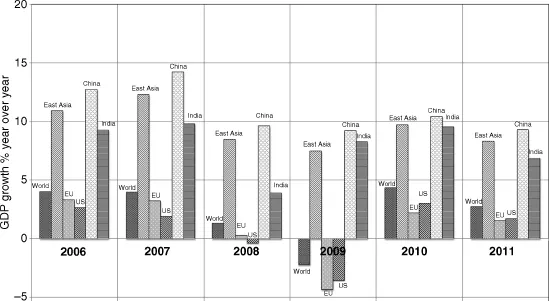
The growth in number of IPv6-only users is expected to surface initially in Asia. The economies of major Asian countries, particularly China and India, have grown more rapidly in recent years than the rest of the world according to the International Monetary Fund [5] as illustrated in Figure 1-6. From 2000 through 2011, the average annual GDP growth in China was 10.2% and India was 7.1%, while the world average was 2.7%. This in turn has led to rising disposable incomes and government infrastructure investment in communications technologies such as broadband and wireless. Point Topic Ltd estimated that nearly half of the world's broadband net additions for the first half of 2012 were in Asia [6]. Point Topic's report also mirrored that of Internet World Stats, which reported that while Asia boasts the most Internet users at over one billion, its Internet penetration rate is below the world average (33%) at 26%.
Figure 1-6 GDP growth 2006–2010 [7].
Though growth slowed during 2012, the rate of subscriber growth remains strong, stimulating many service providers in the region and throughout the world to implemente translation gateways, tunnel brokers, or similar technologies, which we'll describe in Chapter 3. Depending on the selected approach, these technologies allow service providers to support customer premises equipment (CPE) configured with IPv4 or IPv6 addresses with the ability to access IPv4 or IPv6 Internet destinations. Service providers will need to support customer access to both protocols to avoid subscribers complaining that should IPv4 subscribers be unable to access IPv6-only content and IPv6 subscribers be unable to access IPv4-only content.
1.1.3 Which Internet Are You On?
This is precisely what is at stake with today's current crossroads on the Internet. At this point, perhaps you're wondering what IPv6 deployment in Asia has to do with you. Quite simply, the ubiquity of the Internet is at stake. If every organization with ample IPv4 space continues to manage an IPv4-only Internet presence, then this growing IPv6-only population will be unable to reach them. Converse...
Table of contents
- Cover
- Title Page
- Copyright
- Dedication
- Acknowledgments
- Introduction
- Chapter 1: IPv6 Deployment Drivers
- Chapter 2: IPv6 Overview
- Chapter 3: IPv4/IPv6 Co-Existence Technologies
- Chapter 4: IPv6 Readiness Assessment
- Chapter 5: IPv6 Address Planning
- Chapter 6: IPv6 Security Planning
- Chapter 7: IPv6 Network Management Planning
- Chapter 8: Managing the Deployment
- Chapter 9: Managing the IPv4/IPv6 Network
- Chapter 10: IPv6 and the Future Internet
- Appendix
- Bibliography
- Index
Trusted by 375,005 students
Access to over 1.5 million titles for a fair monthly price.
Study more efficiently using our study tools.
Frequently asked questions
Yes, you can cancel anytime from the Subscription tab in your account settings on the Perlego website. Your subscription will stay active until the end of your current billing period. Learn how to cancel your subscription
No, books cannot be downloaded as external files, such as PDFs, for use outside of Perlego. However, you can download books within the Perlego app for offline reading on mobile or tablet. Learn how to download books offline
Perlego offers two plans: Essential and Complete
- Essential is ideal for learners and professionals who enjoy exploring a wide range of subjects. Access the Essential Library with 800,000+ trusted titles and best-sellers across business, personal growth, and the humanities. Includes unlimited reading time and Standard Read Aloud voice.
- Complete: Perfect for advanced learners and researchers needing full, unrestricted access. Unlock 1.5M+ books across hundreds of subjects, including academic and specialized titles. The Complete Plan also includes advanced features like Premium Read Aloud and Research Assistant.
We are an online textbook subscription service, where you can get access to an entire online library for less than the price of a single book per month. With over 1.5 million books across 990+ topics, we’ve got you covered! Learn about our mission
Look out for the read-aloud symbol on your next book to see if you can listen to it. The read-aloud tool reads text aloud for you, highlighting the text as it is being read. You can pause it, speed it up and slow it down. Learn more about Read Aloud
Yes! You can use the Perlego app on both iOS and Android devices to read anytime, anywhere — even offline. Perfect for commutes or when you’re on the go.
Please note we cannot support devices running on iOS 13 and Android 7 or earlier. Learn more about using the app
Please note we cannot support devices running on iOS 13 and Android 7 or earlier. Learn more about using the app
Yes, you can access IPv6 Deployment and Management by Michael Dooley,Timothy Rooney in PDF and/or ePUB format, as well as other popular books in Informatica & Ingegneria informatica. We have over 1.5 million books available in our catalogue for you to explore.