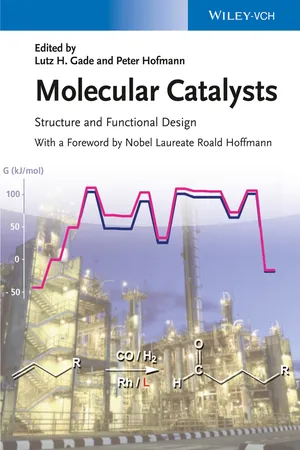
Highlighting the key aspects and latest advances in the rapidly developing field of molecular catalysis, this book covers new strategies to investigate reaction mechanisms, the enhancement of the catalysts' selectivity and efficiency, as well as the rational design of well-defined molecular catalysts. The interdisciplinary author team with an excellent reputation within the community discusses experimental and theoretical studies, along with examples of improved catalysts, and their application in organic synthesis, biocatalysis, and supported organometallic catalysis. As a result, readers will gain a deeper understanding of the catalytic transformations, allowing them to adapt the knowledge to their own investigations.
With its ideal combination of fundamental and applied research, this is an essential reference for researchers and graduate students both in academic institutions and in the chemical industry.
With a foreword by Nobel laureate Roald Hoffmann.
- English
- ePUB (mobile friendly)
- Available on iOS & Android
eBook - ePub
About this book
Information
Part I
Mechanisms of Elementary Reactions in Catalytic Processes
Lutz H. Gade
Catalytic reactions involve a series of chemical transformations resulting from substrate–catalyst interactions, which taken together are referred to as the mechanism of the catalytic reaction. Frequently mentioned in textbooks and research papers alike as “catalytic cycles,” they should be more appropriately referred to as catalytic reaction networks comprising multiple bifurcation points and parallel reaction pathways. Detailed knowledge of the mechanism is a prerequisite for a rational approach in catalyst development, and a great deal of effort goes into their systematic investigation.
In adopting the reductionist approach underlying much of modern scientific research, the reaction networks of catalytic transformations can be broken down to elementary reaction steps. These may involve the formation or cleavage of a single chemical bond but also complex rearrangements representing themselves cascades of addition or dissociation and thus bond-breaking and bond-forming steps. A closer look at such elementary reactions may uncover more complex reaction pathways involving “hidden” intermediates associated with shallow minima in the free-energy landscape, and this complexity then adds onto the overall mechanism of the catalytic reaction.
Our understanding of reaction mechanisms, therefore, begins with a detailed study of the elementary reaction steps and the nature of intermediate species, corresponding to local minima in free enthalpy. This is frequently complicated by the rapidity of the processes and the short lifetimes of the intermediate species and is, consequently, a challenge for the application of analytical methods appropriate to the relevant reaction phase and/or medium. Once such data are available, the theoretical modeling of the process represents the next stage in its understanding. This involves not only modeling the “free-energy landscape” but also the dynamics of the process itself.
A quantum dynamical modeling of olefin insertion into a metal–hydride bond and its reverse reaction is the topic of Chapter 1 by Klatt and Köppel. They employ the wave packet methodology, which is based on the time-dependent Schrödinger equation and allows the description of coherence and tunneling effects as well as the vibrational structure of electronic spectra and thus goes far beyond transition-state theory. The results described in this chapter are relevant to a deeper understanding of the electronic factors that govern, inter alia, olefin polymerizations.
The ligands in molecular metal catalysts may be viewed as moderators of their chemical reactivity, shielding the active site from nonspecific reactive interactions with the surrounding reaction medium and orientating the substrates in their transformation within the coordination sphere. Ligated metal atoms and clusters are thus “passivated” reagents, a notion that is all too obvious whenever chemical reactions of the bare atoms and clusters are studied. This has been achieved, for example, in the collision chambers of mass spectrometers where chemical reactions are observed of which more traditionally minded coordination chemists may dream. An alternative to gas-phase studies is provided by low-temperature matrix isolation in inert gas matrices, the origins of which date back to more than half a century. This approach has been taken by Himmel and Hübner, who describe their studies on bare metal clusters that bind and activate small molecules such as H2, N2, and O2, in Chapter 2. Such studies provide insight into processes that are relevant to both molecular and heterogeneous catalysis.
Most analytical methods employed to study elementary reactions and reaction intermediates provide information about ensembles of reactive molecules. However, for more than a decade now, it has been possible to monitor transformations of single molecules by means of fluorescence microscopy. This involves the labeling of at least one of the reactants with a fluorophore, which in the case of a catalytic reaction would be either the catalyst or the substrate. The visualization of a chemical reaction then relies on changes of the fluorescence induced by a transformation at the reactive center of a catalyst. Herten and coworkers present several case histories. The use of single-molecule spectroscopy and the way in which the methods developed in this field may give rise to potential “single-molecule catalysis” are described in Chapter 3.
The two final chapters in this first part go beyond the elementary reaction steps and focus on reactivity issues in two important areas of molecular catalysis. Molecular gold catalysis has developed rapidly during the past decade and has provided new tools for organic synthesis. Key steps involve the π-coordination and electrophilic activation of an unsaturated substrate. An understanding of the complex subsequent transformations and reaction cascades involved in gold-catalyzed reactions requires a deeper knowledge of the relevant intermediates and their reactive potential. Moreover, the unambiguous assignment of the reactive gold species remains another challenge for many recently discovered reactions. Hashmi discusses some of these issues in Chapter 4.
Olefin metathesis has completely transformed the conceptual framework of organic synthesis and retro-synthesis. It is appropriate to state that its advent in organic synthesis has had an impact that is comparable to the addition of a new move to a chess game. Disconnections of target molecules, which were deemed impossible previously, are feasible because of this type of transformation. The foundations were laid by the groups of Schrock and Grubbs, but continuous development and modification of their catalysts has significantly enhanced the scope of the method. As Straub points out in Chapter 5, the issue of stereoselectivity in olefin...
Table of contents
- Cover
- Related Titles
- Title Page
- Copyright
- List of Contributors
- Foreword
- Introduction
- Part I: Mechanisms of Elementary Reactions in Catalytic Processes
- Part II: New Catalysts – New and Old Reactions
- Part III: Catalysts in Synthesis
- Part IV: Structures and Mechanisms in Biological Systems
- Part V: Studies of Immobilized Catalysts – Introduction
- Index
- End User License Agreement
Trusted by 375,005 students
Access to over 1.5 million titles for a fair monthly price.
Study more efficiently using our study tools.
Frequently asked questions
Yes, you can cancel anytime from the Subscription tab in your account settings on the Perlego website. Your subscription will stay active until the end of your current billing period. Learn how to cancel your subscription
No, books cannot be downloaded as external files, such as PDFs, for use outside of Perlego. However, you can download books within the Perlego app for offline reading on mobile or tablet. Learn how to download books offline
Perlego offers two plans: Essential and Complete
- Essential is ideal for learners and professionals who enjoy exploring a wide range of subjects. Access the Essential Library with 800,000+ trusted titles and best-sellers across business, personal growth, and the humanities. Includes unlimited reading time and Standard Read Aloud voice.
- Complete: Perfect for advanced learners and researchers needing full, unrestricted access. Unlock 1.5M+ books across hundreds of subjects, including academic and specialized titles. The Complete Plan also includes advanced features like Premium Read Aloud and Research Assistant.
We are an online textbook subscription service, where you can get access to an entire online library for less than the price of a single book per month. With over 1.5 million books across 990+ topics, we’ve got you covered! Learn about our mission
Look out for the read-aloud symbol on your next book to see if you can listen to it. The read-aloud tool reads text aloud for you, highlighting the text as it is being read. You can pause it, speed it up and slow it down. Learn more about Read Aloud
Yes! You can use the Perlego app on both iOS and Android devices to read anytime, anywhere — even offline. Perfect for commutes or when you’re on the go.
Please note we cannot support devices running on iOS 13 and Android 7 or earlier. Learn more about using the app
Please note we cannot support devices running on iOS 13 and Android 7 or earlier. Learn more about using the app
Yes, you can access Molecular Catalysts by Lutz H. Gade,Peter Hofmann in PDF and/or ePUB format, as well as other popular books in Technology & Engineering & Materials Science. We have over 1.5 million books available in our catalogue for you to explore.