The Telecommunications Handbook
eBook - ePub

The Telecommunications Handbook

Engineering Guidelines for Fixed, Mobile and Satellite Systems

  1. English
  2. ePUB (mobile friendly)
  3. Available on iOS & Android
eBook - ePub

The Telecommunications Handbook

Engineering Guidelines for Fixed, Mobile and Satellite Systems

About this book

THE TELECOMMUNICATIONS HANDBOOK

ENGINEERING GUIDELINES FOR FIXED, MOBILE AND SATELLITE SYSTEMS

Taking a practical approach, The Telecommunications Handbook examines the principles and details of all the major and modern telecommunications systems currently available to industry and to end-users. It gives essential information about usage, architectures, functioning, planning, construction, measurements and optimization. The structure of the book is modular, giving both overall descriptions of the architectures and functionality of typical use cases, as well as deeper and practical guidelines for telecom professionals.

The focus of the book is on current and future networks, and the most up-to-date functionalities of each network are described in sufficient detail for deployment purposes. The contents include an introduction to each technology, its evolution path, feasibility and utilization, solution and network architecture, and technical functioning of the systems (signaling, coding, different modes for channel delivery and security of core and radio system). The planning of the core and radio networks (system-specific field test measurement guidelines, hands-on network planning advices and suggestions for parameter adjustments) and future systems are also described.

With contributions from specialists in both industry and academia, the book bridges the gap between communications in the academic context and the practical knowledge and skills needed to work in the telecommunications industry.
Frequently asked questions

Yes, you can cancel anytime from the Subscription tab in your account settings on the Perlego website. Your subscription will stay active until the end of your current billing period. Learn how to cancel your subscription.
No, books cannot be downloaded as external files, such as PDFs, for use outside of Perlego. However, you can download books within the Perlego app for offline reading on mobile or tablet. Learn more here.
Perlego offers two plans: Essential and Complete
  • Essential is ideal for learners and professionals who enjoy exploring a wide range of subjects. Access the Essential Library with 800,000+ trusted titles and best-sellers across business, personal growth, and the humanities. Includes unlimited reading time and Standard Read Aloud voice.
  • Complete: Perfect for advanced learners and researchers needing full, unrestricted access. Unlock 1.4M+ books across hundreds of subjects, including academic and specialized titles. The Complete Plan also includes advanced features like Premium Read Aloud and Research Assistant.
Both plans are available with monthly, semester, or annual billing cycles.
We are an online textbook subscription service, where you can get access to an entire online library for less than the price of a single book per month. With over 1 million books across 1000+ topics, we’ve got you covered! Learn more here.
Look out for the read-aloud symbol on your next book to see if you can listen to it. The read-aloud tool reads text aloud for you, highlighting the text as it is being read. You can pause it, speed it up and slow it down. Learn more here.
Yes! You can use the Perlego app on both iOS or Android devices to read anytime, anywhere — even offline. Perfect for commutes or when you’re on the go.
Please note we cannot support devices running on iOS 13 and Android 7 or earlier. Learn more about using the app.
Yes, you can access The Telecommunications Handbook by Jyrki T. J. Penttinen in PDF and/or ePUB format, as well as other popular books in Technology & Engineering & Electrical Engineering & Telecommunications. We have over one million books available in our catalogue for you to explore.

1
Introduction

Jyrki T. J. Penttinen

1.1 General

This chapter provides an introduction to the contents of the book. It also includes high level information about telecommunications, and instructions on how to utilize the modular structure of the chapters in an efficient way.
The main idea of the book is to combine the theoretical and practical aspects of the complete telecommunication fields, including fixed, mobile, satellite, broadcast and special systems, which is clarified in this chapter.
This Telecommunications Handbook describes principles and details of all the major and modern telecommunications systems that are relevant for the industry and to end-users, and gives useful information about usage, architectures, functioning, planning, construction, measurements and optimization. The book describes applications, equipment, radio, transport and core networks of the selected systems. The book focuses on practical descriptions and gives useful tips for the planning, setup, measurements, optimization, utilization and feasible options. In general, the book will help readers to understand the complete telecommunications field in a practical way.
The contents include the introduction of each technology, evolution path, feasibility, utilization, motivation, importance, solution, network architecture, and technical functioning of the systems. This includes signaling, coding, different modes for channel delivery and security of core and radio system as well as the planning of the core and radio networks. There are system-specific field test measurement guidelines, hands-on network planning advice and suggestions for the parameter adjustments included in several sections of the book. The book also describes the most probable future systems.

1.2 Short History of Telecommunications

1.2.1 The Beginning

The initiation of the actual telecommunications as we understand the term has a long precedence and history, from the era of fire and smoke signals in the most primitive yet functional format in order to deliver simple messages between two different physical locations. Claude Chappe was one of the pioneers who brought the optical signaling techniques to a new level by introducing a method that was based on the different positions of wooden signaling poles 1792 [1].
The finding of ways to handle electricity finally opened the new era of telecommunications as it provided the necessary means to deliver messages over long distances without the limitations of the line-of-sight that previous optical methods required. The characteristics of copper as telecommunication line conductor were well understood in the nineteenth century [2]. The most concrete application of this era was Morse code in the 1800s, which is still utilized actively by radio amateurs, or hams, all over the globe, although its importance in commercial communications has practically disappeared and it is utilized merely as a backup support in limited environments when other systems fail. Table 1.1 shows the original Morse codes that are still utilized in the ham community in addition to other transmission modes.
Table 1.1 The Morse code table
A . - K -.- U . .- 0 - - - - -
B -. . . L .-. . V . . .- 1 .- - - -
C -.-. M - - W .- - 2 . .- - -
D -. . N -. X -. .- 3 . . .- -
E . O - - - Y -.- - 4 . . . .-
F . .-. P .- - . Z - - . . 5 . . . . .
G - - . Q - - .- Dot .-.-.- 6 -. . . .
H . . . . R .-. = -. . .- 7 - - . . .
I . . S . . . Error . . .-. 8 - - - . .
J .- - - T - End . . .-.- 9 - - - -.
Voice services took their first steps soon after, and Alexander Graham Bell patented the fixed telephone in 1876. Regardless of official recognition, there were also other inventors like Elisha Gray brainstorming on the same topic, which was a concrete sign that people realized the importance of telecommunications.
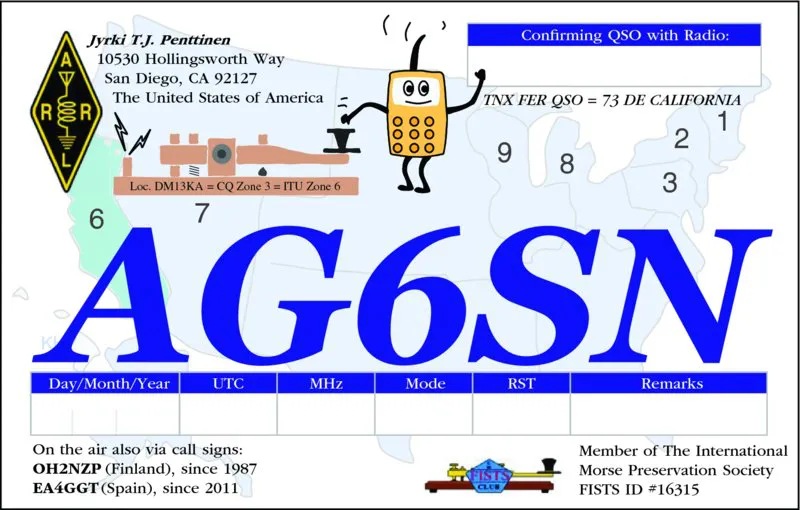
The relevance of early experiments by radio amateurs cannot be underestimated. Radio and television broadcasting as we know it today benefited greatly from the experiments that radio amateurs carried out. After hobby-based activities, broadcasting was taken over by governments as the importance of communications started to become clear. Nevertheless, radio amateurs still continue with the experiments of the old and new transmission modes of wireless communications. The radio amateurs or “ham radio” community enjoys the amateur radio hobby in such a way that licensed participants operate communications equipment with a deep appreciation of the radio art [3]. Connections are typically confirmed via QSL card, i.e., cards for the acknowledgement of radio amateur connections, which nowadays can also have electronic form. Figure 1.1 shows an example of QSL card of radio amateurs which is used for acknowledging 2-way connections. Today, amateur radio activity is a mix of fun, public service, and convenience.
images
Figure 1.1 The QSL card is still utilized in amateur radio communications for confirming the connections.
Amateurs have a basic knowledge of radio technology and operating principles, and pass an examination for the regulators' license to operate on radio frequencies in the amateur bands. As an example, FCC is responsible for radio amateur licensing in the USA. As soon as the candidate passes the exams that include radio technologies, communications procedures and regulations, the candidate is awarded a license to operate in the frequencies with the modes and technical limitations the respective class dictates. It should be noted that earlier the passing of the Morse code exam was also required for part of the classes, but it is not included in the official exam any more. Nevertheless, operating in continuous wave (CW) via Morse code is still one of the popular modes today.
The regulators, following the national and international principles, reserve the radio amateur frequency blocks for use by hams. There are various bands for the use of radio amateurs in almost all of the practically usable frequencies, beginning with the low frequency bands of 160 m (1.8 MHz band) up to the mm-bands near the li...

Table of contents

  1. Cover
  2. Titlepage
  3. Copyright
  4. Preface
  5. Acknowledgements
  6. Abbreviations
  7. List of Contributors
  8. 1 Introduction
  9. 2 Standardization and Regulation
  10. 3 Telecommunications Principles
  11. 4 Protocols
  12. 5 Connectivity and Payment
  13. 6 Fixed Telecommunications Networks
  14. 7 Data Networks
  15. 8 Telecommunications Network Services and Applications
  16. 9 Transmission Networks
  17. 10 Modulation and Demodulation
  18. 11 3GPP Mobile Communications: GSM
  19. 12 3GPP Mobile Communications: WCDMA and HSPA
  20. 13 3GPP Mobile Communications: LTE/SAE and LTE-A
  21. 14 Wireless LAN and Evolution
  22. 15 Terrestrial Broadcast Networks
  23. 16 Satellite Systems: Communications
  24. 17 Satellite Systems: Location Services and Telemetry
  25. 18 Other and Special Networks
  26. 19 Security Aspects of Telecommunications: 3GPP Mobile Networks
  27. 20 Planning of 2G Networks
  28. 21 Planning of Advanced 3G Networks
  29. 22 Planning of Mobile TV Networks
  30. 23 Planning of Core Networks
  31. 24 EMF – Radiation Safety and Health Aspects
  32. 25 Deployment and Transition of Telecommunication Systems
  33. 26 Wireless Network Measurements
  34. Index
  35. End User License Agreement