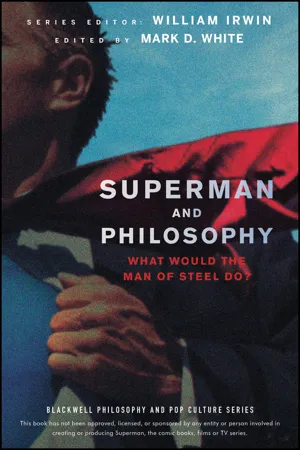
He has thrilled millions for 75 years, with a legacy that transcends national, cultural, and generational borders, but is there more to the Man of Steel than just your average mythic superhero in a cape? The 20 chapters in this book present a fascinating exploration of some of the deeper philosophical questions raised by Superman, the Last Son of Krypton and the newest hero in the Blackwell Philosophy and Pop Culture arsenal.
- English
- ePUB (mobile friendly)
- Available on iOS & Android
eBook - ePub
About this book
Go beyond the cape and into the mind of the Man of Steel, in time for release of Zack Snyder's Man of Steel movie and Superman's 75th anniversary
Information
Part One
THE BIG BLUE BOY SCOUT
ETHICS, JUDGMENT, AND REASON
Chapter 1
Moral Judgment
The Power That Makes Superman Human
“Do whatever you think is best. I trust you.”
Lois Lane to Superman 1
Superman has incredible powers and, luckily for us, he chooses to use them for good. But good intentions are not enough to actually do good with his powers—he must know what to do with them as well. Most of the time this is simple: see bank robber, catch bank robber. Hear Jimmy Olsen’s signal watch, get him out of trouble. Find out Doomsday is threatening Metropolis, fight Doomsday (even to the death).
But not all choices are so clear-cut. Often there will be two or more disasters Superman needs to prevent. His enemies put him in such situations—“What will you do now, Superman: save the bus full of schoolchildren or your precious Lois?”—because that’s one of the few ways the writers of Superman can challenge him (aside from using kryptonite or magic). Sometimes he can find a way to save both the kids and Ms. Lane—after all, he is Superman—but other times he must make a choice. In such cases, all the superpowers in the world don’t matter, and it all comes down to judgment, the ability to make tough choices in difficult situations. The need for judgment is what brings all superheroes down to Earth, and what ultimately makes them relatable to their fans despite their fantastic abilities.
The Trinity of Moral Philosophy
Moral philosophy (or ethics) is the area of philosophy dealing with what we should do, what kind of people we should be, and what kind of lives we should live. There are three basic schools of ethics: utilitarianism, deontology, and virtue ethics. Utilitarianism says that we should do those things that maximize the “good” in the world, whether that good is understood to be happiness, well-being, or some other valuable part of life. Deontology emphasizes the morality of actions themselves without relying exclusively on their consequences, and is often put in terms of the “right” instead of the “good.”2 Finally, virtue ethics changes the focus from actions to actors, describing the characteristics of a good or virtuous person and then taking what such a person would do as the basis for virtuous action. A simple Web search for “what would Superman do?” reveals the popularity of the virtue ethics approach!3
To some extent, each of these three schools of ethics can be understood as laying out simple rules or formulas for making moral decisions. Utilitarianism demands that you consider the benefit and harm to all people affected (and as far into the future as you can anticipate) of each potential action, and then choose the option with the most total benefit compared to harm. Deontology would have you assess each potential action according to a moral standard, often in the form of rules or duties, and then choose the option with the highest moral “status” according to that standard. Virtue ethics is the farthest removed from rules or formulas. Nonetheless, it asks us to imagine what someone we imagine as virtuous would do in a similar situation and then do likewise.
For example, suppose Jimmy Olsen is considering telling a young woman that he’s a full-fledged reporter (instead of a photographer) for the Daily Planet in hopes of impressing her and getting a date. If he were a utilitarian, he would assess the consequences of his deception: maybe he’d get a date, but he’d either have to keep up his ruse while he was with her (and involve his friends and colleagues in it), or else his dream girl would find out and stick his camera somewhere even Superman couldn’t find it. It could work out, if he’s very lucky, but likely not. If he were a deontologist, the issue would be much simpler: lying is usually considered to be wrong, especially if it’s done for personal gain. Or he could be a virtue ethicist and ask what his Big Blue buddy would do—but he could never imagine Superman lying to a woman to get a date. (“He wouldn’t have to,” Jimmy may grumble.) Despite their differences in approach and focus, the three schools of ethics often agree on the “big” moral issues, such as murder, theft—and lying, even if only to get a date. Even for Jimmy. (Sorry, Jimmy.)
But Like Superpowers, Ethics Only Gets You So Far
If only we could deal with all of our moral questions as easily as we did with Jimmy and his love life. Let’s take a more complicated example: Lois is investigating corruption in the Metropolis mayor’s office, but in order to get the last piece of information that will make the story complete and bring down the guilty parties, she has to blackmail one of her sources. Lois knows full well that blackmail is illegal—she’s reported on it many times—but at the same time she believes that this story will strike a major blow to corruption and make Metropolis a better place to live for all its citizens.4 While Jimmy was thinking of doing something normally regarded as bad or wrong merely to get a date, Lois has what most would consider a good reason to commit blackmail. So she has to decide: is it OK to use blackmail in her situation?
In this case, our three schools of ethics are less helpful because there are good reasons on both sides of the argument. Ethical theories are very good at nailing down reasons to do or not do something, but not so good at comparing reasons for one action to reasons for another. Utilitarianism would seem to offer the best way out. But it is incredibly difficult to calculate and compare the good and bad consequences of breaking the story and committing blackmail. Deontology avoids the messy business of valuing consequences and having to put everything into numbers, and instead focuses on the right and wrong in the situation. But deontology still leaves us with the difficult issue of whether to commit the wrong (blackmail) in order to further the good (fight corruption). Finally, virtue ethics would have us ask what the good person would do, but we have to assume good people would also struggle with these issues. Certainly, exposing wrongdoing and obeying the law are both virtuous actions, but which one is more important?
What all three ethical schools are missing—at least in their simplest forms—is a theory of judgment . Philosopher Immanuel Kant (1724–1804), a deontologist famous for his categorical imperative that generates moral duties, believed that judgment was necessary for putting those duties to work in real-life situations. Abstract duties and rules require “a power of judgment sharpened by experience, partly in order to distinguish in what cases they are applicable, and partly to gain for them access to the human will as well as influence for putting them into practice.” 5 But while Kant’s categorical imperative provides formulas that determine whether a general plan of action (or maxim ) is permissible or forbidden, it doesn’t tell us what to do when duties or obligations conflict, such as in Lois’s case. In fact, there is no rule or formula that can help her make this decision; if there were, that rule would someday come in conflict with another, requiring another rule, and so on. As Kant wrote:
although the understanding is certainly capable of being instructed and equipped through rules, the power of judgment is a special talent that cannot be taught but only practiced. Thus this is also what is specific to so-called mother-wit, the lack of which cannot be made good by any school. 6
If Lois were a Kantian deontologist, she would recognize a duty to expose wrongdoing as well as a duty to obey the law, two duties that conflict in her current predicament. According to Kant, there is no higher-order rule or duty to tell her which is more important, because that depends on the situation—so she must use her judgment, her “moral compass,” to determine the right answer.
Although Kant was a deontologist, this idea of judgment can be applied to the other two ethical theories as well. Like deontologists, virtue ethicists need to balance different virtues that may conflict, with no recourse to a higher “meta-virtue” that can solve the problem. Utilitarians seem to have it easy, since their “balancing” consists of comparing goods and bads on a common scale of utility or happiness. But they can’t possibly anticipate and calculate all of the consequences of their actions, so they need to decide which are most important—and this takes judgment. Specifically, contemporary philosopher Barbara Herman writes that judgment of this kind provides “moral salience,” which a person needs “to pick out these elements of his circumstances or of his proposed actions that require moral attention.”7 If Lois were a utilitarian, she would presumably focus on the big things: the benefits to the citizens of Metropolis of exposing government corruption and the risks of someone discovering her blackmail. She may also consider the effects on the person she would blackmail, but may judge his well-being to be less important, given his role in the corruption scandal. She may also consider the effects on her friends and family if she were convicted of blackmail, but may dismiss these concerns because she believes these people would support her. Given the impossible task demanded of utilitarians, she has to focus on the most salient moral consequences—but at the risk of forgetting something that may have changed her mind.
Tragic Dilemma in Your Pocket (Universe)
Despite his superpowers, Superman still confronts ethical dilemmas and still needs to use judgment to solve them. For him, however, the stakes are usually much higher than those the average person deals with. The weight of Superman’s choices is often like that of world leaders’ choices, potentially affecting millions of lives and the future of nations.
One of Superman’s darkest hours came during an adventure in an alternate “pocket” universe in which he encountered three Kryptonians—including that universe’s version of General Zod—who escaped imprisonment in the Phantom Zone and killed the entire population of that universe’s Earth. 8 After defeating them using gold kryptonite, which robbed them of their powers (but didn’t affect Superman because he was from a different universe), Superman had to decide what to do with them. He felt they had to be punished for killing five billion people, but the Phantom Zone projector was destroyed, so they couldn’t be returned there. He could simply leave them on the scorched Earth of the pocket universe, but the criminals promised to find their way to Superman’s universe once their powers returned—stronger than Superman’s—and then destroy him and his Earth.
In the end, Superman proclaimed to them, “What I must now do is harder than anything I have ever done before. But as the last representative of law and justice on this world, it falls to me to act as judge, jury … and executioner.”9 He opened a canister containing green kryptonite (from their universe), and the three criminals pled for their lives as it killed them. Superman shed a solemn tear and then returned to his own universe, clearly distressed by what he had done: “I know that from now on things can never truly be the same again.”10
Superman faced an impossible decision: either kill the three Kryptonian criminals or risk them invading his own universe and threatening to destroy another Earth. Philosophers call this a tragic dilemma, a choice situation “from which it is impossible to emerge with clean hands.”11 There is no way out of this dilemma for Superman; whatever decision he makes will be morally horrible in some way. Nonetheless, he must make a choice, because even flying away would be a choice to let the Kryptonians live to destroy his own world. And even after he made a choice, the choice he judged to be best (or least bad), he still felt remorse and regret—not for the choice he made, but for the fact that the circumstances forced him to make a choice at all.
Soon after his return, Superman suffered an episode of split personality, adopting the alter ego of a vengeful, terrorizing hero named Gangbuster. After discovering his breakdown and the harm it had caused, he went into exile from Earth due to his tremendous guilt—another exercise of judgment balancing his duties to humanity and his responsibility to protect it from his instability.12 After some time away he meets a cleric, a priest from Krypton, who uses a Kryptonian relic, the Eradicator, to help Superman get past his guilt so he can return to Earth. Visiting the gravesite of the criminals he killed, Sup...
Table of contents
- Cover
- Series page
- Title page
- Copyright page
- Introduction: It’s a Bird, It’s a Plane … It’s Philosophy!
- Part One: THE BIG BLUE BOY SCOUT
- Part Two: TRUTH, JUSTICE, AND THE AMERICAN WAY
- Part Three: THE WILL TO SUPERPOWER
- Part Four: THE ULTIMATE HERO
- Part Five: SUPERMAN AND HUMANITY
- Part Six: OF SUPERMAN AND SUPERMINDS
- Contributors: Trapped in the Philosophy Zone
- Index: From Brainiac’s Files
Trusted by 375,005 students
Access to over 1.5 million titles for a fair monthly price.
Study more efficiently using our study tools.
Frequently asked questions
Yes, you can cancel anytime from the Subscription tab in your account settings on the Perlego website. Your subscription will stay active until the end of your current billing period. Learn how to cancel your subscription
No, books cannot be downloaded as external files, such as PDFs, for use outside of Perlego. However, you can download books within the Perlego app for offline reading on mobile or tablet. Learn how to download books offline
Perlego offers two plans: Essential and Complete
- Essential is ideal for learners and professionals who enjoy exploring a wide range of subjects. Access the Essential Library with 800,000+ trusted titles and best-sellers across business, personal growth, and the humanities. Includes unlimited reading time and Standard Read Aloud voice.
- Complete: Perfect for advanced learners and researchers needing full, unrestricted access. Unlock 1.5M+ books across hundreds of subjects, including academic and specialized titles. The Complete Plan also includes advanced features like Premium Read Aloud and Research Assistant.
We are an online textbook subscription service, where you can get access to an entire online library for less than the price of a single book per month. With over 1.5 million books across 990+ topics, we’ve got you covered! Learn about our mission
Look out for the read-aloud symbol on your next book to see if you can listen to it. The read-aloud tool reads text aloud for you, highlighting the text as it is being read. You can pause it, speed it up and slow it down. Learn more about Read Aloud
Yes! You can use the Perlego app on both iOS and Android devices to read anytime, anywhere — even offline. Perfect for commutes or when you’re on the go.
Please note we cannot support devices running on iOS 13 and Android 7 or earlier. Learn more about using the app
Please note we cannot support devices running on iOS 13 and Android 7 or earlier. Learn more about using the app
Yes, you can access Superman and Philosophy by Mark D. White, William Irwin in PDF and/or ePUB format, as well as other popular books in Philosophy & Philosophy History & Theory. We have over 1.5 million books available in our catalogue for you to explore.