Comprehensive coverage explaining the correlation and synergy between Next Generation Networks and the existing standardized technologies
This book focuses on Next Generation Networks (NGN); in particular, on NGN architectures, protocols and services, including technologies, regulation and business aspects. NGN provides convergence between the traditional telecommunications and the Internet, and it is globally standardized by the ITU (International Telecommunication Union), where ITU is the United Nations specialized agency for Information and Communication Technologies – ICTs. The convergence towards the NGN is based on the Internet technologies, and the introductory chapters cover the Internet fundamentals of today, including architectures, protocols (IPv4, IPv6, TCP, DNS, etc.), Internet services (WWW, e-mail, BitTorrent, Skype, and more), as well as Internet governance. Further, the prerequisite for convergence of all ICT services over single network architectures is broadband access to the Internet. Hence, the book includes architectures of fixed broadband Internet access networks, such as DSL (Digital Subscriber Line) networks, cable networks, FTTH (Fiber To The Home), next generation passive and active optical networks, and metro Ethernet. It also covers network architectures for next generation (4G) mobile and wireless networks (LTE/LTE-Advanced, and Mobile WiMAX 2.0), then Fixed Mobile Convergence - FMC, next generation mobile services, as well as business and regulatory aspects for next generation mobile networks and services.
Comprehensive coverage explaining the correlation and synergy between Next Generation Networks and the existing standardized technologies
Focuses on Next Generation Networks (NGN) as defined by the ITU, including performance, service architectures and mechanisms, common IMS (IP Multimedia Subsystem), control and signalling protocols used in NGN, security approaches, identity management, NGN Service Overlay Networks, and NGN business models
Examines the most important NGN services, including QoS-enabled VoIP, IPTV over NGN, web services in NGN, peer-to-peer services, Ubiquitous Sensor Network (USN) services, VPN services in NGN, Internet of things and web of things
Includes the transition towards NGN from the PSTN (Public Switched Telephone Networks) and from the best-effort Internet via the same Internet access
Explores advanced topics such as IPv6-based NGN, network virtualization, and future packet based networks, as well as business challenges and opportunities for the NGN evolved networks and services
Essential reading for engineers and employees from regulatory bodies, government organisations, telecommunication companies, ICT companies.
The development of telecommunications and communication technologies in the twenty-first century, at least in its first half, has an unambiguous direction toward a single goal, and that is the Internet as a single platform for all services through a global network. However, the initial concept of telecommunications was based on real-time services such as voice communication between users over a telephone network (i.e., telephony), or diffusion of video and/or audio (i.e., television and radio). If we go even further in the past, one may mention the telegraphy in the nineteenth century as the first telecommunications technology for data transmission based on the usage of electrical signals.
However, the world of telecommunications or ICT (Information and Communication Technologies) is continuously evolving and changing, including the technologies, regulation and business aspects. Going from the telegraphy as main telecommunication service in the nineteenth century, then the telephony and television (including the radio diffusion) as fundamental telecommunication services in the twentieth century (and they continue to be nowadays), and Internet phenomenon by the end of the twentieth and beginning of the twenty-first century, telecommunications have changed and the technologies have changed. But, in such process was kept the backward compatibility for the flagship services, such as telephony and television, and their integration with the new services, such as Internet native services [e.g., World Wide Web (WWW), electronic mail (e-mail), etc.].
Regarding the development of the telecommunications so far, one may distinguish among four key phases:
The automation of the telephone exchanges and networks at the end of the nineteenth and the beginning of the twentieth century;
The transition from analog to digital telecommunication systems from the 1970s to 1990s;
The integration of the circuit-switched telephone networks, such as Public Switched Telephone Networks (PSTN) and Public Land Mobile Networks (PLMN), with the packet-based Internet in the 1990s and 2000s;
The convergence of all telecommunication services, including telecom-native services (such as telephony and TV/radio) as well as Internet-native services (such as WWW, e-mail, peer-to-peer services, etc.), over the broadband Internet as a unified global networking platform (regardless of the access network type, either wired or wireless), toward the Next Generation Networks (NGN), in 2010s and 2020s.
The four phases of telecommunications development have resulted in exponential increase of number of telecommunication networks and number of users. The nineteenth century can be denoted as a century dedicated to telegraphy. At the end of the nineteenth century the telephony was invented and telephone networks started to be implemented around the world. The twentieth century was dedicated mainly to telephony as primary service in telecommunications worldwide. At the end of the twentieth century appeared the Internet for public usage. Nowadays, in the second decade of the twenty-first century, all telecommunications services are being transferred to Internet. Hence, from this point of view, one may say (or predict) that twenty-first century will be dedicated to Internet and will be information centric. The framework of such development is set by the ITU (International Telecommunication Union) in the NGN concept. The main requirement for accomplishment of such task is broadband access to Internet, including fixed broadband, as well as mobile broadband. The broadband is a term used to describe the Internet access data rates which can provide access to all existing telecommunication services at given time including the currently most demanding ones such as video or multimedia streaming services (e.g., TV over the Internet). The birth and rise of the Internet, as well as broadband access to the global Internet network, has influenced the “look” of the telecommunications (i.e., the ICT).
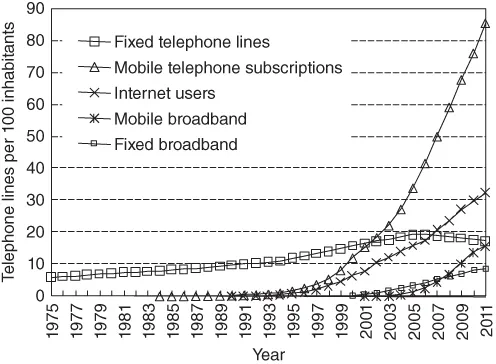
So, today we have several important segments in the ICT globally. Telephony is still one of the primary services, where one can distinguish between fixed telephony and mobile telephony. Further, Internet is usually identified by certain types of services such as WWW, e-mail, peer-to-peer services, and many more, provided in so-called best-effort manner. Best-effort principle is based on connection control by the end point of the communication (called hosts, such as computers, servers, mobile terminals, etc.), where network nodes perform basically routing of all packets from all services without differentiation among them. Finally, Internet requires broadband access, including fixed broadband and mobile broadband, with aim to provide capabilities for different types of services including the most demanding ones regarding the available data rates (i.e., the bandwidth). These five segments form the outlook of today's telecommunications. The number of users for fixed telephony, mobile telephony, individual Internet users, and users with fixed and mobile broadband access to Internet are shown in Figure 1.1 (for more details a reader may refer to [[1]]). It is obvious that mobile telephony has overtaken the number of telephone users from the fixed telephony a decade ago. Hence, the number of mobile users increases exponentially and it is targeting the total population on Earth. Mobile telephony is personal, while fixed telephony is related to a certain location (e.g., a home or an office). Hence, the market capacity for the fixed telephony is several times smaller than the market capacity for the mobile telephony. However, it is likely that mobile telephony will be soon saturated by reaching 100% of the world population. On the other side, the mentioned trend of integration between traditional telecommunications and the Internet, which have been developed separately at the beginning of each of them, is finally resulting in transition of telecommunication world into the Internet world, and vice versa. The number of Internet users is increasing exponentially in the past two decades, almost in parallel with the rise of number of mobile users, as it can be seen in Figure 1.1. The broadband is crucial for the Internet. However the exponential rise of the broadband access started 10 years ago, including fixed broadband access and mobile broadband, and currently it is in a similar position to mobile telephony a decade ago (Figure 1.1). Hence, the highest market potential (in the ICT world) currently is the broadband Internet. Similar to the mobile-to-fixed telephony comparison, the mobile broadband is personal and hence will have faster exponential growth and higher penetration compared to the fixed broadband. On the other side, the fixed broadband will always have a higher capacity due to scarce radio spectrum resources over a given geographical area.
Figure 1.1 Global development of ICT
According to the discussions above, in the following part we will cover the main aspects of the traditional telecom world, and then the traditional Internet world, which converge nowadays to NGN as defined by the ITU (International Telecommunication Union). However, the ITU was established in 1865, when there was only the telegraphy present as a telecommunication service, and hence it was originally founded as the International Telegraph Union. Later the word “Telegraph” in the name of the ITU was replaced with the word “Telecommunication”, with the aim to cover the broader range of services after the invention of telephony and later the invention of radio broadcast and television. Today the ITU is part of the United Nations (UN), as a specialized UN agency for ICT. It is main international organization for telecommunications, which provides harmonization regarding the radio frequency spectrum worldwide through the sector International Telecommunication Union-Radiocommunication (ITU-R). Also, ITU develops technical standards as well as provides harmonization for usage of ICT technologies globally via its sector International Telecommunication Union-Telecommunications (ITU-T). Finally, ITU strive to improve the access to ICTs to developing countries and underserved communities worldwide through its sector International Telecommunication Union-Development (ITU-D), because everyone in the world has a fundamental right to communicate.
1.2 Traditional Telecom World
Traditional telecom world is mainly based on the telephony, which is the most important service in it. Hence, on the way toward the NGN, the telephony is still one of the most influential services. The other important traditional telecommunication service is television (also, coming from the first half of the twentieth century, while main spreading of the television worldwide happened in the second part of the last century). However, from the beginning the tele...
Table of contents
Cover
Title Page
Copyright
Dedication
About the Author
Chapter 1: Introduction
Chapter 2: Internet Fundamentals by IETF
Chapter 3: NGN Standards and Architectures
Chapter 4: Broadband Internet: the Basis for NGN
Chapter 5: Mobile Broadband: Next Generation Mobile Networks
Chapter 6: Quality of Service and Performance
Chapter 7: Service Aspects
Chapter 8: NGN Services
Chapter 9: Transition to NGN and Future Evolution
Chapter 10: Conclusions
Index
End User License Agreement
Trusted by 375,005 students
Access to over 1.5 million titles for a fair monthly price.
Study more efficiently using our study tools.
Frequently asked questions
Yes, you can cancel anytime from the Subscription tab in your account settings on the Perlego website. Your subscription will stay active until the end of your current billing period. Learn how to cancel your subscription
No, books cannot be downloaded as external files, such as PDFs, for use outside of Perlego. However, you can download books within the Perlego app for offline reading on mobile or tablet. Learn how to download books offline
Perlego offers two plans: Essential and Complete
Essential is ideal for learners and professionals who enjoy exploring a wide range of subjects. Access the Essential Library with 800,000+ trusted titles and best-sellers across business, personal growth, and the humanities. Includes unlimited reading time and Standard Read Aloud voice.
Complete: Perfect for advanced learners and researchers needing full, unrestricted access. Unlock 1.5M+ books across hundreds of subjects, including academic and specialized titles. The Complete Plan also includes advanced features like Premium Read Aloud and Research Assistant.
Both plans are available with monthly, semester, or annual billing cycles.
We are an online textbook subscription service, where you can get access to an entire online library for less than the price of a single book per month. With over 1.5 million books across 990+ topics, we’ve got you covered! Learn about our mission
Look out for the read-aloud symbol on your next book to see if you can listen to it. The read-aloud tool reads text aloud for you, highlighting the text as it is being read. You can pause it, speed it up and slow it down. Learn more about Read Aloud
Yes! You can use the Perlego app on both iOS and Android devices to read anytime, anywhere — even offline. Perfect for commutes or when you’re on the go. Please note we cannot support devices running on iOS 13 and Android 7 or earlier. Learn more about using the app
Yes, you can access NGN Architectures, Protocols and Services by Toni Janevski in PDF and/or ePUB format, as well as other popular books in Technology & Engineering & Electrical Engineering & Telecommunications. We have over 1.5 million books available in our catalogue for you to explore.