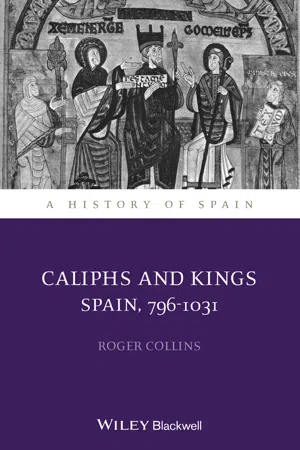
Caliphs and Kings
eBook - ePub

Caliphs and Kings

Spain, 796-1031

  1. English
  2. ePUB (mobile friendly)
  3. Available on iOS & Android
eBook - ePub

Caliphs and Kings

Spain, 796-1031

About this book

CALIPHS AND KINGS: ?SPAIN, 796-1031

The last twenty-five years have seen a renaissance of research and writing on Spanish history. Caliphs and Kings offers a formidable synthesis of existing knowledge as well as an investigation into new historical thinking, perspectives, and methods.

The nearly three-hundred-year rule of the Umayyad dynasty in Spain (756-1031) has been hailed by many as an era of unprecedented harmony and mutual tolerance between the three great religious faiths in the Iberian Peninsula – Christianity, Judaism, and Islam – the like of which has never been seen since. And yet, as this book demonstrates, historical reality defies the myth. Though the middle of the tenth century saw a flowering of artistic culture and sophistication in the Umayyad court and in the city of Córdoba, this period was all too shortlived and localized. Eventually, twenty years of civil war caused the implosion of the Umayyad regime. It is through the forces that divided – not united – the disparate elements in Spanish society that we may best glean its nature and its lessons. Caliphs and Kings is devoted to better understanding those circumstances, as historian Roger Collins takes a fresh look at certainties, both old and new, to strip ninth- and tenth-century Spain of its mythic narrative, revealing the more complex truth beneath.

Frequently asked questions

Yes, you can cancel anytime from the Subscription tab in your account settings on the Perlego website. Your subscription will stay active until the end of your current billing period. Learn how to cancel your subscription.
No, books cannot be downloaded as external files, such as PDFs, for use outside of Perlego. However, you can download books within the Perlego app for offline reading on mobile or tablet. Learn more here.
Perlego offers two plans: Essential and Complete
  • Essential is ideal for learners and professionals who enjoy exploring a wide range of subjects. Access the Essential Library with 800,000+ trusted titles and best-sellers across business, personal growth, and the humanities. Includes unlimited reading time and Standard Read Aloud voice.
  • Complete: Perfect for advanced learners and researchers needing full, unrestricted access. Unlock 1.4M+ books across hundreds of subjects, including academic and specialized titles. The Complete Plan also includes advanced features like Premium Read Aloud and Research Assistant.
Both plans are available with monthly, semester, or annual billing cycles.
We are an online textbook subscription service, where you can get access to an entire online library for less than the price of a single book per month. With over 1 million books across 1000+ topics, we’ve got you covered! Learn more here.
Look out for the read-aloud symbol on your next book to see if you can listen to it. The read-aloud tool reads text aloud for you, highlighting the text as it is being read. You can pause it, speed it up and slow it down. Learn more here.
Yes! You can use the Perlego app on both iOS or Android devices to read anytime, anywhere — even offline. Perfect for commutes or when you’re on the go.
Please note we cannot support devices running on iOS 13 and Android 7 or earlier. Learn more about using the app.
Yes, you can access Caliphs and Kings by Roger Collins in PDF and/or ePUB format, as well as other popular books in History & European Medieval History. We have over one million books available in our catalogue for you to explore.

Information

1
Al-Andalus
War and Society, 796–888
The Annalists
The problems we face in using the Arabic sources for the history of al-Andalus in the ninth to eleventh centuries are both fewer and simpler than those met with in trying to make sense of the preceding period of the conquest, the rule of the governors, and of the first two Umayyads (711–796).1 But we need to understand the purposes for which they were written and the relationships between them. Some of the earliest historical writings in al-Andalus were composed to resolve legal questions rather than provide factual narratives of events for their own sake. By the early part of the tenth century, however, Andalusi historians were motivated by rather different concerns and began using the relatively copious records of the Umayyad court to produce substantial narrative works containing detailed information on a number of specific topics. These included the appointments made by the ruler each year to military commands and to judicial and administrative posts; the deaths of distinguished individuals; and the aim, course, and outcome of any military expeditions, including the numbers of “infidels” killed and captured.2 The practice of compiling such lists goes back to the earliest phases of Islamic historiography in the mid-eighth century.3
Based on such yearly records kept by the Umayyad administration, these narrative histories generally took an annalistic form and structured their content into annual units. Only when a ruler died would this pattern be modified, when reports of his life, his wives, his children, his age and appearance, and the chief ministers who had served him would be included in a round-up section added to the appropriate annal. This pattern of historical writing was definitely not unique to al-Andalus, having first emerged around the middle of the eighth century in Syria, quite possibly influenced by the Syriac tradition of annal writing. It developed gradually into its full-grown form in the work of writers such as al-
abar
(d. 923) in the ‘Abb
sid caliphate from the early ninth century onwards, and its Western equivalents generally followed a generation or more later.4 Indeed, some of the Andalusi historians wrote with the deliberate aim of providing information on Western events largely overlooked by their ‘Abb
sid predecessors. Such a genesis in the official records of the Umayyad court makes the work of these historians extremely valuable, though it has to be accepted that the details given in government reports can be exaggerated, especially when it is a matter of publicizing the dynasty's achievements.
A more serious problem than allowing for propagandistic distortion of the details of military and other achievements is the fact that many of these works have been lost or survive only as fragments preserved in the larger-scale compilations of later generations of historians. Inevitably this raises the question of how such excerpts were made. Were they verbatim or did a later writer edit or condense the text he was borrowing, possibly interpolating other material? In some cases the survival of fragments of a work permits comparisons with the way it was used by later writers and thus reveals how faithful they were to the texts they were copying or excerpting.
For example, only some sections of the work of the most important Andalusi historian for this period, Ibn
ayy
n (d. 1076), have survived intact, but the whole of it was used as a source by a North African annalist, Ibn ‘Idh
r
, who was writing in 1313/4.5 Where direct comparison can be made, it is clear that sometimes Ibn ‘Idh
r
lightly condensed his predecessor's work but did not otherwise change or distort the information he took from it. However, it would seem that Ibn
ayy
n was not Ibn ‘Idh
r
's only source, as the latter's work includes information not found in the earlier author. As he did not name his informants, we can only guess at whom these others may have been. So, we cannot simply use Ibn ‘Idh
r
's text as a means of reconstructing the lost sections of that of Ibn
ayy
n.
A general problem with the narrative sources for the history ...

Table of contents

  1. Cover
  2. Series
  3. Title Page
  4. Copyright
  5. Dedication
  6. Genealogies
  7. Maps
  8. Introduction
  9. Chapter 1: Al-Andalus
  10. Chapter 2: The Asturian Kingdom
  11. Chapter 3: The Christians of al-Andalus
  12. Chapter 4: Monks, Books, and Saints in the Christian North
  13. Chapter 5: Al-Andalus
  14. Chapter 6: The Kingdom of León, 910–1037
  15. Chapter 7: Al-Andalus
  16. Chapter 8: The Kingdom of Navarre and the Pyrenean Counties, 799–1035
  17. Chapter 9: The County of Castile, c.860–1037
  18. Bibliography
  19. Glossary
  20. Acknowledgments
  21. Index