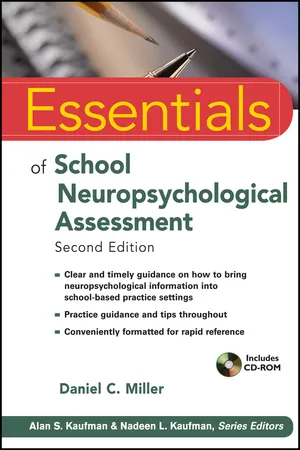
Essentials of School Neuropsychological Assessment
eBook - ePub

Essentials of School Neuropsychological Assessment

  1. English
  2. ePUB (mobile friendly)
  3. Available on iOS & Android
eBook - ePub

Essentials of School Neuropsychological Assessment

About this book

Written by a renowned expert in school neuropsychology, Essentials of School Neuropsychological Assessment, Second Edition is a practical resource presenting school psychologists, educational diagnosticians, and pediatric neuropsychologists with clear coverage and vital information on this evolving area of practice within school psychology. Filled with case studies and guidance for your practice, the Second Edition offers new coverage of major neuropsychological test batteries for children, including NEPSY ®-II; Wechsler Intelligence Scale for Children®, Fourth Edition Integrated; and Delis-Kaplan Executive Function System ™.

Like all the volumes in the Essentials of Psychological Assessment series, this book is designed to help busy mental health professionals quickly acquire the knowledge and skills they need to make optimal use of major psychological assessment instruments. Each concise chapter features numerous callout boxes highlighting key concepts, bulleted points, and extensive illustrative material, as well as test questions that help you gauge and reinforce your grasp of the information covered.

The accompanying CD-ROM provides helpful tools, including sample case studies and searchable databases of neuropsychological tests classified by processing area and conceptual model. Essentials of School Neuropsychological Assessment, Second Edition explores how to identify the need for testing, conduct a neurodevelopmental history, select appropriate assessment instruments, effectively evaluate students, and accurately interpret results.

Frequently asked questions

Yes, you can cancel anytime from the Subscription tab in your account settings on the Perlego website. Your subscription will stay active until the end of your current billing period. Learn how to cancel your subscription.
No, books cannot be downloaded as external files, such as PDFs, for use outside of Perlego. However, you can download books within the Perlego app for offline reading on mobile or tablet. Learn more here.
Perlego offers two plans: Essential and Complete
  • Essential is ideal for learners and professionals who enjoy exploring a wide range of subjects. Access the Essential Library with 800,000+ trusted titles and best-sellers across business, personal growth, and the humanities. Includes unlimited reading time and Standard Read Aloud voice.
  • Complete: Perfect for advanced learners and researchers needing full, unrestricted access. Unlock 1.4M+ books across hundreds of subjects, including academic and specialized titles. The Complete Plan also includes advanced features like Premium Read Aloud and Research Assistant.
Both plans are available with monthly, semester, or annual billing cycles.
We are an online textbook subscription service, where you can get access to an entire online library for less than the price of a single book per month. With over 1 million books across 1000+ topics, we’ve got you covered! Learn more here.
Look out for the read-aloud symbol on your next book to see if you can listen to it. The read-aloud tool reads text aloud for you, highlighting the text as it is being read. You can pause it, speed it up and slow it down. Learn more here.
Yes! You can use the Perlego app on both iOS or Android devices to read anytime, anywhere — even offline. Perfect for commutes or when you’re on the go.
Please note we cannot support devices running on iOS 13 and Android 7 or earlier. Learn more about using the app.
Yes, you can access Essentials of School Neuropsychological Assessment by Daniel C. Miller in PDF and/or ePUB format, as well as other popular books in Psychology & Research & Methodology in Psychology. We have over one million books available in our catalogue for you to explore.

Information

Chapter One
The Emerging Specialization of School Neuropsychology

This first chapter reviews the major reasons why there is an interest in the emerging specialization of school neuropsychology, including the acknowledgment of the neurobiological bases of childhood learning and behavioral disorders, the increased number of children with chronic medical conditions that affect school performance, the increased use of medications with school-age children, the increase in the number of children with severe behavioral and emotional challenges, and the increased emphasis on the identification of processing disorders in children with specific learning disabilities. The chapter also reviews the need for providing neuropsychological assessment and consultation services within the schools. A definition of school neuropsychology is provided and the roles and functions of a school neuropsychologist are outlined. Finally, lists of the recent school neuropsychological publications and scholarly journals, that publish school neuropsychology research are presented.

Reasons Why there is a Growing Interest in School Neuropsychology

There are several reasons why there is a growing interest in school neuropsychology, including: (1) the wealth of research on the neurobiological bases of childhood learning and behavioral disorders; (2) the increased numbers of children in the schools with medical conditions that affect their school performance; (3) the increased use of medications prescribed to children; (4) the increase in the incidence rate of children who had serious educational and behavioral problems; and (5) the increased emphasis on the identification of processing disorders within children diagnosed with a specific learning disability.These reasons will be covered in more detail in this section of the chapter.

Recognition of the Neurobiological Bases of Childhood Learning and Behavioral Disorders

The interest in the biological bases of human behavior is not new to the school psychology profession, but it is becoming more relevant to the current generation of school psychologists. Some of the seasoned veterans or psychology historians suggest that there has always been an interest in the biological bases of behaviors. In fact, the “nature versus nurture” debate is as old as the psychology profession. Some major theorists in our shared past, such as B. F. Skinner and John B. Watson, were strict behaviorists. They believed that observable behavior was the only essential element that needed to be considered in human behavior. The curriculum-based measurement/assessment approach touted by many practitioners today has its theoretical roots in behaviorism.

Don't Forget

Many parents and educators are looking to school psychologists for answers as to why a student is not achieving at grade level or is behaving in socially inappropriate ways, rather than merely receiving a special education diagnosis.
In the late 1950s, researchers came to realize that the behaviorist approaches could not “explain complex mental functions such as language and other perceptual functions” (Gazzaniga, Ivry, & Mangun, 2002, p. 21), and this still holds true today. On the opposite end of the theoretical spectrum were the cognitive psychologists such as George Miller, Noam Chomsky, and Michael Posner, who believed that brain function needed to be considered in understanding human behaviors. Starting in the 1970s and continuing through today, the cognitive psychologists were tremendously aided by the development of neuroimaging techniques. Magnetic resonance imaging (MRI), positron emission tomography (PET), and functional MRI (fMRI) are all useful tools in validating or helping to refine theoretical models of cognition developed by cognitive psychologists.
It is important to acknowledge that the integration of neuropsychological principles into educational practice got off to a rough start. Practitioners who entered the field prior to the 1970s may remember Doman and Delcato's perceptual-motor training (R. Doman, Spitz, Zucman, Delacato, & G. Doman, 1960) for children with “minimal brain dysfunction” or tests such as the Illinois Test of Psycholinguistic Abilities (S. Kirk, McCarthy, & W. Kirk, 1968). These approaches may have had good face validity, but they did not accurately show treatment efficacy for either perceptual-motor deficits or language deficits. These early missteps in integrating neuropsychological principles into educational practice only reinforced the rising role of behaviorism in school psychology (Hynd & Reynolds, 2005). Some contemporary and influential scholars still cite inadequate findings on the early process assessment approach in the 1970s as the basis for current legislative changes to the definition of a specific learning disability (Reschly, Hosp, & Schmied, 2003). Unfortunately, these influential scholars seem to have omitted an impressive body of empirical research in the past 30-plus years that supports the biological bases to the majority of childhood disorders.

Caution

A chief concern among school neuropsychologists is the increased emphasis in these federal laws and national reports on behavioral techniques at the expense of the role that individual differences in cognitive processes play in the child's learning.
After passage of Public Law 94–142 in the 1970s, researchers began to investigate the neurobiological bases of learning disabilities and behavioral disorders (Obrzut & Hynd, 1996). The past 40 years have yielded substantial evidence for the biological bases of behavior. There is strong neurobiological evidence for attention deficit hyperactivity disorders (see Hale et al., 2010, for a review), reading disorders (see Feifer, 2010, for a review), written language disorders (see Berninger, 2010, for a review), mathematics disorders (see Maricle, Psimas-Fraser, Muenke, & Miller, 2010, for a review), pervasive developmental disorders (see Bauman & Kemper, 2005; Dooley, 2010, for reviews), autism spectrum disorders (see Lang, 2010, for a review), and Asperger's disorder (see DeOrnellas, Hood, & Novales, 2010, for a review). See D. Miller (2010) for a comprehensive review of the neurobiological correlates to common childhood developmental disorders, academic disabilities, and processing disorders. School psychologists who want to translate this brain-behavior research into practice are increasingly interested in applying neuropsychological principles into their professional practice.

Increased Number of Children with Medical Conditions that Affect School Performance

An increasing number of children in the schools are affected with known or suspected neurological conditions. Unfortunately, many of these children rarely have their educational needs addressed. Accurate developmental histories may not be available to reflect early developmental concerns, medical conditions, or genetic predispositions.
As an example, if you were to walk into a neonatal intensive care unit, you would find many infants who were born prematurely and with very low birth weight. Many of these infants are so small that you might hold them in the palm of your hand. These infants often spend the first several months of their lives hooked up to ventilators and a mass of other medical moni...

Table of contents

  1. Cover
  2. Table of Contents
  3. Essentials of Psychological Assessment Series
  4. Title
  5. Copyright
  6. Dedication
  7. Foreword
  8. Series Preface
  9. Acknowledgments
  10. Chapter One: The Emerging Specialization of School Neuropsychology
  11. Chapter Two: Historical Influences of Clinical Neuropsychology and School Psychology
  12. Chapter Three: Training and Credentialing in School Neuropsychology
  13. Chapter Four: When to Refer for a School Neuropsychological Assessment
  14. Chapter Five: An Integrated Model for School Neuropsychology Assessment
  15. Chapter Six: School Neuropsychology Report Writing
  16. Chapter Seven: Major School Neuropsychological Test Batteries for Children
  17. Chapter Eight: Clinical Interpretation Guidelines
  18. Chapter Nine: Case Study Illustration
  19. Chapter Ten: Sensorimotor Functions
  20. Chapter Eleven: Visuospatial and Auditory Cognitive Processes
  21. Chapter Twelve: Learning and Memory Cognitive Processes
  22. Chapter Thirteen: Executive Functions
  23. Chapter Fourteen: Attention and Working Memory Facilitators/Inhibitors
  24. Chapter Fifteen: Speed, Fluency, and Efficiency of Processing Facilitators/Inhibitors
  25. Chapter Sixteen: Acquired Knowledge: Acculturation Knowledge and Language Abilities
  26. Chapter Seventeen: Acquired Knowledge
  27. Chapter Eighteen: Future Directions of School Neuropsychological Assessment
  28. Appendix
  29. References
  30. About the Author
  31. Index
  32. About the CD-ROM
  33. Download CD/DVD Content
  34. End User License Agreement