![]()
Part I
BIOMEDICAL NANOMATERIALS
![]()
Chapter 1
Nanoemulsions: Preparation, Stability and Application in Biosciences
Thomas Delmas1 Nicolas Atrux-Tallau1,4 Mathieu Goutayer1 Sang Hoon Han2 Jin Woong Kim3 Jérôme Bibette4
1Capsum, Marseille, France
2Amore-Pacific Co. R&D Center, Bora-dong, Giheung-gu, Yongin-si, Gyeonggi-do, South Korea
3Department of Applied Chemistry, Hanyang University, Gyeonggi-do, South Korea
4ESPCI ParisTech, Lab Colloides and Mat Divises, Paris, France
Abstract
Nanoencapsulation is being thoroughly investigated for the encapsulation and delivery of actives and/or contrast agents. Our approach allows for better solubilization, protection, transportation, and delivery of encapsulated molecules to their biological site of action. This is expected to increase treatment efficiency while reducing possible side effects through dose reduction and/or targeted delivery. Among other nanocarriers, lipid nanoparticles are biocompatible, biodegradable, can be easily produced by up-scalable processes and, depending on the lipid physical state, may allow control of the release of encapsulated molecules.
This chapter will explain how nanoemulsions can be efficiently used as nanocarriers for drug delivery and imaging. We will first emphasize the importance of specific formulation to reach long-term physical stability of the nanoparticles in simple and more complex formula. We will then highlight how the lipids’ physical state dramatically impacts the actives encapsulation and release behaviors. Finally, we will explore the interaction of nanoemulsion with biological media in terms of biocompatibility and targeting possibilities. Differences between the two main application domains envisaged, namely pharmaceutics and cosmetics, are detailed, and implications for nanoemulsion preparation are discussed.
Keywords: Nanoemulsion lipid nanoparticles entropic stabilization trapped species active encapsulation release kinetics passive targeting active targeting
1.1 Introduction
The use of nanostructured materials is envisioned to revolutionize biosciences and biomedical applications through earlier and more acute diagnosis, or personalized and controlled therapy [1, 2]. For this purpose, numerous nanocarrier types have been proposed as delivery vehicles for contrast agents or drug molecules for all possible administration routes [3]. Nanocarriers can indeed significantly improve therapeutic efficiency while limiting possible undesirable effects, through specific delivery to the pathological zone and control over active molecules release [4]. One of the first requirements for these systems is to present an absolute harmless-ness and biocompatibility. It is for this reason that the scientific community has principally focused its work on the development of organic particles.
Among a wide variety of nanocarriers, lipid-based systems have aroused interest because of their composition which is based on natural lipids already widely present in the organism, and therefore confers such carriers with high biocompatibility and biodegradability [5, 6]. As previously shown, these lipid nanocarriers can furthermore be easily produced by versatile and up-scalable processes [7-9], and can provide the possibility to control actives encapsulation and release [10].
Hydrophobic molecules encapsulation favors the use of lipid nanospheres, instead of the originally developed nanocapsule initiated by the liposomes discovery in 1964 [11]. The typical structure of a lipid nanosphere is directly derived from nanoemulsion structure, typically relying on a lipid core surrounded by a membrane of diverse surfactants. The history of lipid nanospheres development has followed the understanding of the importance of lipids physical state:
- Classical nanoemulsions were the first lipid nanospheres to be introduced decades ago. These systems were composed of a liquid lipid core, stabilized by a membrane of surfactants. Despite the interest of these initially developed systems for solubilization of lipophilic actives in aqueous phases, few finally reached the market due to formulation issues. Indeed, these systems used to suffer from low colloidal stability (even though this has been dramatically improved as will be shown here), and sustained release of encapsulated actives is difficult to achieve due to the low viscosity of the dispersed phase [12], high surface/volume ratio, and low rigidity of the surfactants membrane. This generally leads to the rapid diffusion of the drugs out of the droplets.
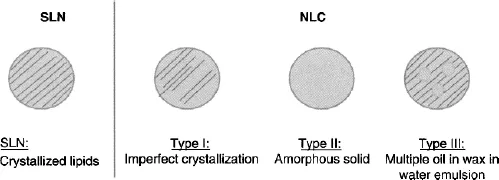
- Solid Lipid Nanoparticles (SLN) have thus been proposed to overcome these limitations. These systems present a structure identical to nanoemulsions. However, the internal lipids forming the nanoparticle core are crystalline lipids here, conferring a solid nature to the particle’s core (Figure 1.1). SLN are thus generally composed of pure long chain triglycerides, wax or long chain carboxylic acids [8]. They can be stabilized by all types of surfactants; their choice being principally dictated by the administration route envisaged [8]. SLN fabrication processes are similar to nanoemulsions, but the lipid phase is generally heated above the lipids fusion temperature to favor droplet size reduction. Lipid crystallization then occurs following cooling and storage. However, despite high expectations of such systems for prolonged release of hydrophobic molecules, SLN have shown limited controllability. As will be further explained, crystallization of the lipid phase generally leads to active/lipid phase separation and subsequent expulsion, providing high burst release [13, 14].
- Nanostructured Lipid Carriers (NLC) were introduced as a compromise. Composed of a mixture of liquid and solid lipids, the NLC core presents an imperfect crystallization which favors better encapsulation ratio thanks to lower crystallinity, while allowing control over release kinetics through the solid character of the lipid phase [15]. Three different types of NLC have been proposed (Figure 1.1): 1) the imperfect type, whose crystallinity is lowered by creating imperfections in the crystal lattices; 2) the structureless type, which is solid but amorphous; and 3) the multiple O/F/W type, in which small droplets of liquid lipids are phase separated in the solid matrix [16]. Although these 3 types can theoretically be obtained, the mixture of spatially incompatible lipids generally leads to the obtainment of the first type NLC [17, 18]. Several studies have reported the obtainment of the forms II and III, however, there is discrepancy in the conclusions. Some authors thus account for supercooled melt rather than amorphous solid particles concerning the structureless type [15, 19, 20]. Similarly, the same system was described as a typical multiple oil in fat in water type (O/F/W) [21], while a complete demixing of oil from wax occurs in the so-called “nanospoon structure” [22–24].
The further development of these nanoemulsion-based systems for application in biosciences should rely on the complete understanding of nanoemulsion physicochemical properties, production procedures, stability rules, and on control over the internal lipids physical state. We will present here a general approach that can be followed to formulate such systems aiming for biomedical applications. After giving a thermodynamic definition of nanoemulsions, we will first describe possible production procedures and explain the general rules that need to be followed to formulate stable nanoemulsions. We will then investigate the role of the lipids physical state over particle stability, actives encapsulation and release, along with the biocompatibility of the particles. Next we will show how this understanding allows for finely tuning nanoemulsions properties in order to have control over the applicative properties of biodistribution and actives encapsulation/release. Two main domains of application are then detailed through examples of nanoemulsion-based systems for biomedical imaging and drug delivery in the pharmaceutical field, and topical delivery for cosmetics.
1.2 Nanoemulsion: A Thermodynamic Definition and Its Practical Implications
1.2.1 Generalities on Emulsions
An emulsion is a mixture of two immiscible liquids, one liquid being dispersed in the other as droplets, stabilized by surfactants. The size of the droplets may vary from the characteristic size of micelles (10–20 nm) to diameters larger than the micrometer. This mainly depends on the surface tension of the system and the energy provided by the production process [25]. Although direct (oil in water) and inverse (water in oil) similarly exist, we will focus on direct emulsions.
- Interest: Emulsions are largely used to solubilize and transport substances in a continuous phase in which they are normally not soluble: hydrophobic substances can, for instance, be easily solubilized in water without the use of any solvents [25, 26]. Such an approach is of high interest for surface treatment like route surfacing or painting; the aim being to depose hydrophobic substances onto surfaces through a continuous water phase that will evaporate, and form a film by fusion between adjacent droplets. Emulsions are also widely used for their rheological properties: it is indeed possible to change liquid solutions into semi-solid formulations such as gels or creams, property largely used in the food and pharmaceutical/cosmetics industry; or, inversely, to make macroscopic solid become easily spreadable, such as bitumen for route surfacing.
- Production: Most emulsion systems generally require energy for their formation. One part of it allows overcoming the surface-free energy required to increase the interface between the two phases (ΔG = γΔA; with ΔG, free energy of the system; γ, surface tension; ΔA, created interface area) and finely disperse one phase into the other. The other important part is also used to overcome the viscous resistance along the scission of large globules into small droplets. Finally, the last part is simply lost through dissipation by the Joule effect. Different methods exist and are already used at a laboratory- and industrial-scale: mechanical agitation, high pressure homogenizer or ultrasonication and microfluidics systems [25, 26].
- Stability: Once formed, emulsions can present highly different life-time, depending on their composition and their production procedure. This stability can thus vary from a few hours to more than a year [25, 27, 28]. Among the most important parameters are the mutual solubility of the two phases and the surfactant(s) type(s) and concentration(s) [25, 27]. Indeed, different phenomena can lead the system to destabilize: some of them rely on particles aggregation and gravitation, and are reversible; others, related to droplets size evolutio...