Statistical Robust Design
eBook - ePub

Statistical Robust Design

An Industrial Perspective

  1. English
  2. ePUB (mobile friendly)
  3. Available on iOS & Android
eBook - ePub

Statistical Robust Design

An Industrial Perspective

About this book

A UNIQUELY PRACTICAL APPROACH TO ROBUST DESIGN FROM A STATISTICAL AND ENGINEERING PERSPECTIVE

Variation in environment, usage conditions, and the manufacturing process has long presented a challenge in product engineering, and reducing variation is universally recognized as a key to improving reliability and productivity. One key and cost-effective way to achieve this is by robust design – making the product as insensitive as possible to variation.

With Design for Six Sigma training programs primarily in mind, the author of this book offers practical examples that will help to guide product engineers through every stage of experimental design: formulating problems, planning experiments, and analysing data. He discusses both physical and virtual techniques, and includes numerous exercises and solutions that make the book an ideal resource for teaching or self-study.

  • Presents a practical approach to robust design through design of experiments.
  • Offers a balance between statistical and industrial aspects of robust design.
  • Includes practical exercises, making the book useful for teaching.
  • Covers both physical and virtual approaches to robust design.
  • Supported by an accompanying website www.wiley/com/go/robust featuring MATLAB scripts and solutions to exercises.
  • Written by an experienced industrial design practitioner.

This book's state of the art perspective will be of benefit to practitioners of robust design in industry, consultants providing training in Design for Six Sigma, and quality engineers. It will also be a valuable resource for specialized university courses in statistics or quality engineering.

Frequently asked questions

Yes, you can cancel anytime from the Subscription tab in your account settings on the Perlego website. Your subscription will stay active until the end of your current billing period. Learn how to cancel your subscription.
No, books cannot be downloaded as external files, such as PDFs, for use outside of Perlego. However, you can download books within the Perlego app for offline reading on mobile or tablet. Learn more here.
Perlego offers two plans: Essential and Complete
  • Essential is ideal for learners and professionals who enjoy exploring a wide range of subjects. Access the Essential Library with 800,000+ trusted titles and best-sellers across business, personal growth, and the humanities. Includes unlimited reading time and Standard Read Aloud voice.
  • Complete: Perfect for advanced learners and researchers needing full, unrestricted access. Unlock 1.4M+ books across hundreds of subjects, including academic and specialized titles. The Complete Plan also includes advanced features like Premium Read Aloud and Research Assistant.
Both plans are available with monthly, semester, or annual billing cycles.
We are an online textbook subscription service, where you can get access to an entire online library for less than the price of a single book per month. With over 1 million books across 1000+ topics, we’ve got you covered! Learn more here.
Look out for the read-aloud symbol on your next book to see if you can listen to it. The read-aloud tool reads text aloud for you, highlighting the text as it is being read. You can pause it, speed it up and slow it down. Learn more here.
Yes! You can use the Perlego app on both iOS or Android devices to read anytime, anywhere — even offline. Perfect for commutes or when you’re on the go.
Please note we cannot support devices running on iOS 13 and Android 7 or earlier. Learn more about using the app.
Yes, you can access Statistical Robust Design by Magnus Arner in PDF and/or ePUB format, as well as other popular books in Mathematics & Probability & Statistics. We have over one million books available in our catalogue for you to explore.

Information

Publisher
Wiley
Year
2014
Print ISBN
9781118625033
eBook ISBN
9781118841952
1
What is robust design?
1.1 The importance of small variation
When mass production started in the dawn of the industrial revolution, variation came in the focal point of interest. An early example that illustrates this concerns mass production of guns. The French gunsmith Honoré le Blanc realized the importance for guns to have interchangeable parts. His solution was the invention of a system for making gun parts in a standardized way. The problem that challenged le Blanc is the same as in any modern day manufacturing, as, for example, in the production of bolts and nuts. It shall be possible to pick a bolt and a nut at random that fit together. This requires that the variation in diameter, in roundness, and in thread pitch is small from bolt to bolt and from nut to nut. Unless this is the case, there will be a substantial amount of scrapping, or even worse bolts that crack or fall off while they are in use.
Before the industrial revolution, this problem was handled by good craftsmen. In the industrial era, this was not an option anymore. The importance of managing the variation became obvious. Several approaches emerged. Specifying the tolerance limits was one of them and even if the gunsmith le Blanc did not get many immediate followers in France, some Americans saw the potential of his ideas and implemented them at the armoury in Springfield. This is sometimes considered as the birth of tolerance limits (which is not quite true as tolerance limits are much older than this).
To quote Edward Deming, a forefront figure in quality engineering, ‘Variation is the enemy of quality.’ The bolt and the nut is one example. Another one is thickness variation of the plastic film on the inside of a milk package–a plastic film preventing the beverage from coming in contact with the aluminium foil that is present in most milk (and juice) packages. If this thickness varies too much, it may occasionally happen that there is a point with direct contact between the beverage and the aluminium foil. However, it is not the fact that there is a contact point that should be the centre of interest. The focus should rather be the size of the film thickness variation. The contact point is just a symptom of this problem.
Investigations show that a substantial part of all failures observed on products in general are caused by variation. With this in mind it is obvious that variation needs to be addressed and reduced. The issue is just how.
This book is about random variation, or more specifically how to reduce random variation in a response variable y, but not just any way to reduce this variation. It will not be about tightening tolerances, not about feedback control systems, and not sorting units outside the tolerance limits. The focus is solely on preventing variation to propagate. It is this approach to variation that is called robust design.
1.2 Variance reduction


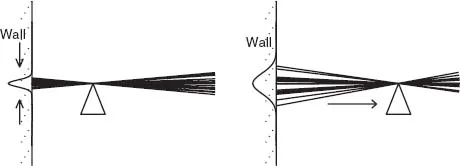
Example 1.1 Consider a bar that is attached to a wall. There is a support to the bar and a random variation in the insertion point in the wall, as sketched in Figure 1.1. We are interested in the position (x, y) of the end point of the bar and that its variation is small.
Figure 1.1 A bar is attached to a wall. There is a support to keep it in place. If there is a variation in the insertion point, there will be a variation in the end point.
c01f001
The variation of the end point position can be reduced in two fundamentally different ways. One is to reduce the variation of the insertion point in the wall. It may be costly. Typically it can involve investment in new and better equipment. However, it might be another way to reduce the variation of the end point position, namely to move the support. In that way the design becomes less sensitive to the variation in the insertion point (Figure 1.2). This is what we mean by robust design: to make the variation of the output insensitive (robust) against incoming variation.
Figure 1.2 A bar is attached to a wall. The variation in the end point can be reduced in two fundamentally different ways, namely by reducing the incoming variation or by making the design robust against this variation.
c01f002


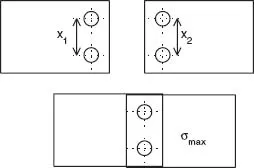
Example 1.2 Two metal sheets are attached to each other. There are two holes in each one and they are attached to each other using two bolts (Figure 1.3). Assume that the maximum stress σmax in the metal sheets is of interest to us. A small variation in the position of the holes, or rather distance between them, affects this stress.
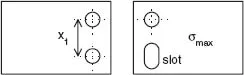
Suppose that this stress should be minimized. This can be achieved by increasing the precision of the positions of the holes. It can also be achieved by changing the design so that one hole is exchanged for a slot (Figure 1.4). In that way, the variation in the response, the maximum stress, is decreased without reducing the variation in the sources of variation, the hole positions. The stress is robust to the hole position.
Figure 1.3 Two metal sheets are mounted together. Since there is a variation in the attachment position, there will be a variation in the maximum stress.
c01f003
Figure 1.4 Exchanging one hole for a slot will make the stress robust against the variation in the hole position.
c01f004
We have seen two examples of robust design, the end point of the bar and the stress of the metal sheets. For both of them, ways to reduce the variation of the output without reducing or removing the original source of variation were pointed out.
In robust design, the original source of variation is called noise. This noise is typically sources of variation that the engineer cannot remove or even reduce, or something that can be reduced but at a considerable cost.
1.3 Variation propagation
The essence of robust design is to make use of nonlinearities in the transfer function y = g(x, z) in such a way that variation in the noise z is prevented from propagating. The key is in the derivative of the transfer function. We will study how this can be expressed mathematically.
Assume that Z is a random variable with mean μz and standard deviation σz and that x is a nonrandom variable. F...

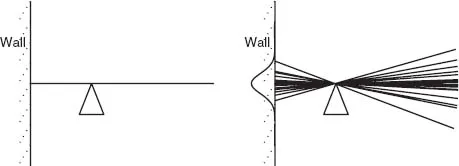
Table of contents

  1. Cover
  2. Title Page
  3. Copyright
  4. Preface
  5. Chapter 1: What is robust design?
  6. Chapter 2: DOE for robust design, part 1
  7. Chapter 3: Noise and control factors
  8. Chapter 4: Response, signal, and P diagrams
  9. Chapter 5: DOE for robust design, part 2
  10. Chapter 6: Smaller-the-better and larger-the-better
  11. Chapter 7: Regression for robust design
  12. Chapter 8: Mathematics of robust design
  13. Chapter 9: Design and analysis of computer experiments
  14. Chapter 10: Monte Carlo methods for robust design
  15. Chapter 11: Taguchi and his ideas on robust design
  16. Appendix A: Loss functions
  17. Appendix B: Data for chapter 2
  18. Appendix C: Data for chapter 5
  19. Appendix D: Data for chapter 6
  20. Index