- English
- ePUB (mobile friendly)
- Available on iOS & Android
eBook - ePub
The Consulting Veterinary Nurse
About this book
The Consulting Veterinary Nurse is an invaluable source of information for all veterinary nurses setting up and conducting their own nursing clinics in small animal practice. From the basics of setting up the consulting room to running and marketing individual clinics, this book provides a comprehensive coverage of the role of the consulting veterinary nurse. A large section of the book details specific clinics run by nurses, including nutritional assessments, behavioural clinics, puppy parties, seasonal information campaigns, senior pet clinics and medical clinics for a full range of conditions from arthritis and dental problems to epilepsy and cancer. A chapter specifically on rabbit clinics is also included.
Written by an experienced senior veterinary nurse, this is a vital guide for all veterinary nurses seeking to develop their consulting role and contribute effectively to the long-term success of their practice.
KEY FEATURES
- Provides a comprehensive guide to the role of the consulting veterinary nurse
- Details specific nutritional, medical and behavioural clinics run by nurses
- Includes advice on presentation, marketing and communicating with clients
- Discusses client compliance and internal procedure and protocol
- Contains sample diet history sheets and unit conversion charts for use in practice
- Endorsed by the British Veterinary Nursing Association
Frequently asked questions
Yes, you can cancel anytime from the Subscription tab in your account settings on the Perlego website. Your subscription will stay active until the end of your current billing period. Learn how to cancel your subscription.
No, books cannot be downloaded as external files, such as PDFs, for use outside of Perlego. However, you can download books within the Perlego app for offline reading on mobile or tablet. Learn more here.
Perlego offers two plans: Essential and Complete
- Essential is ideal for learners and professionals who enjoy exploring a wide range of subjects. Access the Essential Library with 800,000+ trusted titles and best-sellers across business, personal growth, and the humanities. Includes unlimited reading time and Standard Read Aloud voice.
- Complete: Perfect for advanced learners and researchers needing full, unrestricted access. Unlock 1.4M+ books across hundreds of subjects, including academic and specialized titles. The Complete Plan also includes advanced features like Premium Read Aloud and Research Assistant.
We are an online textbook subscription service, where you can get access to an entire online library for less than the price of a single book per month. With over 1 million books across 1000+ topics, we’ve got you covered! Learn more here.
Look out for the read-aloud symbol on your next book to see if you can listen to it. The read-aloud tool reads text aloud for you, highlighting the text as it is being read. You can pause it, speed it up and slow it down. Learn more here.
Yes! You can use the Perlego app on both iOS or Android devices to read anytime, anywhere — even offline. Perfect for commutes or when you’re on the go.
Please note we cannot support devices running on iOS 13 and Android 7 or earlier. Learn more about using the app.
Please note we cannot support devices running on iOS 13 and Android 7 or earlier. Learn more about using the app.
Yes, you can access The Consulting Veterinary Nurse by Nicola Ackerman in PDF and/or ePUB format, as well as other popular books in Medicine & Veterinary Medicine. We have over one million books available in our catalogue for you to explore.
Information
The Role of the Nurse in the Veterinary Practice
1
Ethics
The role of the veterinary nurse has evolved into a regulated profession. A registered veterinary nurse (RVN) is regulated by the Royal College of Veterinary Surgeons under the Veterinary Surgeons Act 1966 (VSA). A solid understanding of this legislation is required in order to ensure that your actions are not only within the law but also in line with the professional code of conduct.
As a consulting nurse it is important to know your own limits, both to be within the law and not to exceed your own personal limitations. Under the VSA only veterinary surgeons are permitted to make a diagnosis. When examining an animal or answering an owner’s questions, you must take care in the area of diagnosis. The veterinary nurse is permitted to inform the owner of the clinical symptoms that the animal is displaying, such as weight loss, increased thirst, tachypnoea, anaemia. You can discuss conditions that display these symptoms, and give guidance on what steps the owner needs to take next – for example, consultation with a veterinary surgeon. If it is likely that the animal will require further investigations, such as blood tests, the owner should be advised that this may occur in the veterinary consultation and the owner can prepare the animal if required; for example, they can pre-starve the patient rather than having to come back for an additional appointment.
Suitably Qualified Persons
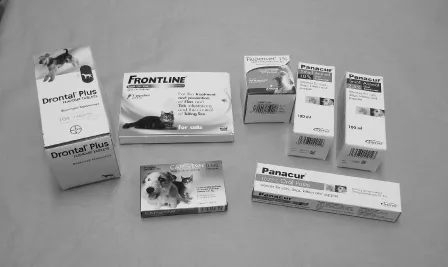
It is useful for veterinary nurses to have the ‘suitably qualified person’ (SQP) qualification in order to prescribe and dispense appropriate medicines for animals. The SQP qualification is regulated by the Animal Medicines Training Regulatory Authority (AMTRA) and requires annual retention fees alongside continued professional development that has been approved by AMTRA. Many anthelmintics are prescription-only medicine (POM-VPS) or in the non-food animal (NFA-VPS) category, which means they can be prescribed by a veterinary nurse with the appropriate SQP qualification. It is necessary for a nurse who conducts clinics to hold this qualification, so that appropriate anthelmintics can be given without needing to consult the veterinary surgeon (Figure 1.1).
Figure 1.1 Example of anthelmintics that SQPs can prescribe.
One of the roles of the veterinary nurse is to ensure compliance with recommendations given by the veterinary surgeon. Sometimes this can refer to medications, and you should confirm with the owner that they are able to administer the medications that have been prescribed. In some cases a different format of medication, such as liquid instead of tablets, can be helpful. These cases require not just an initialled change to the prescription, but a separate prescription that must be written by the veterinary surgeon.
When animals are presented to the veterinary nurse for a repeat of injectable medications a veterinary surgeon stills needs to be present in the building as you are administering the medication under veterinary direction. The veterinary surgeon should be in a position to intervene if required, even after they have prescribed the medication.
As an RVN is it vital to have personal indemnity insurance. RVNs are responsible for their own actions, and this includes any work undertaken within a consultation or clinic. Indemnity insurance for RVNs can be included under the veterinary practice’s insurance policy for all staff, or as a personal policy for those who are self-employed. Self-employed locum nurses have to ensure that they are adequately insured.
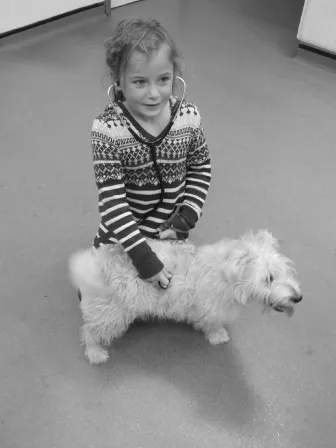
During a consultation, the person conducting the consultation is responsible for the health and safety of all the people in the room; this includes the client. This means that if the client is hurt, even if by their own pet, the practice is responsible. Any injuries, such as bites or scratches, should be entered into the practice’s Accident Book. It is therefore prudent to ask a colleague to restrain any animals that are not being adequately cooperative. If children are being unruly, you are within your rights to request the parent/guardian to ask their children to behave. If consultations are going to be lengthy, activities to keep children occupied can be a useful distraction. Pictures to colour in, or a pretend ‘vet kit’ with a stuffed toy, can be a great hit with younger children (Figure 1.2). The pictures that they draw or colour can be put up on the wall or notice board.
Figure 1.2 Entertainment for children can prove to be a useful distraction during lengthy consultations.
2
Consulting Room and Literature
When conducting their own nurse clinics or consultations, nurses need to portray themselves as professionals. This includes how and where the nursing consultations are held. Having to conduct a consultation in the waiting room or preparation room does not portray the person holding the consultation as professional. If you are conducting your own consultations then it is important to have a room dedicated for this purpose.
The nurses’s consulting room, like a veterinary surgeon’s consulting room, needs to be clean, tidy and fit for purpose. All of the equipment that you will require to conduct the consultation needs to be in working order and easily to hand (see Box 2.1). All other members of staff, especially receptionists, need to be made aware that during the specified block of time this consulting room is to be kept solely for the use of nurse consultants.
Box 2.1 Equipment required for the consulting room
- Microchip scanner and microchips
- Various types of nail clippers
- Bandaging materials
- Grooming combs and brushes
- Toothbrushes and paste
- Leaflets
- Pen, and paper to write on
- Slip lead
- Suture and staple removers
- Weighing scales
- Thermometer
- Vaseline
- Gloves
- Cotton wool
- Table cleaning disinfectants
- Hibiscrub
- Tape measure
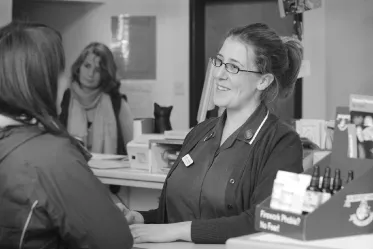
On many occasions clients turn up to the practice in person without an appointment, or telephone in wanting advice. You should always make an effort to speak to these clients; if it is not possible to speak to them immediately, you should offer to contact them later (Figure 2.1). Receptionists should take appropriate contact details and/or make an appointment for the client to bring their pet in to see you. The consulting veterinary nurse should appear as approachable as possible.
Figure 2.1 Always be happy to speak to clients in reception.
Environmental factors within the consulting room are also important. It is important for the room to have good ventilation and temperature control (Figure 2.2).
Figure 2.2 The consulting room needs to be clean and ventilated.
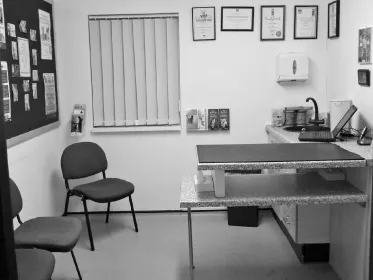
Some consultations may be lengthy – for example, an initial consultation for an obesity clinic. It is therefore important to have chairs in the consulting room, as some clients will prefer to sit down.
Literature
Most clients will find it difficult to remember everything that is said to them in the course of a consultation. It is helpful to give clients handouts on what you have been discussing, and in some cases to give specific written instructions. When clients walk out of the consultation room with information in hand, they have a perception that they have received better value for money than if they just walk out empty-handed. Clients who have received written instructions, either a handout or specific written instructions, are more likely to comply with the instructions given to them.
The literature that you decide to use in your consultations with clients needs to be of a high standard. There are two views of what types of literature should be used. One approach is to use only literature that is produced by the veterinary practice itself, with the practice’s branding on it. In this case all the literature is in line with your practice policy, and you can be completely at ease with what is written there. The other approach is to use literature that is produced by manufacturing companies. This is generally well written and produced to a very high standard, but sometimes it is written around a specific product, rather than around a condition, which can be a disadvantage. Many pharmaceutical companies are now producing condition-specific literature, because of the restrictions on advertising of prescription-only veterinary medications (POM-V) directly to pet owners.
Any equipment you may need during the consultation needs to be present in the consulting room. All equipment needs to ...
Table of contents
- Cover
- Title page
- Copyright page
- Foreword
- Abbreviations
- Introduction
- Acknowledgements
- Part I: The Role of the Nurse in the Veterinary Practice
- Part II: Nutrition and Diet
- Part III: Behavioural Issues
- Part IV: ‘Well Pet’ Clinics
- Part V: Medical Clinics
- Appendix 1 Diet History Sheet
- Appendix 2 Unit Conversion Tables
- Glossary
- Index
- Eula