![]()
Chapter 1
What Are your Natural Training Strengths?
Your strengths are an expression of who you are. They are connected to the way you think, perceive, and evaluate the world around you. Marcus Buckingham, who is often referred to as the leader of the “strengths revolution,” points out that our strengths are a composite of natural talent, skill, and knowledge. In other words, your strengths are directly linked to innate abilities (a talent for reading others or seeing the big picture) and the skills/knowledge (effective coaching skills or strategic planning skills) that you bring to the table.
For example, I have a friend who is a truly masterful networker. She has used her talent to generate a great deal of knowledge—connections and relationships she can tap into when needed. The skill she has developed is the methodical way she meets, greets, and follows up with her contacts. Taken together my friend’s strength has given her a network of valuable contacts. On the other hand, networking is not one of my natural strengths. Yet, I have managed to acquire the needed skills and knowledge to thrive in business through observing and learning from masterful networkers (like my friend) and figuring out what works for me.
The Trainer’s Strengths
The ability to effortlessly deliver engaging and transforming learning experiences is a rare gift. Most trainers and instructional designers come to the craft with a natural ability in one or more training approaches (dynamic storytelling or organized delivery, for example). Other approaches require us to build knowledge and skills, just as I had to work on my networking skills.
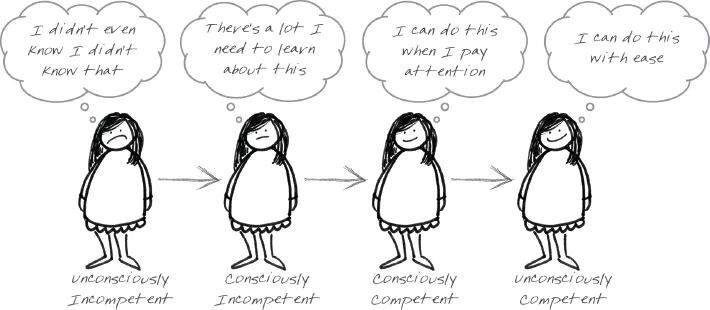
As we develop skill, we move though a predictable process. The Conscious Competency Spectrum describes the stages we move through as we develop our abilities and build skill and knowledge. Learners begin in a stage of “unconscious incompetence” and move to the final stage of “unconscious competence” (Chapman).
In the unconsciously incompetent stage, we have little to no knowledge of a given subject and are often unaware of what we don’t know. When we discover how much we don’t know, we become consciously incompetent. We seek out new information and practice new skills, which brings us to the stage of being consciously competent. And if we continue to practice and gain mastery, we move to the stage of unconsciously incompetent.
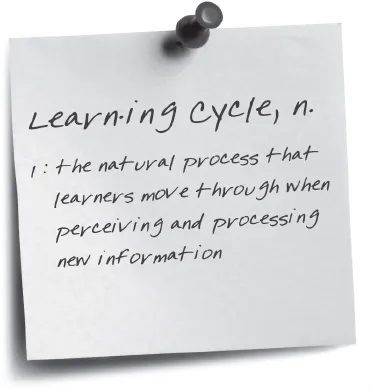
In this book, you will become aware of skills you are unconsciously competent (even masterful) in because they are an extension of your natural strengths. And you will become aware of skills that, if practiced, can greatly enhance your ability to perform the real job of a trainer, which is to move learners through a complete learning cycle.
The Conscious Competency Spectrum
Job of the Trainer
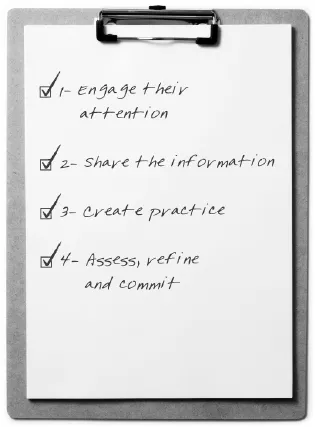
As a trainer, you move learners through the competence spectrum by creating an opportunity for them to discover what they know, what they don’t know, and the value of knowing more. You do this by guiding the learner through a complete learning cycle that includes four essential steps.
1 You gain the learners’ attention and generate interest in the content so that they are aware of the value of the learning and appreciate that there is room for personal growth. If you have ever tried to “teach” people something they believe they already know, you know this is a “not to be missed” step in the learning cycle.
2 Next, you share information that will enable the learner to move into application. One of the most important jobs during this stage is to ensure that the learner is not overwhelmed with information. To accomplish this, the content must be refined to the essential information and delivered with clear and consistent organization.
3 You create an opportunity for learners to practice and build skill. As the learners practice and gain skill in real-world application, the job of the trainer is to coach and assist them as they evaluate their own applications.
4 To ensure performance transfer, you create an opportunity for the learners to assess their applications, refine for implementation, and commit to next steps. In this final step, you prepare the learners to move out into the real world and generate performance results.
Value of This Book
This book will share with you the training skills you need to deliver a complete learning experience that appeals to all learning styles while moving learners through a complete learning cycle. To do this well, you must competently and confidently guide learners through the four unique parts of the learning cycle. You will discover what must happen for real learning transfer to occur. You will learn how to build on your strengths to design and deliver the four critical parts of the learning experience. You will have an opportunity to assess your training strengths using the 4MAT® Training Style Inventory (TRSI). As you move through this book, we’ll explore the four critical parts of the learning cycle and show you how to build upon your existing strengths to enable you to be masterful in leading a learning experience that appeals to all learning styles.
Let’s Get Started: Taking the Training Style Inventory® (TRSI®)
In the companion site to this book, you will access your personal 4MAT Training Style Inventory. The Training Style Inventory will assess your strengths in four critical training approaches. You can access the Training Style Inventory (TRSI) at www.trainers-guide-to-learning-styles.com. Use the access code found in the last section of this book.
Once you have completed the Training Style Inventory, you will have access to a comprehensive Training Strengths Report and Action Guide. This guide features an in-depth analysis of your training style strengths and will help you understand how your strengths relate to the diversity of learning style preferences. You’ll discover what comes naturally to you and discover the dangers of over-using your natural strengths.
The Action Guide also provides you with skill development ...