A comprehensive guide to financial planning and venture fundraising for tech entrepreneurs
As technology progresses, impacting our daily lives in more and greater ways, technology start-ups come and go at a dizzying pace. There are plenty of opportunities out there for anyone with a great idea, but it takes much more than a great idea to make your tech start-up a success. In addition to creativity and new ideas, being a successful tech entrepreneur requires strategic decision-making in terms of business planning, financial planning, negotiations, and corporate governance.
This book serves as a thought-provoking guide that helps tech entrepreneurs avoid the dangers inherent in business start-ups in general and the treacherous realm of venture capital in particular. This book is the ideal reference for anyone who wants to overcome the challenges of running a start-up from incubation to exit.
Excellent advice for tech entrepreneurs written in layman's terms
Written by an author with more than fifteen years of experience as a founder and co-founder of tech start-ups in the U.S. and Asia
Designed to fill the role of an experienced mentor for tech entrepreneurs
For first-time founders of tech start-ups requiring venture capital, Start-Up Guide for the Technopreneur is the perfect resource.
An appropriate starting point for this book is a review of some basic financial terms and concepts that will be useful in understanding the principal themes to be found in the ensuing chxpters. This chapter consists of seven sections: fundraising stages, risk/return, types of funding, capital structure, intellectual property, valuation, and exit strategy.
Fundraising Stages
According to standard definitions, a company’s fundraising stage is determined by a number of factors, including the number of employees, amount of revenues, capitalization, profit, and the status of product development. For purposes of this book, it is more accurate and useful to define a fundraising stage as a period during which the cost of funds, whether in terms of equity dilution or rate of borrowing interest, is comparable throughout such period. Reaching the next fundraising stage requires progression to the next stage of business development and/or attainment of the necessary financial objectives permitting the solicitation of additional capital at more favorable terms vis-à-vis a higher valuation or a lower interest rate that can be secured from prospective lenders. The significant implication is the derived value of raising funds efficiently via raising only the necessary funds in each funding round at the lowest cost of capital currently available to reach the next fundraising stage. Determining the “necessary” amount of funds and identifying the sources of funding currently offering the lowest costs of capital requires a financial plan.
This section consists of four subsections, beginning with the necessary preparation required during a prefunding period followed by the three successive fundraising stages: seed, series A, and series B.
Prefunding Period
The prefunding period is the time between the conception of business idea and the organization of this idea into a business plan. A series of important questions must be answered during this stage:
Is your idea a possible solution to an identifiable problem?
Are you uniquely qualified to execute such an idea?
Who would benefit from effective execution of your idea?
Without an affirmative answer to these questions, the idea, although possibly worthy and interesting, may not present a business opportunity for you and prospective investors. If you can answer yes to these questions, the next issues must to be considered:
How much development time is required for your product or service? This consideration is particularly important in the fast-changing world of technology. If you expect it will take five years to develop something that would almost certainly be obsolete at the end of those five years, perhaps your business idea is not meant to be.
Do like-minded individuals/competitors exist? If you and a partner want to attempt to do something a big company like Yahoo! has already decided to spend millions of dollars on for research and development (R&D), perhaps you are contemplating an overly ambitious endeavor.
How willing are you to pursue this business opportunity and accept all the inherent sacrifices and risk? Are you willing to have a Ramen noodle lifestyle, living a meager existence in which all of your earnings or savings is allocated to funding the venture at the expense of other personal spending options?
Do you have considerable family obligations, such as kids demanding your time, a spouse preferring a sufficient and stable income?
What if this business venture does not succeed? How much have you risked? Is there a contingency plan for you?
What if it does succeed and requires heavy and extended duty? Are you capable of making such a commitment?
Can you reasonably envision investors assuming the risks and potential employees sharing your passion? Will others be willing to patiently share in your pain and suffering?
The main objective of this stage is to write a business plan that can provide answers to the first set of questions and offer a framework on how the idea can be executed.
Seed Funding Stage
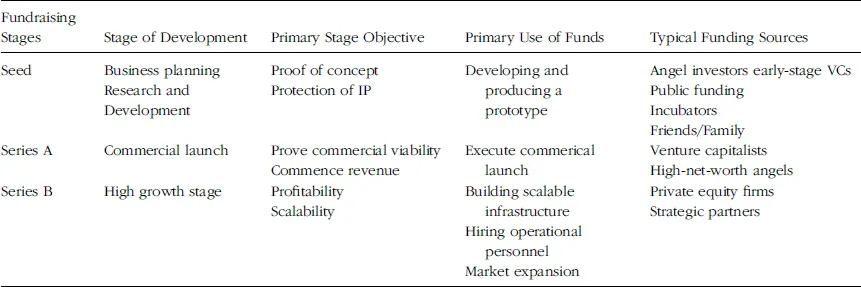
The seed funding stage is the first true fundraising stage occurring between the composition of a business plan and the completed development of a working prototype. The primary objectives of this stage are proof of concept through the development of a working prototype and protection of intellectual property (IP).
The development of a prototype has to progress to at least the point at which it can be offered on a trial basis to test users with the expectation that useful and actionable feedback can be collected. The prototype must be sufficiently presentable to prospective investors, who are primarily interested in determining its commercial viability.
Proof of concept is defined as being able to actually show a product or service to be useful to someone other than yourself and there is a waiting and prepared market for it. There are several ways to demonstrate proof of concept. The most common and effective proof of concept techniques include alpha/beta user testing, various customer feasibility surveys, and surveys based on Kano analysis. The latter effectively measures customer responses utilizing a practical and actionable customer preference classification system.
During this stage, it is strongly recommended that you protect your intellectual property either by filing patents or by writing hard-to-replicate software.
The amount of seed funding to be secured is determined by the amount of funds necessary to develop a prototype to present to both prospective investors and test users, costs associated with conducting proof-of-concept exercises, and filing and other costs associated with protection of any intellectual property. Common seed stage funding sources include individual friends and family, angel investors, early-stage venture capitalists, public funding agencies, and private incubators/accelerators.
Series A Funding Stage
The series A funding stage is when you evolve from being an R&D enterprise to being a business. The primary objectives of this stage are to begin generating revenue and validate the existence of your business through the execution of a successful commercial launch. Now is the time to implement your marketing plans, establish acceptable payment methods for your customers or users, formulate an optimal pricing policy, select the best channels of distribution, secure favorable arrangements with key vendors, and commence working relationships with any comarketing partners to demonstrate commercial viability to your investors, activities that go well beyond proof of concept. Prospective investors will ask you to “show me the money.” The best way to accomplish this is to point to paying and satisfied customers as well as mutually beneficial relationships with strategic partners.
From a fundraising perspective, the series A funding stage is the most crucial and tricky of all the funding stages. Up to this point, only a modest level of funds, if any, has been raised, and the investors, if any, are people who most likely provided funding to you based on personal trust. It is hoped that you have succeeded in accomplishing your seed stage objectives because now your fundraising efforts will likely be directed toward securing greater funding amounts from individuals and investment groups with a set of defined investment criteria and with whom you have no prior personal experience. The series A funding stage is the primary domain of venture capitalists.
Series B Funding Stage
The series B funding stage is when your company needs to become profitable. The primary objective of this stage is to fund increasing growth in a sustainable manner and demonstrate exponential financial returns. For a technology company, this usually means having the funds necessary to staff support teams, achieve maximum scalability, and expand into new markets. The primary series B funding sources are private equity firms and strategic partners that find your product promising after your successful commercial launch.
The number one challenge entrepreneurs face during this stage is managing growth, which is one of the top reasons why most businesses fail. Failure to meet the explosive growth frequently experienced by successful tech start-ups has often proven to be the death kiss for so many promising entrepreneurial ventures. Securing sufficient series B funding to fund scalability of infrastructure and hire operational and support staff is critical to ensuring that this welcomed growth is supportable. (See Figure 1.1.)
FIGURE 1.1 Fundraising Stages
In Chapter 4 we examine using strategic financial planning as a road map to navigate the successive funding stages.
Risk/Return
An important concept to understand is the relationship between risk and return. The greater the perceived risk, the greater the expected return.
Factors considered by prospective investors that may increase or decrease their perceived risks of investing in your venture include the time to realize returns, the amount of funds to be invested, growth prospects in the market targeted, probability that the product will be commercially successful, and level of confidence in the capability of management in executing its plans. A primary objective of your fundraising efforts is to credibly reduce the perceived risk of investing in your venture to improve your chances of attracting an investor and secure the most favorable terms possible. The better you are in achieving this objective, the higher the perceived valuation of your company will be, thereby commanding a higher equity share price or lowering your venture’s cost of capital at any given point.
At the earlier fundraising stages, the longer time to realize returns (higher risk) is somewhat mitigated by the comparatively modest amount of investment funds required. However, you may unnecessarily forfeit such risk mitigation if you solicit for more funds than needed to achieve your objectives in a given fundraising stage. Therefore an understanding of the risk/return relationship is vital in increasing the probability of success and efficiency of your fundraising efforts to ultimately maximize your returns.
Another aspect of risk/return to be considered is the relative risk/return for the founding partners. As mentioned, the earlier people invest, the greater their return in relation to their assumed risks compared to later investors. The founding partners, original investors who must put forth extraordinary efforts for a successful exit, earn the highest returns in proportion to the amount they actually invested. The founding partners assume four primary risk categories, which can be divided into quantifiable or nonquantifiable.
The quantifiable risks include:
Actual monetary investment. This includes the actual amount of money or other tangible resources committed to the venture.
Financial opportunity cost. This refers to the financial sacrifice assumed by founding partners to pursue the entrepreneurial venture. If a founding partner had to turn down a $100,000-per-year job offer, the opportunity cost equals the annual salary being forfeited multiplied by the years required to be dedicated to the venture. Opportunity costs are often the most significant but overlooked costs borne by a founding partner and should never be discounted.
The nonquantifiable opportunity costs (risks) include:
Blood and sweat. The personal efforts, added stress, and other nonfinancial sacrifices or hardships need to be counted. If an outside investor invested the same amount of money at the same time as a founding partner, the founding partner’s greater efforts than those of a more passive investor should be accounted for at time of exit.
Political capital expended. The risks, added strains, and obligations placed on personal relationships and the professional reputations of the founding partners entitle them to a greater proportion of returns.
A successful exit strategy requires extraordinary efforts on the part of the founding partners that go well beyond their financial contributions. They should be awarded accordingly.
A proper understanding of risk and return is necessary to attract funding on terms of mutual benefit to founding, current, and prospective shareholders. In Chapter 2 we discuss the various risk mitigation factors that can be employed to reduce the perceived risk of your venture.
Types of Funding
Equity and debt are the two primary types of funding from external sources, each with pros and cons and each with specific characteristics and ideal c...
Table of contents
Cover
Contents
Title Page
Copyright
Dedication
Preface
Acknowledgments
Chapter 1: Finance for Start-Ups 101
Chapter 2: Know Your Investors
Chapter 3: Business Planning from a Strategic Financial Perspective
Chapter 4: Financial Planning for Maximizing Returns
Chapter 5: Successful Fundraising
Chapter 6: Becoming a Formidable Negotiator
Chapter 7: Establishing an Investment-Grade Organization
Chapter 8: Financial Decision Making for Optimal Performance
Afterword
Appendix A: Sample Financial Plan
Appendix B: Sample Funding Proposal
Appendix C: Dictums of Entrepreneurial Finance
Glossary
About the Author
About the Website
Index
End User License Agreement
Trusted by 375,005 students
Access to over 1.5 million titles for a fair monthly price.
Study more efficiently using our study tools.
Frequently asked questions
Yes, you can cancel anytime from the Subscription tab in your account settings on the Perlego website. Your subscription will stay active until the end of your current billing period. Learn how to cancel your subscription
No, books cannot be downloaded as external files, such as PDFs, for use outside of Perlego. However, you can download books within the Perlego app for offline reading on mobile or tablet. Learn how to download books offline
We are an online textbook subscription service, where you can get access to an entire online library for less than the price of a single book per month. With over 1.5 million books across 990+ topics, we’ve got you covered! Learn about our mission
Look out for the read-aloud symbol on your next book to see if you can listen to it. The read-aloud tool reads text aloud for you, highlighting the text as it is being read. You can pause it, speed it up and slow it down. Learn more about Read Aloud
Yes! You can use the Perlego app on both iOS and Android devices to read anytime, anywhere — even offline. Perfect for commutes or when you’re on the go. Please note we cannot support devices running on iOS 13 and Android 7 or earlier. Learn more about using the app
Yes, you can access Start-Up Guide for the Technopreneur by David Shelters in PDF and/or ePUB format, as well as other popular books in Business & Entrepreneurship. We have over 1.5 million books available in our catalogue for you to explore.