![]()
1
Building Cooperation and a Community of Learners
The Heart of an Eagle Has Landed
THE HEART OF AN EAGLE
Once upon a time, while traveling from one place to another, a mother and her young son came upon a poultry farm. The boy was very curious and pressed his face into the wire fence to get a closer look at the hundreds of chickens pecking at the ground looking for food.
“Mama, there is a very odd chicken in this cage. He’s not like the other ones at all. Do you see the one I’m talking about?”
As the mother looked at the bird her son was pointing to, a dusty man in dirty clothing walked up to them.
“What are you up to? I don’t like people hanging around my chickens,” he grumbled.
“Just looking, sir. But would you mind telling me about that bird in the corner there? He is an odd bird and in fact, I was thinking he might be a young eagle.”
“Nonsense,” the man replied. “I’ve had him since he was barely a hatchling. Listen boy, when something acts like a chicken and eats like a chicken, he is a chicken.”
“Do you mind if we get a closer look for ourselves?” the boy asked.
“Do what you please,” he answered.
The mother and her son bent in half to fit through the half-built door. She went on her knees and scooped up the young bird. “We think you’re an eagle, not a chicken. You can fly free!”
She held the bird above her head and tossed him in the air. The bird flapped its wings once or twice but fell flat on its beak as it collapsed to the ground, and began to scratch in the dirt for its feed. The farmer, watching from afar, laughed out loud. “I told you that’s a chicken, just an ordinary chicken. You’re both wasting your time and mine!”
As the man turned his back on them to walk away, the boy shouted, “Excuse me, sir, but would you sell this bird to us? Since he’s just an ordinary chicken, I’m sure you wouldn’t miss him.”
“Fine with me. Ten dollars is my price. Take it or leave it.”
The mother knew the price was outrageous, but her son’s eyes were pleading so she gave the old man the money.
The boy scooped the eagle to his chest, ran out of the cage, and began walking and talking to the bird. His words were words of faith that the bird would eventually know its true nature.
After the boy and his mother spent a few days with the bird, the boy suddenly ran down a dusty road. His mother followed him to the top of a small hill.
“What are you doing here, son?”
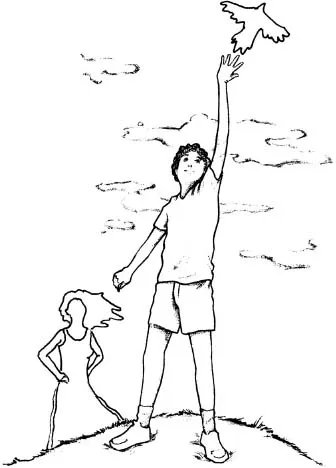
The boy did not answer. Instead he lifted the young bird as high as his arms would stretch and said as he had many times before, “You have the heart of an eagle. You are meant to fly and be free. Spread your wings and go, eagle, fly!”
A gentle current of air ruffled the feathers of the bird. The mother held her breath as her son tossed it high into the wind. The creature stretched out its wings and looked down on the mother and her son. He then began to glide smoothly in a wide circle high above the two of them, above the farm, above the valley.
The mother and her son never saw the eagle again. They never discovered where it decided to go. They only knew it would never return to live the life of a chicken ever again.
RAPPORT: THE POWER OF RELATIONSHIPS
A common mistake we often make as teachers is thinking one person can’t make a difference. Like the mother and son in this African folk tale, told to me by another teacher and mentor many years ago, we as teachers need reminders to find the “eagles” inside our students. Many of our students who are caught in negative behavior cycles require support from one healthy adult to grow beyond their limited belief that they can’t fly.
In order for this to happen, the effective teacher needs to fulfill his or her first responsibility of establishing an emotional foundation for all the teaching that will occur in a year. If we want to have an influence on helping students change undesirable behaviors, the first and most important step is to establish a good rapport with our students. By rapport I mean a synergy, mutual liking and respect between the teacher and the students. It can be characterized by trust, respect, and understanding. This rapport or positive connection formed within a relationship between student and teacher becomes the foundation for all interaction in the classroom. Rapport building can also provide important insights into the students’ needs and interests.
OUTCOMES OF ESTABLISHING RAPPORT
Increased Sense of Security
Once trust and respect have been established within the teacher-student relationship, students are freed from the obstacles of worrying about their emotional, physical, and academic safety in the classroom. They can take comfort in knowing that, even in a crisis, the relationship they have with the teacher will be constant and continue to provide a safe environment in which to work through the crisis.
A Transformative Experience
Teachers need to be models for caring relationships. The teacher-student relationship can provide a context for personal growth in which students learn to care for themselves as well as for others. Students watch to see how their teacher responds to other students and teachers. They learn from the teacher’s comments and make judgments about the intention behind the teacher’s response. Is it to retaliate? Support understanding? Gain control? The model established by the student-teacher relationship can be used to develop new understandings about desirable personal interactions.
A Change in Responsibility
Building positive relationships can increase the trust that exists between teacher and student. As the teacher gives up the burden of being responsible for “controlling students,” the outcome will be a more “manageable” classroom in which learning can occur. For this to occur, however, students need to be given more responsibility for their own behavior and learning, therefore relieving the teacher of the pressure of playing police officer.
HOW TO DEVELOP RAPPORT
I recently read that the three unwritten rules in real estate are “Location! Location! Location!” But how many teachers know the three equally important rules of classroom management? They are “Relationships! Relationships! Relationships!”
It’s evident that some teachers bring out the best in students, and some bring out the worst.
How can a student-teacher relationship be developed? One of my favorite middle school principals once made a surprising comment to me. She said, “Mr. Khalsa, I’m beginning to believe that there are some teachers who actually don’t like children!” Instead, I choose to believe that many teachers struggle with the question of how to develop a positive relationship with their students. New teachers often hear from their well-intentioned colleagues, “Don’t get to emotionally close to the students; you may get hurt and your authority will be undermined” or “If the students see you as a friend, you will not have their respect.” I do agree that “being friends” with your students is not a desirable or effective goal; There is a myth in the teaching profession that states, “It is not important for students to like their teachers. However, they should respect them.” However, in my many years of teaching in a variety of educational settings, I have always found that students work harder for some teachers than they do for others.
In effect, we teachers are salespersons, and common sense dictates that you can’t sell something to someone if they don’t like you or you anger them. Effective teachers have discovered along the way that a major part of their success is due to their ability to establish positive and meaningful relationships with their students. Teachers must therefore take the lead in developing such relationships. We need to demonstrate actively to students that we genuinely care about them, and to establish a healthy and friendly teacher-student relationship without trying to become a personal friend of each student.
It is also important to understand the psychology of students who are underachieving and/or who demonstrate negative behaviors in the classroom. These students have usually experienced years of a damaged self-concept. They see themselves as failures and as unlikable people. But my experience is that a student with such a poor self-concept is likely to make an effort to do school work for a teacher they really like.
Establishing a positive connection can be done in many ways; there is no one correct method. I’ve known teachers who come across as unfriendly and uncaring on the surface but whose names are always on the top of the list when students are asked which teachers they like most. Teachers have their own methods of establishing a caring rapport. Whatever method you use, the goal is to get across to your students that you genuinely like them, that you will enjoy teaching them, and that both of you will have a mutually rewarding time during the year you’ll spend together.
I understand that not all students are “likable” and that some seem to go out of their way to be disliked. But, as one saying goes, “You have to remove a lot of dirt in order to find the gold.” The gold is what we are looking for in our students, and with some it shines on the surface while with others it’s hidden deeply under the ground. Regardless of their approach, if teachers do not take the time to get to know their students and establish a rapport with them as individuals, they will not be able to get these students to meet the challenges of learning.
For example, when I begin the year with a class of new students, I always concentrate during the first week primarily on rapport-building activities. I encourage the students to tell me a little about themselves, what they enjoy doing outside of school, their likes and dislikes, what pets they might have, whether they have brothers or sisters, what sports they like to watch and play, what they like best about school, what they hate about school, what music they enjoy, what they hope to get out of the year, and so forth. I also share appropriate information about myself as a teacher, a husband, and a father. This gives the students the feeling that I am genuinely interested in connecting with them as people. I know that, without rapport, they will not want to learn what I need to teach. Often bringing in a small photo album can start this essential process with students of any age.
Meaningful Dialogue
Meaningful dialogue with students is the key to starting to build caring relationships. Entering into meaningful dialogue in an open and honest manner can be done in several ways. First, it’s important that the teacher be aware of any residual negative feelings or biases that might color the way they perceive the student. For example, if a student is frustrating the teacher because of his or her aggressive verbal comments, the teacher has a choice in how to look at the student. He or she can choose to see the student as a symptom or a behavior problem, or view the student as a person who has many facets to their personality, one of which is difficulty in controlling anger. By taking the second perspective, the teacher chooses to see the student as a whole person; this opens up new ways of interacting with the student that are not limited by one negative viewpoint. Dialogue with the student then becomes more genuine rather than superficial.
Two Scenarios
Let’s look at two scenarios and the dialogue that ensued between the teacher and student which had two possible outcomes.
Mr. Worthy, a sixth-grade teacher, was asking his students to line up for lunch. Steven, who was near the end of the line, began talking to Sara and Jesus, who were standing in front of him. The three students were engrossed in their conversation when Jason, who was walking quickly to get in line, bumped into a desk that then hit Steven’s leg. Steven immediately turned around and pushed the desk into Jason’s legs. Mr. Worthy looked up just in time to see Steven pushing the desk.
Scenario One
Mr. Worthy feels the need to take a controlling stance. He immediately tells Steven to take his seat and explains that, because he cannot interact appropriately with his classmates, he’ll have to eat lunch alone. He further explains to Steven that he will not be able to participate in the afterschool basketball game to which he has been looking forward all week.
Steven begins to protest and blames Jason for the incident. Mr. Worthy quickly interrupts him and explains what he saw, saying that if Steven continues to protest, a phone call will be made to his parents and he will need to be alone for the remainder of the school day. Mr. Worthy feels justified in his actions and thinks, as he’s going to lunch with the rest of the class, “I have the sa...