![]()
Part I
Rethinking Our
Role in the
Classroom
Efficient management without effective leadership is like straightening deck chairs on the Titanic.
—Stephen Covey, 1989, p. 102
Part I sets the stage for all of the strategies that are taught in this book by distinguishing between being a classroom leader and being a classroom manager. Chapter 1 clarifies how our thinking affects our teaching and invites you to reflect on how to shift from the stress of being the manager to the freedom of being a classroom leader. Chapter 2 provides an opportunity to look at various teaching styles to ensure that your teaching style matches your beliefs.
This workbook will provide you an opportunity to
- develop your role as a leader and guide in the classroom rather than a “drill instructor” or “rescuer” (see Table 2.2); and
- experiment with collaborative, respectful, compassionate management strategies, which will help your classroom be a productive, peaceful learning environment.
What This Book Does
This book describes a research-based, proactive classroom leadership approach based on humanistic beliefs, which invites and supports
- intrinsic motivation;
- resourcefulness;
- responsibility; and
- self-assessment using a leadership framework as your guide.
What This Book Does Not Do
This book does not include
- a prescriptive program that tells you what to do;
- a quick-fix recipe for every problem; or
- instructions to create a teacher-controlled climate where students conform rather than participate.
Key Points
- Prevention is the key to successful leadership in any setting. (Four prevention modules are offered in Part II.)
- Classroom leadership is one of the climate variables documented in school effectiveness research.
- If prevention strategies are not in place, academic success is compromised.
- If academic success is the only focus in the classroom, it is compromised.
- Climate: Picture a bowl that holds everything together.
- What you teach: Curriculum = the ingredients in the bowl.
- How you teach: Strategies, both instruction and management = the tools you use to mix, dice, mold, shape, blend, and whip the ingredients you put into the bowl.
Without the bowl (the climate you create), your recipe will fail no matter how fresh and wonderful the ingredients may be.
What Is Climate?
Climate is the values, beliefs, feelings, and norms of the classroom/school.
- Climate is established the moment you meet your students.
- Planning for how you will create climate happens before school starts.
Chapters 1 and 2 ensure that the climate you create will give you a strong framework, or “bowl,” for your teaching.
![]()
1
Shifting From
Manager to
Leader
We are what we think. All that we are arises with our thoughts. With our thoughts we make the world.
—Buddha
Shifting From Manager to Leader: Essential Questions
These are the essential questions that you will be able to answer after completing this chapter:
- Why does shifting from being the classroom manager to being the classroom leader set the stage for more cooperation?
- How do my beliefs and values match the research?
RETHINKING OUR ROLE AS TEACHERS
Essential Question
- How does my thinking influence and affect my interactions with students, parents, and colleagues and my success as a teacher leader?
Classroom Connection
Jamal Patel was a fairly new teacher who seemed to work magic in getting his students to produce high academic work and engage in appropriate social behavior. His classroom was orderly and ran smoothly. He had strong personal connections with his students and received excellent evaluations and commendations from his principal and his peers after his first year of teaching. He believed in intrinsic motivation and wanted his students to be motivated from within. He rewarded his students for their good behavior with points, which were redeemable at the end of the week for such things as a free homework pass or a new design pencil or a sticker or whatever else was in the “goody box.” However, when Mr. Patel was absent, he received numerous phone calls from his principal or his fellow teachers, saying that his students were impolite, unruly, and unproductive with the substitute teacher.
On one occasion, when Mr. Patel was out for over a week, the sub left negative notes about the class’s behavior, specifically about how they had tried to reverse the point system and see how many points they could lose. Mr. Patel was puzzled. This did not match his experience of these students or the philosophy of internal motivation he had tried to instill. During a class meeting about their behavior with subs, the students revealed that they behaved and performed well when he was there because they really liked him but that they didn’t like the substitutes. They said that the incentive system was fun and they liked it but that they really didn’t care about the “goody box items.”
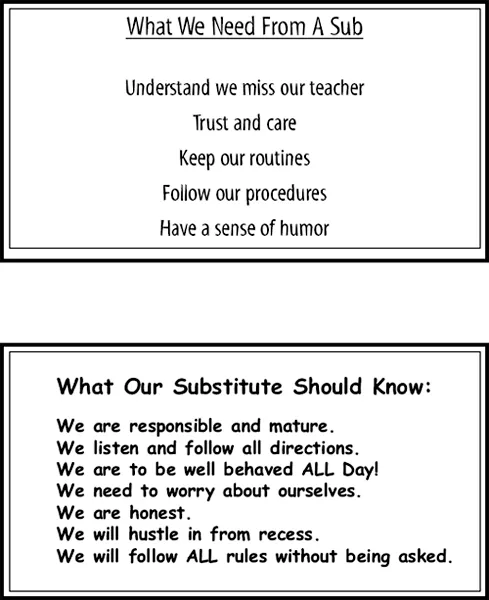
Jamal Patel shared this information with his mentor and began to rethink and research the issue of intrinsic motivation. Clearly, the students were motivated by their relationship with him, but their motivation had not transferred to the higher level of doing the right thing because it was the right thing (intrinsic motivation). They were still pleasing their teacher and getting “goodies” or losing points (extrinsic motivation). Mr. Patel began to reassess his role as the “keeper of the norms” and the manager of the classroom. He began to strategize about how to become more of a leader who could guide the students to take more internal ownership of their behavior. He began by sharing his beliefs and thinking about intrinsic motivation with them at a class meeting and asking for their input. He recorded their ideas about how they thought that they could “manage themselves” when a substitute was in the classroom. They created two charts: “What We Need From a Sub” and “What Our Substitute Should Know” (Figure 1.1).
Many thinkers and teachers, both ancient and modern, have asserted that our thoughts create our reality. We know that how we think about a problem strongly influences our ability to solve the problem. Mr. Patel thinks of himself as a capable teacher who can turn any upset upside down and as a creative force in the classroom who “works magic” with challenging students. He thinks of himself as having influence in his classroom, even though he realizes he may have little influence over what happens outside his classroom, in students’ homes and private lives. Thus, he had no fears about calling a meeting to involve his students in creating a solution, rather than creating one by himself. His thinking was influenced strongly by his beliefs in intrinsic motivation, and when he experienced a conflict between his students’ behavior and his understanding of them, he re-evaluated his current practices.
On the other hand, if that same teacher, with that same group of students, started questioning his ability to “dance out of power struggles” and began to think of himself as unable to “manage these kinds of kids” because, for example, they came to him with too many home problems outside of his influence, he would lose his effectiveness. He would begin to notice all of the times when he was “out of control” and his students were uncooperative, and then he would see the cup as being half empty instead of half full.
Figure 1.1 Charts Created by Mr. Patel’s Class
Our thinking does indeed affect our actions. According to Stephen Covey (1989), when we focus on things outside of our sphere of influence (e.g., changing our students’ parents), we will be frustrated, worry more, and wield less influence, but when we put our attention on the things over which we have some control, our influence and sense of power will increase. We will be empowered to turn any upset upside down, just like Mr. Patel. This principle is paramount in the story of The Little Engine That Could, who, while saying, “I think I can, I think I can, I think I can,” gradually climbed the impossible hill. Rethinking Classroom Management invites you to shift from the narrow focus of the teacher as manager in the classroom to the bigger picture of the teacher as leader in the classroom.
Take a few moments to respond to the question below and make your own personal connection to Mr. Patel’s story and how your thinking affects your actions.
Personal Connection
What are some areas in your school setting that are within your sphere of influence, that is, you have control over them?
What are some areas over which you have no control?
By the end of this chapter, you will be able to rethink, clarify, and write down your beliefs about your role as a leader in the classroom. This process will help you rethink your role in your classroom and discover creative, proactive solutions to problems and issues that concern you. You already know how negative th...