Published in cooperation with the Association of Counselor Education and Supervision (ACES)
This definitive single-volume guide is the first of its kind on teaching and developing counselor educator programs that embrace constructivist and developmental theory. Leading scholars and experts offer practical advice on teaching courses in every area of counseling practice. As a result, the book is ideal for current and future counselor educators and supervisors as well as faculty in other helping professions. The authors seek to inspire educators to empower and involve, to risk "losing control" over subject matter, to hear student voices, to pose dilemmas, and to challenge their own assumptions in the presence of their students using constructivist, developmental, and experiential thinking and strategies.
Dear Instructors,
Sage and ACES are pleased to announce that we together have published the first comprehensive guide to educating future counselors in the form of the Handbook of Counselor Preparation: Constructivist, Developmental, and Experiential Approaches, which has been co-edited by Garrett McAuliffe and Karen Eriksen, with contributions from leading counselor educators from two countries. In this book you will find rich, accessible guides to teaching in general and to teaching specific courses in the counseling curriculum. From foundations in constructivist teaching, including guides to the seminal works of Dewey and Kohlberg, to suggestions for teaching and student evaluation practices, the Handbook will function as the fundamental text for your course. We hope you will adopt this first-of-a-kind text for this course.
Sage Publications, Inc.
ACES
Garrett McAuliffe and Karen Eriksen
eBook - ePub
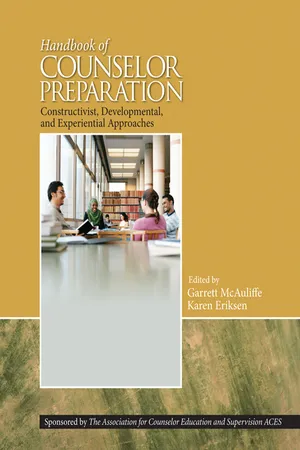
Handbook of Counselor Preparation
Constructivist, Developmental, and Experiential Approaches
- 464 pages
- English
- ePUB (mobile friendly)
- Available on iOS & Android
eBook - ePub
Handbook of Counselor Preparation
Constructivist, Developmental, and Experiential Approaches
About this book
Information
PART I
Foundations: Constructivism, Development, Culture, and Teaching
Chapter 1
Constructing Counselor Education
Chapter 2
Deep Learning: The Work of Dewey, Kohlberg, and Kolb
Chapter 3
Guidelines for Constructivist-Developmental Counselor Education
Chapter 4
Who Are the Learners? Phases of Counselor Development
Chapter 5
A Primer on Six Key Teaching Strategies: Lecturing, Discussion, Questioning, Small Groups, Reading and Writing, and Improvisation
CHAPTER1
Constructing Counselor Education
You probably teach very well without recognizing that, often, the more teaching, the less learning. Our job in adult education is not to cover a set of course materials, but to engage adults in effective and significant learning.
Jane Vella, Adult Educator
With that declaration, Jane Vella (1994) challenges teachers to instigate something called significant learning. This certainly sounds like a desirable goal for all counselor educators. But what is significant learning? Is it the achievement of a set of specific counseling competencies? For sure. Is it a set of positive attitudes toward the work of helping? Yes, in the sense that attitude precedes much behavior. But, most of all, significant learning lies in the ability to perform what Schön (1991) defines as professional work—the use of judgment and considered action in ambiguous situations. Professional work is characterized by unclear problems with multiple dimensions. Such work is commonly fraught with ethical and value implications. The counselor often makes decisions in such situations in the moment. Counseling requires the ability to make commitments knowing that there are other choices that might be equally valid. From these conditions, it might be clear that the act of counseling does not lend itself to rote practice (Harris, 1993).
If counselors are to be prepared for the complexity of the work—in the form of multiple societal values, ethnicities, moral centers, gender expectations, and the like—then the designers of counselor education must prepare students (and themselves) to have a corresponding complexity. That complexity might take two forms: (1) a way of knowing that is reflexive and includes a tolerance for ambiguity and (2) the ability to be culturally relativistic.
In the first case, counselors must embrace uncertainty as an expected condition of the work. The counselor must consistently entertain the possibility “I might be wrong.” Counselors must remind themselves, when they are tempted to make a glib assessment, or automatically adhere to a favored technique, “I must catch myself trying to be too complete,” to use developmental theorist Robert Kegan’s (1998) phrase. Counselors must be reflexive and tolerant of ambiguity.
The second requirement is cultural relativism. In order to work with all clients, counselors must be able to de-center from their cultural assumptions. Those emerge from their gender, social class, ethnicity, sexual orientation, and religion. Walt Whitman framed this challenge in Leaves of Grass: “Re-examine all you have been told at school or church, or in any books, and dismiss whatever insults your soul.” Whitman’s words ask individuals to self-authorize (Kegan, 1998) their values. Similarly, philosopher Richard Rorty (1989) challenges individuals to be culturally de-centered, when they are taking a position, to think they might have “been initiated into the wrong tribe” (p. 75) on that value or issue. In this fluid, constructed social world, teachers and learners must regularly question their certainties, examining the limits of their knowing.
In sum, it is the position of this chapter, indeed of this entire book, that such a flexible, reflexive mindset, or way of knowing, is required for the work of professional counseling. The counselor’s own mental complexity must match the requirements of the professional work. Of course, specific knowledge and skill competencies are also required for becoming a good group leader, career counselor, crisis intervener, and child advocate, to name a few professional counseling roles. But those skills must be applied provisionally, with situation, culture, and individual in mind. Given the fluidity of any knowledge base (just think about the single-minded adherence to psychoanalysis in the first half of the 20th century and the humanistic contagion of the second half), no professional can rely on a permanent set of understandings and expect to continue to do ethical and competent counseling. She or he must have the capacity of mind to fully engage and critically evaluate a fluid knowledge base, meet multiple professional roles, and recognize perspectives from diverse cultures.
CONSTRUCTIVISM: AN OVERVIEW
Constructivism is the guiding metaphor for this book. The Latin origin of the word itself (con = with; struere = to build) refers to the communal act of making something, of putting together. From the constructivist perspective (also called constructionist, which will be explained later), humans do not “find” or “discover” knowledge, nor do they receive it from infallible authorities. Knowledge is continually created through conversations. These conversations occur through the sciences, the arts, religion, the media (e.g., blogs, talk shows), professional journals, and classroom discussion, to name some examples.
Constructivism is not a method. It is instead a way of understanding human meaning-making. It invites the individual into a world in which subjectivity is ultimate (but, lest we descend into total relativism, not all positions are equally helpful or defensible, as determined by a community’s standards). Constructivism’s central premise is that individuals actively create the world as they experience it. Individuals do not learn by copying some outside reality. Nor do they find knowledge as if it were a gem waiting to be uncovered in a mine (Gergen, 2009). They are actively involved in a joint enterprise with others in creating (constructing) new and preferably more helpful meanings. Some constructivist thinkers (which I will here call developmental constructivists) also emphasize the pre-understandings, or cognitive capacities, that individuals bring to experience. These two versions of constructivism are discussed next.
Social Constructionism
Humans are always in a social surround, whether that consists of their internalized conceptions of the good and the beautiful (the social-in-the-individual) or the ongoing public conversations in media, religion, literature, and culture in general (the individual-in-the social), to name some examples. Social constructionism (note that the tion in the word is a mere convention from its usage by Berger and Luckmann [1966] in their classic The Social Construction of Reality) emphasizes the inevitably social, or communal, context of human meaning-making. All meaning is saturated in culture, history, place, and time. Humans are ineluctably shaped by the social forces of language and interaction. There is no “pure” thought that is not socially mediated.
Obvious examples of the social construction of meaning lie in the words humans use to describe their experience of the world, such as sinful, gay, moral, mannerly, and beautiful. Each of those words is heavily saturated with meanings that are created in human communities (e.g., ethnic cultures). Other obvious examples of socially constructed meanings are the norms that guide humans’ thinking and behaving, such as cultural rules for interpersonal relations (e.g., greetings, politeness, honesty) and those for gender behavior (e.g., nurturing, aggressiveness). Less subtle are the implicit assumptions that guide thinking about what is good, true, and beautiful (e.g., a work ethic, salvation, conceptions of beauty).
Social constructionists propose that there is no pure knowledge, that is, there are no ideas that are outside of time and place, or chronology and geography, in Gergen’s (2009) words. The very language that humans use is, of course, socially constructed. For example, the English word love cannot be directly translated into many languages. In Japanese, there is suki, which generally means like (e.g., food, movies), koi for passionate love, and ai for parental love. These terms are not directly translatable into the English word love.
In addition, it is not just the specific meaning of words, but the way in which they are used, that affects the construction of meaning in cultures. In Japanese culture, koi and ai are not often spoken directly to another—it is not common to say, “I love you” to a person. Humans are always more or less embedded in their language. Individual meaning-making is socially constructed.
Two terms, discourse and deconstruction, are associated with social construction. They will be discussed next.
Discourse
The term discourse represents any particular socialized meaning system that informs a person’s constructions. Therefore one can refer to, for example, a gender (e.g., male) discourse, a religious (e.g., Christian) discourse, a class (e.g., middle-class) discourse, an ethnic (e.g., Anglo American) discourse, a scientific (e.g., positivist) discourse, and a theoretical (e.g., humanistic) discourse.
Any thread of ideas might be called a discourse. In fact, the very concept of social construction is itself a discourse. The discourse of social construction is guided by the notion that humans are always constructing knowledge. Such a view contrasts with the spectator discourse about knowledge. Referring to the spectator view, Ahuja and colleagues (2008) say, “In such a view, the thinker pushes ideas and concepts around in his mental space like pieces of furniture—frozen concepts without a life of their own—making the assumption that the concepts completely render the world they are meant to model” (Part One, para. 10). This notion is nonconstructivist in that it treats knowledge as found, rather than constructed by a community. By contrast, social constructionist thinking assumes the changeable, fluid nature of knowledge, that is always contingent on place and time, or discourse.
Deconstruction
Any discourse can be analyzed for its foundations. Deconstruction is the act of examining the origins and implications of an idea, that is, seeking its roots in a particular discourse, such as in the zeitgeist of an era or in a thinker’s biography (Gergen, 2009). Deconstruction challenges the idea that there are noncontextual, unquestionable verities or givens that can be known. All ideas can be subjected to deconstruction. There is no room for “that’s just the way it is.”
Implications of Social Construction for Education
It follows, from the social constructionist perspective, that there are no realities that can be purely known beyond culture. The filters of such social identities as gender, age, race, religion, ethnicity, ability, class, and sexual orientation are pervasive lenses through which individuals create meanings. Teachers and counselors should be aware of the social constructions that inform their own assumptions, lest they treat their current understanding as “real” and therefore unassailable.
There are at least three dimensions of social constructionist thinking that have implications for counselor education. Burbules and Rice (1991) lay them out thus:
- A rejection of absolutes. Any declaration of objectively knowable universals results in the restriction of human possibilities. So-called metanarratives, such as grand counseling theories, are viewed as expressions of particular points of view. Therefore, meaning-makers must be humble and reflexive, exquisitely attuned to the limits of their conclusions. They are asked to be consistently aware of their standpoints, whether they be based in culture, situation, temperament, or other characteristics of the time, place, and person. This standpoint awareness has implications for teaching: Since knowledge is something that is developed in community rather than an objectively determined verity, the teacher must be persistently self-reflective, be open to the limits of her or his current positions and methods, and be willing to seek feedback about teaching content and process from fellow learners, including students. Social constructionist educators are aware of the context that affects any perspectives that they may take on phenomena.
- The saturation of all social discourse with power or dominance. Power pervades all human encounters, including the power of hierarchy, physical size, sexual appeal, money, and persuasion. In the classroom, teachers can unthinkingly perpetuate broader patterns of dominance, especially in their use of authority. Teachers can subtly reinforce or challenge existing power relationships through how or whether they encourage students’ voices in the classroom, through how they use titles and names, through their openness to being questioned on their own teaching practices, and by being respectful or dismissive in responding to students. With this awareness of power, teachers can give assignments, grade tests, and lead discussions in ways in which the fundamental equality and value of all persons are respected. Counselor educators are thereby challenged to lift the veil of power to make sure that they are not perpetuating inequities. Methods for sharing power will be discussed throughout this book. They include teachers encouraging student feedback on course content and process, sharing their reasons for assignments, and revealing their own doubts.
- The celebration of difference. Social constructionism assumes that the constitutive quality of existence is plurality. In contrast, the objectivist or essentialist stance proclaims that a diversity of ideas is a temporary state on the way to perfect knowing. From the social constructionist framework, any singular, unified discourse is to be treated skeptically, since it is likely that such discourse comes from the framework of the dominant group. For counselor educators, this assumption is a call to attend to the perspectives and experiences of so-called marginalized groups. Participation, it follows, is a correlate of social constructionism. Social constructionist educators therefore actively extend invitations to voices that might otherwise be excluded, in admissions, assignments, and topics for discussion, to name some examples.
Finally, there are at least two implications of the social constructionist impulse: humility and egalitarianism. In the first case, the knower should not take his positions too permanently, or seriously, since they are built on the shifting foundations of culture, era, and selected evidence (Gergen, 2009). Social constructionist counselors are therefore attuned to the discourses from which they speak, whether they be gender, ethnic, social class, or historical contexts, among others. Such counselors recognize the fluidity of all sense-making and the ongoing evolution of ideas. They will consistently ask, “What is another possibility?” and “From what discourse am I speaking?” That is a form o...
Table of contents
- Cover Page
- Title
- Copyright
- Contents
- Preface
- Acknowledgments
- PART I FOUNDATIONS: CONSTRUCTIVISM, DEVELOPMENT, CULTURE, AND TEACHING
- PART II A GUIDE TO INDIVIDUAL COURSES AND TOPICS IN THE COUNSELOR EDUCATION CURRICULUM
- PART III INNOVATIVE PROGRAM PRACTICES
- PART IV CONCLUSIONS AND IMPLICATIONS
- Author Index
- Subject Index
- About the Editors
- About the Contributors
Trusted by 375,005 students
Access to over 1.5 million titles for a fair monthly price.
Study more efficiently using our study tools.
Frequently asked questions
Yes, you can cancel anytime from the Subscription tab in your account settings on the Perlego website. Your subscription will stay active until the end of your current billing period. Learn how to cancel your subscription
No, books cannot be downloaded as external files, such as PDFs, for use outside of Perlego. However, you can download books within the Perlego app for offline reading on mobile or tablet. Learn how to download books offline
Perlego offers two plans: Essential and Complete
- Essential is ideal for learners and professionals who enjoy exploring a wide range of subjects. Access the Essential Library with 800,000+ trusted titles and best-sellers across business, personal growth, and the humanities. Includes unlimited reading time and Standard Read Aloud voice.
- Complete: Perfect for advanced learners and researchers needing full, unrestricted access. Unlock 1.5M+ books across hundreds of subjects, including academic and specialized titles. The Complete Plan also includes advanced features like Premium Read Aloud and Research Assistant.
We are an online textbook subscription service, where you can get access to an entire online library for less than the price of a single book per month. With over 1.5 million books across 990+ topics, we’ve got you covered! Learn about our mission
Look out for the read-aloud symbol on your next book to see if you can listen to it. The read-aloud tool reads text aloud for you, highlighting the text as it is being read. You can pause it, speed it up and slow it down. Learn more about Read Aloud
Yes! You can use the Perlego app on both iOS and Android devices to read anytime, anywhere — even offline. Perfect for commutes or when you’re on the go.
Please note we cannot support devices running on iOS 13 and Android 7 or earlier. Learn more about using the app
Please note we cannot support devices running on iOS 13 and Android 7 or earlier. Learn more about using the app
Yes, you can access Handbook of Counselor Preparation by Garrett McAuliffe,Karen Eriksen,ACES, Garrett J McAuliffe, Karen Eriksen, ACES in PDF and/or ePUB format, as well as other popular books in Psicología & Asesoramiento psicoterapéutico. We have over 1.5 million books available in our catalogue for you to explore.