- 296 pages
- English
- ePUB (mobile friendly)
- Available on iOS & Android
eBook - ePub
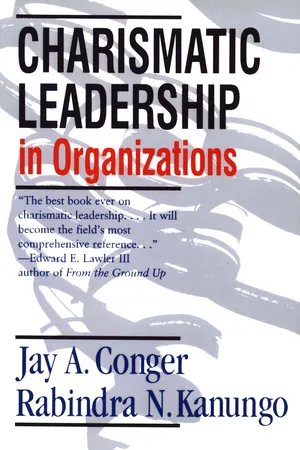
Charismatic Leadership in Organizations
About this book
Charismatic leaders have proven to be remarkable change agents, able to create or reinvent entire organizations. At the same time, these leaders provide us with lessons about the greatest dangers of leadership. For example, throughout history, certain charismatic leaders have demonstrated a shadow side as master manipulators and purveyors of evil. Charismatic Leadership in Organizations reflects the latest thinking on this seemingly elusive yet remarkable form of leadership. Written by two of the most important scholars on the subject, this volume not only integrates the growing body of research and theory on the subject, but also pushes the frontiers of our knowledge by introducing new theory and insights. It presents readers with a highly comprehensive model of the charismatic leadership process that is documented with extensive empirical research and richly illustrated with case examples of corporate leaders. The book also includes a questionnaire measure of charismatic leadership and suggests an agenda for future research in the field. Written in a highly accessible style, Charismatic Leadership in Organizations will be of interest to professionals, students, and scholars in management, public administration, psychology, political science, sociology, and religion.
Information
PART I
THEORY DEVELOPMENT
1
Evolution of the Field
It is a commonplace observation that leadership plays an important role in the creation, survival, growth, and decay of organizations. Considering its importance, numerous books and articles have been written on leadership (see, e.g., Bass, 1990; Yukl, 1994) during the past half century, yet social scientists and managerial scholars started to show a genuine interest in studying the phenomenon of charismatic leadership in organizations only during the past decade. In this introductory chapter, we will look at how research on charismatic leadership in organizations has evolved over this decade. When we wrote the book Charismatic Leadership (Conger & Kanungo, 1988b) in 1988, the field was still very young. We commented at the time:
The topic has actually suffered from a serious lack of attention. To put its neglect into perspective, we turn to Stogdill’s Handbook of Leadership (Bass, 1981), which is considered the reference book on leadership studies. Combing through the more than 5,000 studies included in the handbook, only a dozen references to charismatic leadership are to be found. This is an ironic and disheartening discovery given the profound impact of charismatic leaders. (p. 12)
More recently, this situation has begun to reverse itself. Today interest in charismatic leadership has blossomed. What is particularly surprising is the number of empirical studies that have appeared. Most of the academic work up to the publication of Charismatic Leadership had been largely theoretical in nature, with little empirical research. Today that situation has changed dramatically.
Several dozen empirical investigations of charismatic leadership in organizations have now been conducted. They have involved a wide range of samples such as middle- and lower-level managers (Bass & Yammarino, 1988; Conger & Kanungo, 1994; Conger, Kanungo, Menon, & Mathur, 1997; Deluga, 1995; Hater & Bass, 1988; Koene, Pennings, & Schrender, 1991), senior executives (Agle, 1993; Agle & Sonnenfeld, 1994; Conger, 1985, 1989a), U.S. presidents (House, Spangler, & Woycke, 1991), educational administrators (Koh, Terborg, & Steers, 1991; Roberts & Bradley, 1988; Sashkin, 1988), military cadets and leaders (Atwater, Camobreco, Dionne, Avolio, & Lau, 1997; Curphy, 1990; Howell & Avolio, 1993; Koene et al., 1991; Waldman & Ramirez, 1992), and students who were laboratory subjects (Howell & Frost, 1989; Kirkpatrick, 1992; Kirkpatrick & Locke, 1996; Puffer, 1990; Shamir, 1992, 1995). In addition, the subject has been explored using a wide variety of research methods. For example, there have been field surveys (Conger & Kanungo, 1992, 1994; Hater & Bass, 1988; Podsakoff, MacKenzie, Moorman, & Fetter, 1990), laboratory experiments (Howell & Frost, 1989; Kirkpatrick, 1992; Kirkpatrick & Locke, 1996; Puffer, 1990), content analyses of interviews and observation (Conger, 1989a; Howell & Higgins, 1990), and analyses of historical archival information (Chen & Meindl, 1991; House et al., 1991; Shamir, Arthur, & House, 1994).
What is more remarkable than this flowering of research is the relative uniformity of findings despite some differences in theoretical approaches. As Shamir, House, and Arthur (1993) have noted, findings across the board demonstrate that leaders who engage in the behaviors that are theorized to be charismatic actually produce the charismatic effects that theory predicts. In addition, many of these studies have shown that leaders who are perceived as charismatic receive higher performance ratings, are seen as more effective leaders than others holding leadership positions, and have more highly motivated and more satisfied followers than others in similar positions (e.g., see Agle & Sonnenfeld, 1994).
Given this new body of research, this chapter aims to trace the evolution of the field over the last decade. The goal is to identify both advances and remaining gaps in our understanding of charismatic leadership in organizations. We begin our discussion, however, by exploring the backdrop of changes in the business world that not only have served as catalysts for the growing interest but also have shaped how researchers have approached the subject.
Following this discussion, we will describe contributions since the late 1980s. When Charismatic Leadership was published in 1988, the field was in its infancy, and the existing body of research at that time could be broken down into three distinct clusters based on (1) behavioral dimensions of the charismatic leader, (2) the psychological characteristics or dispositions of charismatic leaders, and (3) the institutionalization of charisma. Today, our knowledge has deepened in these areas. In addition, several other topic areas have received some attention. These include the dimensions of (1) contextual factors, (2) succession and maintenance factors, and (3) the dark side of charismatic leadership. In the second section of this chapter, we will cover developments in all these areas.
BACKGROUND FORCES IN THE BUSINESS WORLD
To understand why the subject of charismatic leadership has grown in interest for organizational theorists, we must look at the world around us—a larger backdrop of global competition. The rise of Asian economic powers, such as Japan and the Little Dragons, as well as European players like Germany, shattered the market dominance of North American companies. This had a dramatic impact not only on industry but also, in turn, on research within business schools. In terms of the world of commerce, it forced many large corporations to reinvent themselves radically after enjoying several decades of what in hindsight appears to have been relative stability. As companies attempted to adapt, they discovered that the process of reinvention was extremely difficult. For example, rarely did company insiders possess the courage and change management skills needed to orchestrate large-scale transformations. The leadership talent necessary for such undertakings essentially was in short supply.
A second dilemma facing these organizations was employee commitment. In the midst of their change efforts, companies resorted to extensive downsizing as well as to new organizational arrangements such as flatter hierarchies and strategic business units. While often improving bottom-line performance, these initiatives took their toll on worker satisfaction and empowerment. In the process, the old social contract of long-term employment in return for employee loyalty was broken. The net result was disenfranchisement for many in the workforce. This occurred just at the moment when corporations were demanding ever greater performance and commitment from employees. For companies, the challenge became a question of how to orchestrate transformational change while simultaneously building employee morale and commitment—a seemingly contradictory endeavor.
These important events in the business world had a direct impact on the study of leadership. Because the majority of organizational scholars who studied leadership held positions within business schools, their attention turned to the role of leadership in addressing these twin challenges of transformational leadership and empowerment. They would also feel a need to explain why so many organizations had been slow to change and why turnaround efforts often were unsuccessful. To address these issues, researchers turned to a simple dichotomy: Managers and leaders were different.
Up to this point in time, leadership researchers had rarely drawn a clear distinction between the roles of leading and managing. The idea that leadership and management might stand for different phenomena or roles or personalities was novel. Not even in its selection of candidates for study had the leadership field discriminated between the two notions. Instead, it was assumed that anyone in a management position essentially was in a “leadership role.” A consensus is emerging, however, among management scholars that the concept of leadership must be distinguished from the concept of supervision/managership for the purpose of developing future research agendas and addressing organizational challenges (Adler, 1997; House, 1995; Kanungo & Mendonca, 1996b; Zaleznik, 1990). In light of this, the earlier streams of leadership research conducted in the 1950s and 1960s at Ohio State University and the University of Michigan, identifying the task or initiating structure and the person or consideration roles of leadership, would today be reclassified as more managerial because of the activities on which they focused.
One of the first appearances of a distinction between leading and managing can be traced back to 1975. Abraham Zaleznik and Manfred Kets de Vries (1975) argued in a book titled Power and the Corporate Mind that there were two types of organizational leaders: the maximum man and the minimum man. In business, the maximum man was the creative institution builder, and the minimum man was the modern-day manager:
[Maximum man’s relationship to subordinates] is usually simple: He is their leader. At times he may be recognized practically on sight because of the glow of confidence his inner light gives him. He is charismatic, people are drawn to him by the power of his convictions and visions of reality. His presence inspires both dread and fascination; he evokes mystical reactions… The minimum man is concerned with the opinion of his peers. He would rather have egalitarian relations with men as brothers than be in the socially distant position of a father figure. He does not, therefore, lead public opinion, but follows it. (pp. 237-241)
Their notions of “maximum man” and “minimum man” were rooted in the work of the early American psychologist William James (1958), who had formulated a theory of personality types called the “once-borns” and the “twice-borns.” The once-borns, James proposed, were individuals who experienced the flow of life as relatively straightforward from the time of birth. Their family life was harmonious and peaceful. The twice-borns experienced quite the opposite. They faced great struggles. Their lives were never easy, and unlike the once-borns, they could take little for granted. As a result, the two personalities developed not only very different perspectives on the world but also different expectations of achievement. The once-borns went on to become managers: “Managers perceive life as a steady progression of positive events …” (Zaleznik, 1990, p. 9). Leaders, on the other hand, were the twice-born personalities:
Leaders are twice-born individuals who endure major events that lead to a sense of separateness, or perhaps, estrangement from their environment. As a result, they turn inward in order to reemerge with a created rather than an inherited sense of identity. That sense of separateness may be a necessary condition for the ability to lead. (Zaleznik, 1990, p. 9)
This theme of essential differences between managers and leaders would be further accentuated in the 1980s, when a group of organizational theorists initiated what would in essence become a new paradigm of leadership theory. At the core of this group was a small number of individuals (e.g., Bass, 1985; Bennis & Nanus, 1985; Conger & Kanungo, 1987; Kotter, 1988; Kouzes & Posner, 1987; Peters & Waterman, 1982; Tichy & Devanna, 1986), most of whom were examining executives and managers involved in transforming their organizations. Called the “new leadership school” by Bryman (1992) and the “neo-charismatic paradigm” by House (1995), these researchers constructed their notions of leadership around contrasts with the role of management. For example, Bennis and Nanus (1985) would argue:
By focusing attention on a vision, the leader operates on the emotional and spiritual resources of the organization, on its values, commitment, and aspirations. The manager, by contrast, operates on the physical resources of the organization, on its capital, human skills, raw materials, and technology… An excellent manager can see to it that work is done productively and efficiently, on schedule, and with a high level of quality. It remains for the effective leader, however, to help people in the organization know pride and satisfaction in their work. (p. 92)
Kotter (1988) would argue similarly that the fundamental difference between leadership and management was that the former is concerned with activities that produce “constructive or adaptive change:” whereas the latter is concerned with producing “consistency and order.” Leadership focused on the long-term issues of the organization, whereas management attended to the short-term. Leadership acquired commitment to performance through empowerment, whereas management acquired it through contractual arrangements.
As a result of these new conceptualizations, we today conceive of the role activities of leading and managing as distinct (as outlined in Table 1.1). A person in a managerial position may have to execute administrative, supervisory, and leadership functions for the organization. Administrative functions involve the procurement and deployment of available resources to maintain the day-to-day operations of the organization. Supervisory functions require looking after the efficient and effective day-to-day utilization of human resources so as to accomplish previously set operational tasks and organizational objectives. Execution of both functions ensures the maintenance of standard job behavior on the part of employees. Thus, both administration and supervision are directed toward maintaining the status quo. Both aim to achieve short-term, operational objectives of the organization, primarily by using control strategies and tactics. The execution of these functions is the primary objective of “managership.” Leadership functions, on the other hand, require an executive or manager to formulate long-term objectives for the organization that are novel and therefore different from the status quo. The essential characteristics of leadership become (1) challenging the status quo, (2) engaging in creative visioning for the future of the organization, and (3) promoting appropriate changes in followers’ values, attitudes, and behaviors by using empowering strategies and tactics.
Distinguishing leading from managing, the new leadership school argued that the inability of North American corporations to adapt to a changing world could be traced back largely to organizations directed by too much management and too little leadership. A severe shortage of le...
Table of contents
- Cover Page
- Title
- Copyright
- Contents
- Preface
- Part I: Theory Development
- Part II: Components of Charismatic Leadership
- Part III: Remaining Challenges
- Appendix: The Conger-Kanungo Charismatic Leadership Questionnaire
- References
- Index
- About the Authors
Trusted by 375,005 students
Access to over 1.5 million titles for a fair monthly price.
Study more efficiently using our study tools.
Frequently asked questions
Yes, you can cancel anytime from the Subscription tab in your account settings on the Perlego website. Your subscription will stay active until the end of your current billing period. Learn how to cancel your subscription
No, books cannot be downloaded as external files, such as PDFs, for use outside of Perlego. However, you can download books within the Perlego app for offline reading on mobile or tablet. Learn how to download books offline
Perlego offers two plans: Essential and Complete
- Essential is ideal for learners and professionals who enjoy exploring a wide range of subjects. Access the Essential Library with 800,000+ trusted titles and best-sellers across business, personal growth, and the humanities. Includes unlimited reading time and Standard Read Aloud voice.
- Complete: Perfect for advanced learners and researchers needing full, unrestricted access. Unlock 1.5M+ books across hundreds of subjects, including academic and specialized titles. The Complete Plan also includes advanced features like Premium Read Aloud and Research Assistant.
We are an online textbook subscription service, where you can get access to an entire online library for less than the price of a single book per month. With over 1.5 million books across 990+ topics, we’ve got you covered! Learn about our mission
Look out for the read-aloud symbol on your next book to see if you can listen to it. The read-aloud tool reads text aloud for you, highlighting the text as it is being read. You can pause it, speed it up and slow it down. Learn more about Read Aloud
Yes! You can use the Perlego app on both iOS and Android devices to read anytime, anywhere — even offline. Perfect for commutes or when you’re on the go.
Please note we cannot support devices running on iOS 13 and Android 7 or earlier. Learn more about using the app
Please note we cannot support devices running on iOS 13 and Android 7 or earlier. Learn more about using the app
Yes, you can access Charismatic Leadership in Organizations by Jay A. Conger,Rabindra N. Kanungo in PDF and/or ePUB format, as well as other popular books in Business & Organisational Behaviour. We have over 1.5 million books available in our catalogue for you to explore.