eBook - ePub
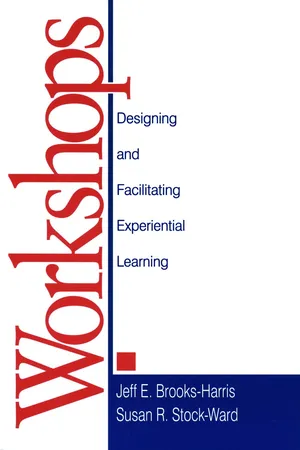
Workshops
Designing and Facilitating Experiential Learning
- 208 pages
- English
- ePUB (mobile friendly)
- Available on iOS & Android
eBook - ePub
About this book
This volume is designed to present a practical approach to designing and running workshops. It is meant to introduce novice facilitators as well as those with much experience to an integrated model of workshop design and development. Grounded in learning theory, this model is used to demonstrate how to design, facilitate, and direct workshops, as well as how to identify and improve existing skills. Practical, how-to sections assist readers in creating specific experiential activities designed to facilitate different types of learning. Readers also learn how to understand and attend to individual differences as well as to take all workshop participants through a universal cycle of learning. Workshops will be useful to anyone who facilitates workshops in higher education, adult education, business, health care, and other educational settings.
Information
Publisher
SAGE Publications, IncYear
1999Print ISBN
9780761910213
9780761910206
Edition
1eBook ISBN
9781452239644
Chapter | Toward an Integrated Model of Workshop Design and Facilitation |
Workshops provide environments for learning to occur in a dynamic and powerful manner. The workshop format can be used to promote personal growth, teach professional skills, or create change within existing systems. Workshops provide an effective short-term training method that can be used in a wide array of settings with an infinite number of topics. Because of their short duration, workshops are flexible and cost-effective; they can be easily designed or modified to meet the needs of different groups and organizations. This adaptability to a particular group and topic can be employed to capture the motivation of learners and to enhance the opportunity for long-term change. Workshops have even been referred to as the “workhorse of adult and continuing education” (Fleming, 1997, p. 1) because a workhorse performs “dependably under heavy or prolonged use” (American Heritage Dictionary, 1992, p. 2057).
Previous ideas about workshops will be reviewed before introducing our model of workshop design and facilitation. We begin by describing historical definitions and identifying workshop characteristics and emphases and conclude with our own workshop definition, which will guide the rest of the book. Second, we will highlight the importance of the facilitator role of a workshop presenter. Third, Kolb’s (1984) model of experiential learning, which forms the theoretical basis for much of the book, is introduced. The chapter closes with the application of Kolb’s model to workshop development and a description of the integrated model that results. This integrated model of workshop design and facilitation forms the foundation for all of the material that is explored in subsequent chapters.
Reflecting on Workshop Learning
As you begin to think about workshops, we invite you to reflect on your experience with learning environments by answering the following questions:
1. How would you define the word workshop? What makes a workshop a workshop? How does a workshop differ from a class, lecture, seminar, presentation, or discussion?
2. What was the best workshop (or other learning experience) in which you have participated? What made this experience positive?
3. What was the least effective workshop (or other learning experience) you ever attended? What made it so bad?
Workshop Definitions and Emphases
Historical Definitions
When the word workshop is used to refer to an educational or training format, the word is being used as an analogy. Originally, a workshop was a place where things were made and sold. A cobbler’s workshop was a place where shoes were made and repaired as well as sold. It can be inferred, therefore, that when educators started using the term to describe a particular type of learning environment, it was meant to convey some of the characteristics of the original word. If this logic is followed, it can be assumed that a workshop is a place where work occurs, where tools are used to accomplish this work, where things may be repaired, and where the work may result in a particular product or outcome. We invite you to think about your own role as an educator or trainer and to keep in mind the origin of the term workshop as you develop your own “tools” in this “work.”
EXHIBIT 1.1
Definitional Characteristics of Workshops
Short-Term Intensive Learning
Small Group Interaction
Active Involvement
Development of Competence
Problem Solving
Behavior Change as an Outcome
Application of New Learning
Fleming (1997) recently provided a definition of workshops that emphasized the development of competence, interactive learning among participants, opportunities for hands-on practice, practical and intensive interaction, small-group work, and application of new learning. Earlier definitions of workshops also identified similar themes. Morgan, Holmes, and Bundy (1963) pointed out that “as the word implies, a workshop means work” (p. 61) and highlighted the importance of small groups, complete participation, and behavior change in workshop learning. Sork (1984) defined a workshop as “a relatively short-term, intensive, problem-focused learning experience that actively involves participants in the identification and analysis of problems and in the development and evaluation of solutions” (p. 5). The important elements of these definitions are summarized in Exhibit 1.1.
Workshop Emphases
These workshop definitions offer different emphases. For example, Fleming (1997) emphasized the development of competence (which we will refer to as skill building), whereas Sork (1984) emphasized problem solving as an essential feature of workshops. Our model recognizes skill building and problem solving as two valid workshop goals but also recognizes other emphases such as systemic change, increased knowledge, and personal awareness or self-improvement. These different emphases are listed in Exhibit 1.2, and each is discussed and exemplified.
EXHIBIT 1.2
Possible Workshop Emphases
Problem Solving
Skill Building
Increasing Knowledge
Systemic Change
Personal Awareness/Self-Improvement
Skill Building
Skill-building workshops aim to equip participants with specific skills that they can use in their work or personal lives. The facilitator of a skill-building workshop may have more expertise than participants but there is still an attempt to promote interpersonal learning and hands-on practice. For example, workshops might address management skills, computer use, assertiveness, gardening, or parenting skills.
Problem Solving
Problem-solving workshops bring together people with knowledge that they can share with one another to find new solutions to problems. For example, a group of teachers, administrators, and researchers might work together to find new strategies for preventing violence in schools.
Increasing Knowledge
Increasing knowledge also can be the emphasis of a workshop. However, if knowledge is only transmitted in a didactic fashion, it is considered a lecture and does not fit our definition of a workshop. Although most workshops do result in increased knowledge, they also provide opportunities for participants to use and apply their newfound knowledge. For example, a workshop can be used to inform physicians of the results of new cancer research. For this educational experience to be an experiential workshop, the participants would need to be provided with the opportunity to practice using their new knowledge in diagnosis and to prepare to apply the knowledge in treatment settings.
Systemic Change
Systemic change is another possible emphasis for workshops. Such workshops often fall into the context of consultation or organizational development. For example, a sexual harassment workshop might be offered within a company after there have been reports of harassment. The aim of the workshop would be to change attitudes and behaviors within the workplace in order to create a more positive environment for all of the company’s employees.
Personal Awareness/Self-Improvement
Personal awareness, self-improvement, or both, are the goals for other workshops. These may focus on issues like self-esteem or positive thinking and promote change by helping participants become aware of their own thoughts, attitudes, or feelings and by helping people make positive changes in their lives.
Interaction Among Emphases
It should be pointed out that these emphases may overlap substantially with one another. Rarely is it possible to isolate a process like awareness from related emphases like skill building or problem solving. For example, a workshop that promotes personal awareness in an area such as self-esteem frequently will be tied to skill building in an area such as assertiveness. It is our expectation that most workshops will include more than one of these emphases and some may address all five.

A New Definition
In addition to these characteristics (Exhibit 1.1) and emphases (Exhibit 1.2), the workshop model we describe emphasizes three interrelated elements: experiential learning, sensitivity to different learning styles, and the use of a variety of learning activities. The following definition will be used:
A workshop is a short-term learning experience that encourages active, experiential learning and uses a variety of learning activities to meet the needs of diverse learners.
We see workshops as an ideal way to address the needs of i...
Table of contents
- Cover Page
- Title Page
- Copyright Page
- Contents
- Preface
- Introduction: Three Lessons From The Wizard of Oz
- 1. Toward an Integrated Model of Workshop Design and Facilitation
- 2. Using Learning Styles to Understand Participants and Guide Workshop Design
- 3. Preparing for Workshop Design: Gathering Information and Setting Goals
- 4. Creating a Comprehensive Workshop Design
- 5. Designing Effective Workshop Learning Activities
- 6. Directing the Workshop and Creating a Learning Environment
- 7. Facilitation Skills for Different Types of Experiential Learning
- 8. Workshop Evaluations: Strategies, Variables, and Plans
- 9. Improving Your Workshop Design, Directing, and Facilitation Skills
- References
- Index
- About the Authors
Trusted by 375,005 students
Access to over 1.5 million titles for a fair monthly price.
Study more efficiently using our study tools.
Frequently asked questions
Yes, you can cancel anytime from the Subscription tab in your account settings on the Perlego website. Your subscription will stay active until the end of your current billing period. Learn how to cancel your subscription
No, books cannot be downloaded as external files, such as PDFs, for use outside of Perlego. However, you can download books within the Perlego app for offline reading on mobile or tablet. Learn how to download books offline
Perlego offers two plans: Essential and Complete
- Essential is ideal for learners and professionals who enjoy exploring a wide range of subjects. Access the Essential Library with 800,000+ trusted titles and best-sellers across business, personal growth, and the humanities. Includes unlimited reading time and Standard Read Aloud voice.
- Complete: Perfect for advanced learners and researchers needing full, unrestricted access. Unlock 1.5M+ books across hundreds of subjects, including academic and specialized titles. The Complete Plan also includes advanced features like Premium Read Aloud and Research Assistant.
We are an online textbook subscription service, where you can get access to an entire online library for less than the price of a single book per month. With over 1.5 million books across 990+ topics, we’ve got you covered! Learn about our mission
Look out for the read-aloud symbol on your next book to see if you can listen to it. The read-aloud tool reads text aloud for you, highlighting the text as it is being read. You can pause it, speed it up and slow it down. Learn more about Read Aloud
Yes! You can use the Perlego app on both iOS and Android devices to read anytime, anywhere — even offline. Perfect for commutes or when you’re on the go.
Please note we cannot support devices running on iOS 13 and Android 7 or earlier. Learn more about using the app
Please note we cannot support devices running on iOS 13 and Android 7 or earlier. Learn more about using the app
Yes, you can access Workshops by Jeff E. Brooks-Harris,Susan R. Stock-Ward in PDF and/or ePUB format, as well as other popular books in Social Sciences & Social Work. We have over 1.5 million books available in our catalogue for you to explore.