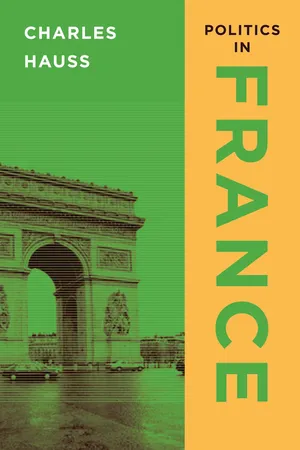
France has shifted toward more "normal" politics since the mid 1960s. That's saying a lot for a country that has had three monarchies, five republics, two empires, and a neo-fascist regime in the years since its revolution in 1789. Hauss's lively and up-to-date new text looks beyond "de Gaulle's revolution," tracing France's historical development up to the present and describing with fresh insight its political culture, parties, interest groups, and institutional system, as well as its place in the EU and the larger global economic order. Hauss offers lively analysis of recent events and issues, including the May 2007 presidential elections; hot-button policy issues like immigration and the assimilation of non-Westerners into the French cultural and political landscape and the impact of the EU on France's economic policies.
- 212 pages
- English
- ePUB (mobile friendly)
- Available on iOS & Android
eBook - ePub
Politics in France
About this book
Information
1
Toward Normal Politics
French voters went to the polls four times during the spring of 2002. First, two rounds of voting, on April 21 and May 5, led to the reelection of Jacques Chirac (1932–). Then, in June, another two rounds of voting were needed to choose a new National Assembly, the all-important lower house of parliament.1
The results of the elections shocked almost everyone. Despite all the pundits’ predictions, the far right-wing (and some would say racist) Jean-Marie Le Pen (1928–) nosed out the incumbent Socialist prime minister, Lionel Jospin (1937–) for second place and a spot in the runoff against Chirac.
On June 9 and 16, legislative elections were held. The newly formed Union for a Presidential Majority (UPM) won a landslide victory of 357 out of 577 seats in the National Assembly, further demoralizing the Socialists and the rest of the Left that had been devastated by Jospin’s third-place showing in the presidential election.
The elections had some peculiarly French features. Each, for instance, required two rounds of balloting before determining the winner. Sixteen candidates ran for the presidency. More than five thousand men and women vied for the 577 seats in the National Assembly. As often happens during French presidential campaigns, the president, Chirac, issued a blanket amnesty for all traffic offenses just before the election; traffic experts think the amnesty may have led to 100 more road deaths than in a normal year.
But in the end, the elections were not terribly different from those held in Britain or the United States. To be sure, the rhetoric was more heated than it usually is in the rest of Europe or North America. However, Chirac, Jospin, and most of the other candidates did not disagree all that much on key issues.
Table 1.1 Presidents of France, 1958–2007
| President | Years in office |
| Charles de Gaulle | 1958–1969 |
| Georges Pompidou | 1969–1974 |
| Valéry Giscard d’Estaing | 1974–1981 |
| François Mitterrand | 1981–1995 |
| Jacques Chirac | 1995–2007 |
| Nicolas Sarkozy | 2007–2007 |
In other words, the stakes of the election were not all that high, because the Fifth Republic was as secure as it had been at any time in its then forty-four-year history. Put simply, France’s two elections, like its political life in general, were what one would expect from a smoothly functioning liberal democracy.
And that will be the theme of this book. Over the nearly fifty years since Charles de Gaulle and his colleagues created the Fifth Republic in 1958, French politics has become much like politics in other advanced democracies.
That had not been the case as recently as 1962, one of the few other years when the French voted both for the president and the Assembly. That August, an assassin fired more than 100 bullets into the limousine taking President Charles de Gaulle (1890–1970) to his country home. Somehow, the president’s driver managed to escape the ambush even though all four tires of his car had been blown out. Somehow, too, the general was not hit. The attack was carried out by disgruntled former army officers who were furious with de Gaulle for granting Algeria independence and who were part of a wave of protest and violence that had swept the country for almost four years.
Within weeks de Gaulle announced that there would be a referendum to allow the direct election of the president. The one and only time the office had been filled, de Gaulle was chosen by an electoral college of about 81,000 national and local political leaders. Now, de Gaulle argued, France needed a popularly elected president, since his successor would not have the general’s charisma or authority.
Critics argued (probably correctly) that the referendum was unconstitutional. They also claimed that directly electing the president was dangerous—a point returned to in Chapters 3 and 4 on French history.
As he often did with referenda, de Gaulle warned the people that if they did not vote “yes,” he would resign. The referendum passed.
Then de Gaulle dissolved the National Assembly and called for new elections, something no president or prime minister had done since the late 1870s. That action further infuriated opposition politicians. Some, like François Mitterrand (1916–1996) and Pierre Mendès-France (1907–1982), called for de Gaulle’s removal and the creation of a sixth republic. The Gaullists and their allies won the election with a firm majority in the Assembly, the first time any such party or coalition had done so since the creation of the Third Republic in 1875.
In other words, French politics was anything but normal in 1962 and had not been for many years. Unlike the United States or the United Kingdom, which have been governed by the same regime for more than two hundred years, France has had three monarchies, five republics, two empires, and a neo-fascist regime in the years since its Revolution in 1789. It wasn’t just that constitutions came and went, sometimes at breathtaking speed. France was deeply divided on just about every issue of the day and on the meaning of its own history. Historians debated the significance of the major turning points in its past. Some analysts claimed that the French were still debating the merits of the Revolution when they celebrated its bicentennial in 1989.
Those long-standing divisions colored everything from election campaigns to the curriculum of the school system.
Yet, as I try to show in the pages that follow, de Gaulle, the other leaders of the Fifth Republic, and the country’s citizens have shifted the country toward a more “normal” politics since the tumultuous days that returned him to office.
We can get a glimpse at this turn toward normal politics by taking six snapshots of political life a decade apart from each other—1948, 1958, 1968, 1978, 1988, and 1998. I did not choose these dates at random. The four years in the middle of the string, in particular, include some of the most important political turning points in France since the end of World War II. Nonetheless, the general pattern would be the same whatever set of years I picked.
In 1948 the Fourth Republic’s first full year did not go well. General de Gaulle, who had led the provisional government from 1944 to 1946, was about to form his first political party, whose overriding goal was to get rid of this new republic that he detested. Moreover, just months into its existence, the country had reverted to the kind of “crisis and compromise” government in which the average cabinet, or governing coalition of ministers, lasted nine months and accomplished little, a system that many held responsible for France’s shameful defeat in 1940, its occupation by Germany, and the Vichy government’s collaboration with the Nazis. The Cold War had begun, which meant that the Communist Party (PCF) was no longer a potential member of a governing coalition, thus depriving France of its only possibility of forming a strong majority. The Communists were not considered viable candidates for holding office, because many worried that they would hand the country over to the Stalinist Soviet Union if they came to power. Finally, the country was still a long way from recovering from the physical and emotional devastation of World War II.
In 1958 de Gaulle succeeded and put the twelve-year-old Fourth Republic out of its misery. He had been taking verbal pot shots at it for more than a decade, but he had little chance of returning to power until a twin revolution broke out in Algeria. As was the case throughout the colonial world at the time, the native Algerian Arabs began demanding independence. Violence broke out in 1954. But Algeria also had about one million settlers of European origin. They chafed at the prospect of Algeria’s gaining its independence, which would have jeopardized their economic and political standing. In April, when it appeared that a moderate would become prime minister and, perhaps, begin negotiations for Algerian independence, much of the army joined the settlers.
On the night of April 13, the military and settlers seized control of Algiers, the colony’s capital city. Later, they landed in Corsica. Rumors spread that paratroopers would soon continue on to the mainland. Before the month was out, mainstream politicians realized that the only way to avoid a military coup was to bring de Gaulle back to power, even though many despised him and had doubts about his commitment to democracy. De Gaulle agreed but only if he were granted emergency powers for six months and could change the constitution. Reluctantly, the politicians agreed.
De Gaulle did not revise the constitution. He wrote a brand new one. As the year ended, the Fifth Republic was being created, and de Gaulle became its first president.
The events of May 1968 brought yet another threat to another French republic. That spring saw student demonstrations against the war in Vietnam and other issues in almost all of the industrial democracies. Only in France did the protests spread to the working class and grow so big that the institutional order of the country was put in jeopardy.
After a minor demonstration, a group of students from the suburban campus at Nanterre was summoned to the Latin Quarter for a disciplinary hearing at the Sorbonne. Protests broke out that evening. Riot police attacked the students, who then started throwing rocks and building barricades. Millions of people were stunned by what they took to be police brutality. The trade unions and left-wing political parties came to the students’ support. Within a week, protests and strikes had brought the country to a standstill. De Gaulle finally had to go to the army, which included many officers who had opposed him on Algeria, and ask for its support. The crisis ended when de Gaulle dissolved parliament and called for new elections. The Gaullists won, in large part because they played on fears of a Communist takeover, even though that was not in the cards. What did seem possible to many of us who were drawn to the events of May is that the far more radical New Left might grow by leaps and bounds and make profound changes in France and beyond.
We were wrong.
By 1978 the turn toward normal politics had begun. In 1972 the Communist and Socialist Parties agreed to a common program or platform they would enact were they to win the elections the next year. The agreement solidified the relationship between the two parties, which, as noted in Chapter 5, gave voters a choice between two teams of potential leaders until the late 1990s. The Left was defeated in the 1973 legislative and 1974 presidential elections, although it regained all the ground it had lost in 1968. The next legislative elections were scheduled for 1978, and the Left should have been able to win, given, among other things, the economic slump following the Organization of the Petroleum Exporting Countries (OPEC) oil embargo of 1973–1974. However, the left-wing parties had a hard time reestablishing their coalition, and the Gaullists and their allies won again, their ninth straight victory under the Fifth Republic.
What is important to note is that next to no one talked about the possible collapse of the Fifth Republic were the Left to win. Some ...
Table of contents
- Cover Page
- Title
- Copyright
- Dedication
- Contents
- Tables, Figures, Map, and Boxes
- Preface
- 1. Toward Normal Politics
- 2. “The Hexagon”: France’s Political and Social Geography
- 3. History I: The Long Term
- 4. History II: The Fifth Republic
- 5. Political Culture and Participation
- 6. Political Parties and Elections
- 7. The State
- 8. Domestic Public Policy
- 9. France and Europe
- 10. Foreign Policy
- 11. Conclusion: Sarkoland
- Notes
- Constitution of 4 1958 October
- Further Reading
- Web Resources
- Glossary
- Index
Trusted by 375,005 students
Access to over 1.5 million titles for a fair monthly price.
Study more efficiently using our study tools.
Frequently asked questions
Yes, you can cancel anytime from the Subscription tab in your account settings on the Perlego website. Your subscription will stay active until the end of your current billing period. Learn how to cancel your subscription
No, books cannot be downloaded as external files, such as PDFs, for use outside of Perlego. However, you can download books within the Perlego app for offline reading on mobile or tablet. Learn how to download books offline
Perlego offers two plans: Essential and Complete
- Essential is ideal for learners and professionals who enjoy exploring a wide range of subjects. Access the Essential Library with 800,000+ trusted titles and best-sellers across business, personal growth, and the humanities. Includes unlimited reading time and Standard Read Aloud voice.
- Complete: Perfect for advanced learners and researchers needing full, unrestricted access. Unlock 1.5M+ books across hundreds of subjects, including academic and specialized titles. The Complete Plan also includes advanced features like Premium Read Aloud and Research Assistant.
We are an online textbook subscription service, where you can get access to an entire online library for less than the price of a single book per month. With over 1.5 million books across 990+ topics, we’ve got you covered! Learn about our mission
Look out for the read-aloud symbol on your next book to see if you can listen to it. The read-aloud tool reads text aloud for you, highlighting the text as it is being read. You can pause it, speed it up and slow it down. Learn more about Read Aloud
Yes! You can use the Perlego app on both iOS and Android devices to read anytime, anywhere — even offline. Perfect for commutes or when you’re on the go.
Please note we cannot support devices running on iOS 13 and Android 7 or earlier. Learn more about using the app
Please note we cannot support devices running on iOS 13 and Android 7 or earlier. Learn more about using the app
Yes, you can access Politics in France by Charles Hauss in PDF and/or ePUB format, as well as other popular books in Politics & International Relations & Comparative Politics. We have over 1.5 million books available in our catalogue for you to explore.