"Paul Messaris is an extremely thoughtful commentator on the world of visuals. He has studied advertising visuals for many years and his insights are always stimulating and sometimes, even controversial. This book makes an important contribution to the literature in two fields: visual communication and advertising. I recommend it for faculty and students as well as professionals in the advertising field."
--Sandra Moriarty, Professor University of Colorado
"With an informal writing style and examples both thoughtful and illustrative, Paul Messaris in his Visual Persuasion leads the reader through the often complex field of visual literacy related to advertising images with high style and intellect. When so much information is conveyed through quickly edited and carefully controlled mass media images, Visual Persuasion is a vital book toward understanding the impact on individuals, cultures, and society of persuasive visual messages."
--Paul Martin Lester, Ph.D, Author of Visual Communication with Messages
"A smartly reasoned and elegantly written treatment of visual argumentation authored by one of America?s most respected authorities on visual communication. "
--James Lull
The pictures in TV commercials, magazine ads, and other forms of advertising often convey meanings that cannot be expressed as well, or at all, through words or music. Visual Persuasion is an exploration of these unique aspects of advertising. By virtue of their ability to simulate the appearance of the physical world, pictures can become surrogate objects of desire or other emotions which ads subsequently associate with products. By exploiting viewers? assumptions of a direct, automatic connection between photography and reality, images can serve as proof of advertising claims. Because of the implicit nature of visual argumentation and the relative lack of social accountability that images enjoy in comparison with words, pictures can be used to make advertising claims that would be unacceptable if they were spelled out verbally. Using these characteristics of visual persuasion as a starting point, this important book analyzes a variety of commercial, political, and social-issue advertisements. A separate chapter examines the role of pictures in cross-cultural advertising. Visual Persuasion is recommended for upper-level undergraduate students and graduate students in communication and media studies. It also contains insights that will be valuable to students in courses in cultural studies, sociology, anthropology, and advertising.
If there is one property that most clearly distinguishes pictures from language and from the other modes of human communication, that property is iconicity (to use the Peircian terminology that was described in the introduction). Through combinations of lines and shapes and colors on a piece of paper or a movie screen or a video monitor, pictures are able to recreate the kinds of visual information that our eyes and brains make use of when we look at the real world. Note that iconicity does not necessarily entail a precise match between the appearance of a picture and the appearance of reality. There are many kinds of pictures—for instance, cartoons, sketches, or black-and-white photographs—whose visual characteristics are superficially quite different from those of real-world objects or places. Nevertheless, all of these kinds of pictures are capable of capturing and conveying to our eyes the distinctive features that our brains need in order to be able to figure out what we are looking at. And that is what counts.
Our goal in this chapter is to address the following question: What are the implications of iconicity for the uses of pictures in ads? An important first step toward an answer comes from recent work by Damasio (1994), Grodal (1994), and Shepard (1990). Although it may seem natural to think of visual perception as an autonomous psychological process, these writers stress the fact that real-world vision is intimately connected with emotion, which, in turn, is tied to our functional needs as biological and social creatures. When we look at the world, we are strongly predisposed to attend to certain kinds of objects or situations and to react in certain kinds of ways. These predispositions reflect the influence of culture, but—as all three of these writers emphasize—they have also been shaped to a certain extent by biological evolution. In short, real-world vision comes with a set of built-in response tendencies. Consequently, to the extent that a picture can reproduce the significant visual features of real-world experience, it may also be able to exploit the response tendencies that are associated with those features.
How do advertising images, in particular, take advantage of this possibility? In principle, we can distinguish between two kinds of roles that real-world visual cues typically play in advertising: on one hand, drawing attention to the ad; on the other hand, eliciting a certain emotion on behalf of whatever it is the ad is selling. One of the simplest examples of the former occurs in advertising images in which someone looks directly at the spectator. This ubiquitous device, used by spokespeople in TV commercials and models in magazine ads, draws its attention-getting power from our real-life tendency to look back when we are looked at. A well-known example of the latter can be found in some political images. On the assumption that looking up at someone can be associated with feelings of respect or awe, portrayals of politicians in ads or posters occasionally adopt a low (upward-looking) angle of view. Because the primary purpose of this convention is to create a certain feeling toward the person in the image, the use of low angles in this context can be considered an emotion-eliciting device.
However, because low angles are less common than straight-on views, it could be argued that they also function as attention-getters; and, conversely, there are some situations—such as the famous recruiting poster of Uncle Sam saying “I want you …”—in which looking into the viewer’s eyes could be considered a means of intimidation or subordination and not just a way of attracting attention. In other words, whereas the distinction between attention-getting and emotion-eliciting devices provides a useful framework for thinking about the different dimensions of our responses to ads, in practice, any one visual device could conceivably serve both functions. The fact that we will discuss these two functions separately should not obscure this point.
ATTRACTING ATTENTION
In an analysis of the fundamentals of persuasive communication, Henrik Dahl (1993) argues that one of its central characteristics is the fact that it is typically unwanted communication. With the possible exception of those of us who have a professional interest in the subject, most people do not actively seek out exposure to advertising. Furthermore, the ability to avoid advertising on television has increased as a result of the proliferation of cable channels. To be sure, advertisers may develop ways of reversing this trend as they become more proficient at using the Internet and other new media. For instance, when television becomes more interactive, commercials may be offered as a precondition for receiving fee-free movies, and viewers may be required to indicate their reactions or provide other information during the course of the commercials as a means of ensuring that attention is paid to them. Even in such circumstances, though, most types of advertising will continue to face the problem of catching the viewer’s eye through their intrinsic qualities. Ordinarily, this can be thought of as the advertiser’s first task. The iconicity of visual images provides advertisers with a variety of tools for handling that task. Many of those tools are derived from the principles of real-world, face-to-face interaction, and that will be a major focus of our discussion. However, we will begin by looking at a very different form of visual attention-getting, a kind of visual manipulation that cannot occur at all in the real world.
Violating Reality
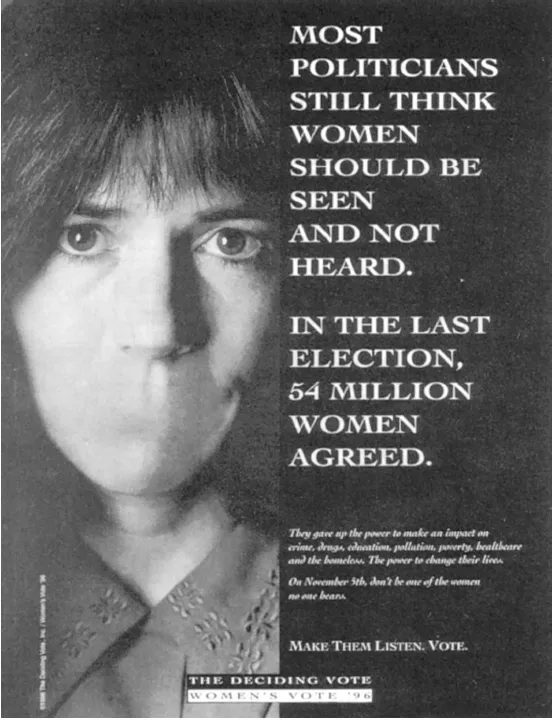
In a medium whose very essence is the ability to reproduce the look of everyday reality, one of the surest ways of attracting the viewer’s attention is to violate that reality. Consider the case of a print ad produced by an organization called The Deciding Vote (see Figure 1.1). The ad’s aim is to get more women to vote, and one of the ways in which it makes its case is through forceful verbal text: “Most politicians still think women should be seen and not heard. In the last election, 54 million women agreed.” But the first thing that hits the viewer’s eye is the striking photograph that accompanies this text. We see a close-up of a woman’s face looking at us with troubled eyes. Her features are normal except for one glaring, one-of-a-kind aberration. Where her mouth should be there is no mouth; only a smooth, seamless continuation of the surface of her skin. This image is an excellent example of the critical role that iconicity plays in our response to pictures. Because of iconicity, we experience the image as a warp in reality, not just the manipulation of a symbol. It gives us a jolt, and it gets us to look.
Figure 1.1.
The perceptual principles that are brought into play when we look at this kind of image have been adumbrated by the distinguished cognitive psychologist Roger Shepard (1990). In the course of a more general examination of how our brains deal with impossible figures, Shepard points out that the human perceptual system is finely tuned to pay special attention to unfamiliar objects when they are only slightly different from our expectations: “[A]n object that is novel and yet similar to an already significant object may especially warrant our close attention. We need to know how far something can depart from its usual or expected form and still have the consequences that we have found to follow from its ‘natural kind’” (p. 202). In the normal course of visual perception, our brain figures out what it is that we are looking at as follows: For each shape that our eyes encounter, the brain attempts to find a match in a “dictionary” of previously encountered shapes that we build up over the course of our lives (Marr, 1982). If an unfamiliar shape is grossly different from anything else in this dictionary, it will either be ignored entirely or the brain may take the first steps in the construction of a new “entry.” However, if the discrepancy between the unfamiliar shape and some preexisting one is only partial, the mental task of fitting in the new shape becomes more complicated. As a result, such partially strange shapes can cause us to pay closer attention.
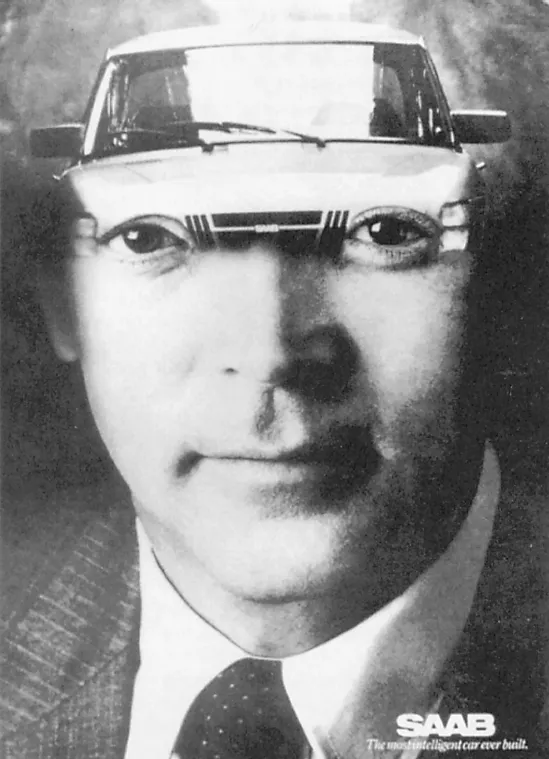
An especially effective application of these principles can be achieved through the technique of “morphing,” or using a computer to bring about a smooth transition between two different images—for example, a man and a woman, or a human and an animal. If the morphing process stops halfway between the two, the resulting hybrid can trap our brain in an unresolvable tug-of-war between two competing entries in our dictionary of shapes. As an attention-getting device, this kind of hybrid can be endlessly fascinating. Another way of approximating this effect involves the blending or merging of two different images without actual morphing. This technique is fairly common in advertising, but it has rarely been used as effectively as in a Saab ad from the 1980s, in which a man’s face and the front of a car come together in one seamless whole (see Figure 1.2). From chin to nose, this object is distinctly human; but at the level of the eyes it begins to merge with the car‘s headlights, and from there on up, the car takes over completely
Figure 1.2.
Surrealism and Visual Metaphor
To viewers who are familiar with the history of art in the 20th century, this man/car image may be somewhat reminiscent of paintings by the surrealist René Magritte, who was fond of such mind-bending constructions. Both surrealism in general and Magritte in particular have provided continuing inspiration to the creators of advertising images, partly because of the effects we are discussing here, but also for other reasons that we will consider in Chapter 6. Strictly speaking, though, there is an important difference between traditional surrealism and the kind of thing that we see in the Saab ad or in the image of the mouthless woman from our earlier example. Surrealism is sometimes thought of as a representation of dream imagery and, therefore, as a source of various hidden meanings. However, attempts to read such meanings into the works of the traditional surrealists very quickly run into the problem of overinterpretation. As practiced by artists like Magritte or Salvador Dali, surrealism was mainly an art of eye-grabbing visual paradoxes. When we look at our Saab/man or mouthless woman, on the other hand, we see visual paradox but we also see something additional. Both of these ads have a very definite metaphorical dimension, and we would be missing much of the ads’ impact if we ignored it.
In the case of the mouthless woman, the first line of the ad’s text (“Most politicians still think women should be seen and not heard”) guides us toward a political interpretation of the image. The erasure of the woman’s mouth represents the suppression of women’s opinions by the political system as well as by their own failure to vote (as the second line of text suggests). The intended meaning of the Saab/man juxtaposition is also indicated textually. The smooth meshing of the man’s features with those of the car is evidently meant as a representation of the car’s perfect responsiveness to its driver, who is made to feel as if the car is an intelligent extension of his own body. In each of these ads, then, an image of a concrete physical event or situation (erasure, merger) is used as a means of evoking an analogous abstract concept (political silencing, automotive responsiveness). Because of the analogical connection between each image and its corresponding concept, these images can be considered visual metaphors.
The topic of visual metaphor has been examined by several writers, including Green (1985), Hatcher (1988), Hausman (1989), Johns (1984), Kaplan (1990,1992), Whittock (1990), and, most notably, Kennedy (1982, 1990, 1993) and Kennedy and Simpson (1982). On the whole, these writers tend to use the term metaphor rather expansively, encompassing some types of visual devices that we will be examining under different headings in later chapters. For the purposes of this discussion, we can define visual metaphor somewhat more narrowly as the representation of an abstract concept through a concrete visual image that bears some analogy to that concept. Note, however, that this definition still covers a wider range of images than the specific types with which we are concerned here, because it includes cases in which there is no distortion of the physical object or event portrayed in the image. For instance, according to this definition, a plain, ordinary, undistorted picture of an eagle can serve as a visual metaphor for the concept of freedom because of the analogy between defying gravity and casting off social restrictions. It should be understood, therefore, that our car/man and mouthless woman images belong to a subcategory of visual metaphor as defined here and are not representative of all possible applications of that term.
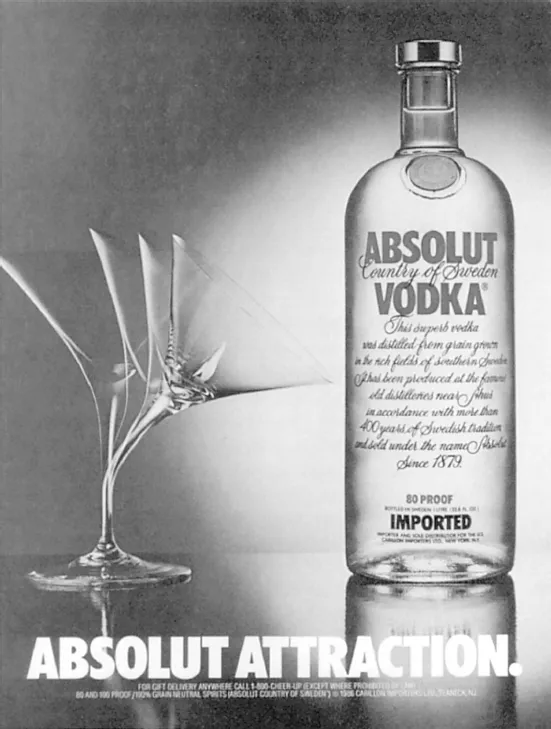
This subcategory of visual metaphor, involving some violation of physical reality, is a very common convention in advertising, and there are any number of examples that we could have chosen in place of the two that we have looked at up to this point. As far as the distortion of bodies is concerned, an even more extreme case than that of our mouthless woman can be found in an ad for the New York Life Insurance Company. The caption reads, “If choosing between life insurance and competitive interest rates is putting you through the wringer … get them both” (see Figure 1.3). The photograph above this caption shows a man literally going through two immense rollers, which squeeze his legs into a pair of flat, undulating ribbons. Another ad by the same company contains a slightly different caption: “If you’re torn between life insurance protection and competitive interest rates … get them both” (see Figure 1.4). These lines are accompanied by a photograph of a man’s body split in half. Similar techniques can be applied to nonhuman objects, of course. An Absolut Vodka ad, labeled “ABSOLUT ATTRACTION,” shows a martini glass next to a bottle of Absolut; the glass is bent in the direction of the bottle, as if being drawn toward it by some invisible force (see Figure 1.5).
Figure 1.3. and Figure 1.4.
Figure 1.5.
The kind of merging or blending of two objects that we encountered in the Saab ad is also a common advertising practice (Wolf, 1988, Chap. 1). Another noteworthy example occurs in an antismoking poster put out by the Health Education Board of Scotland (see Figure 1.6). As in the Women’s Vote ad, the central image here is of a young woman gazing at the viewer with a vaguely uneasy expression. This woman’s facial features are all intact. However, in place of hair, she has a dense, tangled mass of disintegrating cigarette stubs. The caption reads, “Perfume won’t hide it.” Less dramatically, the merging of two or more images that do not belong together has become a staple device in ads featuring landscapes or cityscapes. In such cases, the point of the impossible juxtaposition is typically to demonstrate how easily a travel agency or airline or other mode of transportation can move a passenger between different locations. A recent Ford Explorer ad, for instance, contains a background photograph in which we see the skyline of Manhattan on the right, a Southwestern landscape (Monument Valley, Utah) on the left, and a gradual shift from one to the other in between (see Figure 1.7). The point of this composite is to show that the Ford Explorer is equally at home in both kinds of environments. Likewise, other ads have merged Monument Valley...
Table of contents
Cover Page
Title
Copyright
Contents
Acknowledgments
Intorduction: A Theory of Images in Advertising
PART 1: IMAGE AS SIMULATED REALITY
PART 2: IMAGE AS EVIDENCE
PART 3: IMAGE AS IMPLIED SELLING PROPOSITION
Epilogue: Ethics of Visual Persuasion
References
Index
About the Author
Trusted by 375,005 students
Access to over 1.5 million titles for a fair monthly price.
Study more efficiently using our study tools.
Frequently asked questions
Yes, you can cancel anytime from the Subscription tab in your account settings on the Perlego website. Your subscription will stay active until the end of your current billing period. Learn how to cancel your subscription
No, books cannot be downloaded as external files, such as PDFs, for use outside of Perlego. However, you can download books within the Perlego app for offline reading on mobile or tablet. Learn how to download books offline
Perlego offers two plans: Essential and Complete
Essential is ideal for learners and professionals who enjoy exploring a wide range of subjects. Access the Essential Library with 800,000+ trusted titles and best-sellers across business, personal growth, and the humanities. Includes unlimited reading time and Standard Read Aloud voice.
Complete: Perfect for advanced learners and researchers needing full, unrestricted access. Unlock 1.5M+ books across hundreds of subjects, including academic and specialized titles. The Complete Plan also includes advanced features like Premium Read Aloud and Research Assistant.
Both plans are available with monthly, semester, or annual billing cycles.
We are an online textbook subscription service, where you can get access to an entire online library for less than the price of a single book per month. With over 1.5 million books across 990+ topics, we’ve got you covered! Learn about our mission
Look out for the read-aloud symbol on your next book to see if you can listen to it. The read-aloud tool reads text aloud for you, highlighting the text as it is being read. You can pause it, speed it up and slow it down. Learn more about Read Aloud
Yes! You can use the Perlego app on both iOS and Android devices to read anytime, anywhere — even offline. Perfect for commutes or when you’re on the go. Please note we cannot support devices running on iOS 13 and Android 7 or earlier. Learn more about using the app
Yes, you can access Visual Persuasion by Paul Messaris in PDF and/or ePUB format, as well as other popular books in Languages & Linguistics & Communication Studies. We have over 1.5 million books available in our catalogue for you to explore.