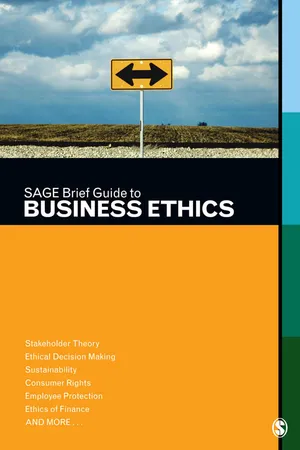
This guide to business ethics provides key terms and concepts related to business ethics in a short, easy-to-use format. It provides objective coverage of theories, corporate social responsibility, human resources issues, consumer protection, and ethical issues in marketing and advertising. It is an ideal supplement for business ethics courses or as a reference for students and practitioners who would like to learn more about the basics of business ethics.
- 408 pages
- English
- ePUB (mobile friendly)
- Available on iOS & Android
eBook - ePub
SAGE Brief Guide to Business Ethics
About this book
Information
PART I
What Is Business Ethics?
Business Ethics
BUSINESS ETHICS
Although defining business ethics has been somewhat problematic, several definitions have been proposed. For example, Richard De George defines the field broadly as the interaction of ethics and business, and although its aim is theoretical, the product has practical application. Manuel Velasquez defines the business ethics field as a specialized study of moral right and wrong. Unfortunately, a great deal of confusion appears to remain within both the academic and the business communities, as other related business and society frameworks, such as corporate social responsibility, stakeholder management, sustainability, and corporate citizenship, are often used interchangeably with or attempt to incorporate business ethics. Relative to other business and society frameworks, however, business ethics appears to place the greatest emphasis on the ethical responsibilities of business and its individual agents, as opposed to other firm responsibilities (e.g., economic, legal, environmental, or philanthropic).
A BRIEF HISTORY OF BUSINESS ETHICS
The subject of business ethics has been around since the very first business transaction. For example, the Code of Hammurabi, created nearly 4,000 years ago, records that Mesopotamian rulers attempted to create honest prices. In the fourth century BCE, Aristotle discussed the vices and virtues of tradesmen and merchants. The Old Testament and the Jewish Talmud discuss the proper way to conduct business, including topics such as fraud, theft, proper weights and measures, competition and free entry, misleading advertising, just prices, and environmental issues. The New Testament and the Koran also discuss business ethics as it relates to poverty and wealth. Throughout the history of commerce, these codes have had an impact on business dealings. The U.K. South Sea Bubble of the early 1700s, labeled as the world’s first great financial scandal, involved the collapse of the South Sea Company. During the 19th century, the creation of monopolies and the use of slavery were important business ethics issues, which continue to be debated until today.
In recent times, business ethics has moved through several stages of development. Prior to the 1960s, business was typically considered to be an amoral activity; concepts such as ethics and social responsibility were rarely explicitly mentioned. During the 1960s, a number of social issues in business began to emerge, including civil rights, the environment, safety in the workplace, and consumer issues. During the late 1970s, the field of business ethics began to take hold in academia, with several U.S. schools beginning to offer a course in business ethics by 1980. From 1980 to 1985, the business ethics field continued to consolidate, with the emergence of journals, textbooks, research centers, and conferences. From 1985 to 1995, business ethics became integrated into large corporations, with the development of corporate codes of ethics, ethics training, ethics hotlines, and ethics officers. From 1995 to 2000, issues related to international business activity came to the forefront, including issues of bribery and corruption of government officials, the use of child labor by overseas suppliers, and the question of whether to operate in countries where human rights violations were taking place. From approximately 2000 until today, business ethics discussion has mainly been focused on major corporate scandals such as Enron, WorldCom, and Tyco, leading to a new phase of government regulation (e.g., the Sarbanes-Oxley Act of 2002) and enforcement.
This current “scandal” phase of the business ethics field has tremendously enhanced its popular use. For example, a search in Google using the term business ethics (as of November 2005) generates over 88 million hits. Hollywood continues to portray important business ethics issues or dilemmas in movies such as Wall Street, Quiz Show, Boiler Room, Erin Brockovich, The Insider, and Jerry Maguire and even in children’s films such as Monsters, Inc.
MORAL STANDARDS AND BUSINESS ETHICS
Although the field of business ethics covers a broad range of topics, the core of the field is based in moral philosophy and its use of moral standards (i.e., values, principles, and theories) to engage in ethical assessments of business activity. A literature review indicates that five moral standards have been applied in the field of business ethics to a greater extent and with greater consistency than others. Two moral theories are particularly dominant in the business ethics literature: utilitarianism and deontology. Utilitarianism, often expressed as a teleological or consequentialist framework, is primarily based on the writings of Jeremy Bentham and John Stuart Mill. Deontology (i.e., duty-based obligations) is often expressed in terms of “Kantianism” (or more specifically as the principle of the categorical imperative), being primarily based on the writings of Immanuel Kant. In addition to utilitarianism and deontology, two other moral theories (typically considered deontological in nature) have been used extensively in the business ethics field: moral rights and justice (e.g., procedural and distributive). The fifth moral theory receiving attention appears to be moral virtue, being primarily based on the writings of Aristotle. The predominant use by business ethicists of these moral theories points toward their importance in the field. Other important moral standards that are also used (although to a somewhat lesser extent) in the field of business ethics include moral relativism, ethical egoism, and religious doctrine.
There have been several means by which moral standards have been applied in business ethics. Some of the more apparent ways are (1) individual ethical decision making; (2) organizational ethical decision making (e.g., policies and practices); (3) the moral evaluation of business systems (e.g., capitalism) and the marketplace (e.g., competition); (4) the relationship between business and society (e.g., corporate social responsibility); and (5) specific issues in business (e.g., affirmative action and discrimination, conflicts of interest, privacy, whistle-blowing, executive compensation, consumer protection or marketing, and international business). In conjunction with the above are the uses made of moral standards with respect to both teaching and research in business ethics.
BUSINESS ETHICS AS AN ACADEMIC FIELD
Richard De George might be considered the first to attempt to distinguish business ethics as a separate field of study. De George suggests that business ethics is a field to the extent that it deals with a set of interrelated questions to be untangled and addressed within an overarching framework. He argues that the framework is not supplied by any ethical theory (e.g., Kantian, utilitarian, or theological) but by the systematic interdependence of the questions, which can be approached from various philosophical, theological, or other points of view.
Despite business ethics being a relatively recent distinct field of study, several typologies have emerged. There appear to be five general approaches: (1) a normative and descriptive approach, (2) a functional approach, (3) an issues approach, (4) a stakeholder approach, and (5) a mixed approach. For example, in terms of the normative/descriptive approach, academic business ethics research is often divided into normative (i.e., prescriptive) and empirical (i.e., explanatory, descriptive, or predictive) methodologies. A functional approach attempts to divide the subject of business ethics into separate functional areas such as accounting, finance, marketing, or strategy. Others attempt to categorize business ethics by using an “issues” approach—in other words, by discussing issues such as the morality of corporations, employer-employee relationships, or other contemporary business issues. Another approach attempts to discuss the subject of business ethics from a stakeholder perspective (i.e., in relation to which stakeholder is most directly affected). For example, business ethics issues might be framed based on the following stakeholders: owners, employees, consumers, suppliers, competitors, the government, the natural environment, and the community. Finally, a mixed approach draws on aspects of several of the approaches (e.g., normative/descriptive, issues, and stakeholder) and appears to be the most popular approach used by business ethics academics. For example, quite often business ethics textbooks will commence with a normative discussion of moral theory and business systems. The discussion will then turn to a more mixed normative/descriptive discussion of the specific issues. In addition, many of the issues are tied to stakeholders, typically involving employees and customers.
In terms of business ethics research, in a review of the first 1,500 articles published in the Journal of Business Ethics from 1981 until 1999, Denis Collins found the presence of the following major business ethics research topics: (1) prevalence of ethical behavior, (2) ethical sensitivities, (3) ethics codes and programs, (4) corporate social performance and policies, (5) human resource practices and policies, and (6) professions—accounting, marketing/sales, and finance/strategy.
MAJOR EARLY CONTRIBUTORS TO BUSINESS ETHICS
Several important early contributors to the field of business ethics, mainly through their initial textbook publications, include Norman Bowie, Richard De George, Manuel Velasquez, Thomas Donaldson, W. Michael Hoffman, Patricia Werhane, John Boatright, and many others too numerous to mention. John Fleming conducted a study in 1987 to determine among other things the most referenced authors, books, and articles in business ethics. The top five referenced authors were (1) Milton Friedman, (2) Christopher Stone, (3) Thomas Donaldson, (4) Peter French, and (5) Alasdair MacIntyre. The top three referenced books were (1) Christopher Stone, Where the Law Ends; (2) Thomas Donaldson, Corporations and Morality; and (3) John Rawls, A Theory of Justice. The top three referenced articles were (1) Brenner and Molander, “Is the Ethics of Business Changing?”; (2) Peter French, “The Corporation as a Moral Person”; and (3) Milton Friedman, “The Social Responsibility of Business Is to Increase Its Profits.”
BUSINESS ETHICS TODAY
Based on early efforts, the field of business ethics continues to flourish in both academia as well as the business community. For example, a search (as of November 2005) using the database ABI/Inform for the term business ethics found in scholarly journal articles generates over 11,000 hits. Several important academic journals now exist, including Journal of Business Ethics, Business Ethics Quarterly, Business & Society, Business Ethics: A European Review, and Business & Professional Ethics Journal, among others. Business ethics conferences are held annually, including those conducted by the Society for Business Ethics and the European Business Ethics Network. Every 4 years, the International Society of Business, Economics and Ethics organizes a World Congress on Business Ethics, often portrayed as the “Olympics of Business Ethics.” Research centers such as Bentley College’s Center for Business Ethics, Wharton’s Zicklin Center for Business Ethics Research, or the Ethics Resource Center based in Washington, D.C., continue to support research efforts in the field of business ethics. Surveys suggest that approximately two thirds of the top U.S. business schools now teach business ethics as either a mandatory or an elective stand-alone course. In the corporate world, the growth of ethics officers as well as the Ethics & Compliance Officer Association, ethics programs (e.g., codes of ethics, ethics hotlines or helplines), ethics audits and reports, ethical investment, and even corporate business ethics awards highlight the growing practical importance of the field. Consulting efforts in the business ethics field appear to have grown significantly as well due to the various corporate scandals and the desire of firms to avoid them in the future.
Yet despite the growth of business ethics and the apparent acceptance of its importance among many, several issues are being debated. For example, can business ethics be taught? What factors actually influence ethical behavior? What should a firm’s ethical obligations (i.e., beyond the law) consist of? Does ethical behavior actually improve the firm’s financial performance? Is a firm capable of being held morally responsible, or only the firm’s agents? How can business ethics best be integrated into a firm’s corporate culture? These issues, as well as many others, remain to be examined and debated by those active in the business ethics field.
—Mark S. Schwartz
Further Readings
Beauchamp, T. L., & Bowie, N. E. (2004). Ethical theory and business (7th ed.). Upper Saddle River, NJ: Pearson.
Boatright, J. R. (2003). Ethics and the conduct of business (4th ed.). Upper Saddle River, NJ: Prentice Hall.
Collins, D. (2000). The quest to improve the human condition: The first 1,500 articles published in the Journal of Business Ethics. Journal of Business Ethics, 26(1), 1–73.
De George, R. T. (1987). The status of business ethics: Past and future. Journal of Business Ethics, 6, 201–211.
De George, R. T. (2006). Business ethics (6th ed.). Upper Saddle River, NJ: Pearson.
Donaldson, T., Werhane, P. H., & Cording, M. (2002). Ethical issues in business: A philosophical approach (7th ed.). Upper Saddle River, NJ: Pearson.
Fleming, J. E. (1987). Authorities in business ethics. Journal of Business Ethics, 6(3), 213–217.
Goodpaster, K. E. (1997). Business ethics. In P. H. Werhane & R. E. Freeman (Eds.), Encyclopedic dictionary of business ethics (pp. 51–57). Cambridge, MA: Blackwell.
Richardson, J. E. (2005). Annual editions: Business ethics 05/06 (17th ed.). Guilford, CT: McGraw-Hill.
Velasquez, M. G. (2006). Business ethics: Concepts and cases (6th ed.). Upper Saddle River, NJ: Pearson.
PART II
Ethics and the Individual
Human Nature
Human Rights
Trust
Integrity
Ethical Decision Making
HUMAN NATURE
Human nature may be defined as the essence of the human species and consists of all the characteristics and behaviors that are inherent in human beings. While inquiries into human nature have occupied philosophers both classical and contemporary, practical men and women frequently attribute one or another experienced injury or benefit to some element of human nature and make decisions informed by their own hopes and fears. Advocates of business ethics often look to human nature to explain abuses or to propose a path of change.
WHAT MAKES A HUMAN BEING?
Humans are distinguished from animals by their ability to use tools, develop language, and reason. These last two are closely connected in that the practice of logic is intertwined with the structure of language. While rhesus monkeys have been taught to use sign language and domesticated animals are capable of understanding spoken words, the development of a formal language is unique to human beings. Indeed, humans have created a diversity of spoken and written languages, and the vocabularies of these languages reveals commonalities and differences among cultures. Written language permits a more detailed historic record and enhanced opportunities for self-consciousness and specialized labor.
In biological terms, the “human” is a mammal, large brained, has an “s”-shaped spinal column, an erect posture, opposable thumbs, an omnivorous di...
Table of contents
- Cover Page
- Title Page
- Copyright
- Contents
- Preface
- PART I: WHAT IS BUSINESS ETHICS?
- PART II: ETHICS AND THE INDIVIDUAL
- PART III: THEORIES OF ETHICS
- PART IV: ETHICS OF BUSINESS AND MANAGEMENT
- PART V: EMPLOYEE AND HUMAN RESOURCES ISSUES
- PART VI: CONSUMER ISSUES
- PART VII: ETHICS OF ADVERTISING, MARKETING, AND PUBLIC RELATIONS
- Appendix A: Problematic Practices
- Appendix B. Business Ethics Organizations
- Appendix C. Business Ethics Periodicals
Trusted by 375,005 students
Access to over 1.5 million titles for a fair monthly price.
Study more efficiently using our study tools.
Frequently asked questions
Yes, you can cancel anytime from the Subscription tab in your account settings on the Perlego website. Your subscription will stay active until the end of your current billing period. Learn how to cancel your subscription
No, books cannot be downloaded as external files, such as PDFs, for use outside of Perlego. However, you can download books within the Perlego app for offline reading on mobile or tablet. Learn how to download books offline
Perlego offers two plans: Essential and Complete
- Essential is ideal for learners and professionals who enjoy exploring a wide range of subjects. Access the Essential Library with 800,000+ trusted titles and best-sellers across business, personal growth, and the humanities. Includes unlimited reading time and Standard Read Aloud voice.
- Complete: Perfect for advanced learners and researchers needing full, unrestricted access. Unlock 1.5M+ books across hundreds of subjects, including academic and specialized titles. The Complete Plan also includes advanced features like Premium Read Aloud and Research Assistant.
We are an online textbook subscription service, where you can get access to an entire online library for less than the price of a single book per month. With over 1.5 million books across 990+ topics, we’ve got you covered! Learn about our mission
Look out for the read-aloud symbol on your next book to see if you can listen to it. The read-aloud tool reads text aloud for you, highlighting the text as it is being read. You can pause it, speed it up and slow it down. Learn more about Read Aloud
Yes! You can use the Perlego app on both iOS and Android devices to read anytime, anywhere — even offline. Perfect for commutes or when you’re on the go.
Please note we cannot support devices running on iOS 13 and Android 7 or earlier. Learn more about using the app
Please note we cannot support devices running on iOS 13 and Android 7 or earlier. Learn more about using the app
Yes, you can access SAGE Brief Guide to Business Ethics by SAGE Publications in PDF and/or ePUB format, as well as other popular books in Business & Business Ethics. We have over 1.5 million books available in our catalogue for you to explore.