![]()
1
Peer Group Lenses
Theories and Perspectives
the•o•ry, n., 1. a coherent explanation for events, behaviors, or observations. 2. a proposed explanation or opinion, whose status can be tested. 3. a guess or idea about what causes certain things to happen.
We are all theorists. Our ideas about why things happen, or what causes people to behave in certain ways, are integral parts of our everyday thinking. Our theories might be mistaken, of course, but they often help us feel in control of our social worlds. Our everyday theories also guide our choices—mental tools that can make other people seem (a little) more predictable and life events seem (somewhat) less uncertain. Our personal theories organize our thinking, for better or for worse.
Social science theories operate in much the same way. Their goal is to increase understanding about the world around us. Scholars agree, however, that what distinguishes social science theories from personally held theories is that we attempt to test scientific theories with research, and then to extend or refine these theories in systematic ways.1 Formal theories and models about social behaviors attempt to fulfill one or more purposes:
to describe behaviors,
to explain behaviors,
to predict future behaviors, or
to offer variables that may change behavior in the future.
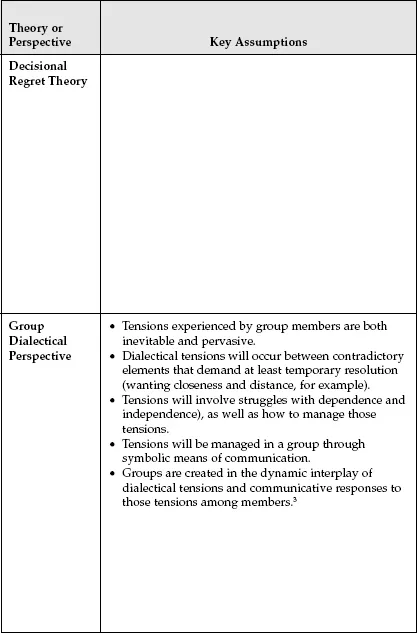
For example, Decisional Regret Theory2
- describes how people talk and think about significant decisions,
- explains how the counterfactual imagining of possible outcomes appears when people face decisional choices,
- predicts that people who cannot imagine a positive outcome of a decisional choice will reject it, and
- offers variables that affect behavior (importance of the decision, unwanted outcomes of past decisions, resolution of imagined unwanted outcomes, anticipation of decisional regret, to name a few).
When a theory or model performs any of these four functions well, helping us understand our own behaviors and those of others around us, it can be argued that such a theory is a practical theory.
Groups can be frustrating places in which to find ourselves (yet they are entirely impossible to avoid), so it is not surprising that formal theories have emerged that attempt to explain group processes and group behaviors. Group research was recently described by leading scholars Poole and Hollingshead as a “fragmented and discipline bound,” with few attempts to connect theory and research across disciplinary boundaries.3 Aptly reflecting the vagaries of real life, however, not all group theories have received their fair share of attention from scholars. Furthermore, some theories that have managed to grab the lion’s share of academic ink have devoted little, if any, attention to explaining or describing what happens in peer groups. We spend most of our life-span group time communicating in peer groups.*
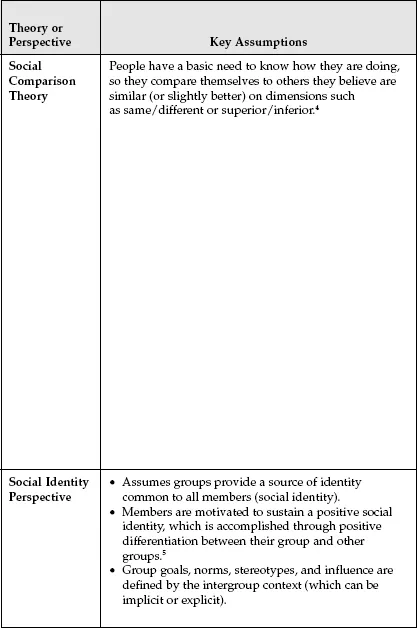
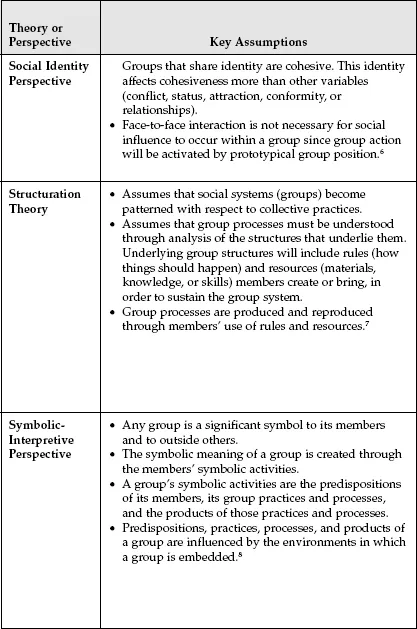
Seven useful perspectives are set forth to guide new thinking about peer group processes, drawing on the latest cross-disciplinary thinking about group dynamics. The specific assumptions of each is described to illustrate how each one is valuable in divergent ways, illuminates different constructs, and contributes to new knowledge about peer group communication, although each contributes differently. A visual tool is offered in Table 1.1 that sets out these theories and perspectives in a way that allows them to be more easily compared and contrasted. In Table 1.1, for each theoretical perspective included, the following is described:
- Key assumptions about groups from that perspective
- Applications to peer groups
- Challenges of studying group dynamics from that perspective
THEORETICAL LIGHTS THAT ILLUMINATE PEER GROUP DYNAMICS
This book shines a spotlight on intriguing (and useful) theories or perspectives that have something to say about communication in peer groups—even though (or perhaps especially because) these newer perspectives have received less attention. These theoretical perspectives can help us understand more about group communication processes in general—and peer group dynamics in particular—because they invite more events to the scholarly group-thinking party.
Symbolic-Interpretive Perspective: The Effects of Symbol Usage
Symbols are one of the primary forms of communication that all people use to share meaning with others. Rituals, objects, colors, music, silences, humor, rewards, punishments, and language are symbolic tools for human communication.
Recently, Frey and SunWolf offered the Symbolic-Interpretive (S-I) Perspective as a useful theoretical framework for understanding small-group dynamics.4 An S-I Perspective is concerned with
| (a) | understanding how group members use symbols, |
| (b) | the effects of symbol usage on individual, relational, and collective processes and outcomes, and |
| (c) | the manner in which groups and group dynamics themselves are the products of such symbolic activity.* |
Table 1.1 Group Theories and Perspectives that Apply to Peer Groups
| Theory or Perspective | Key Assumptions |
| Symbolic-Interpretivist Perspective | |
| Applications to Peer Groups | Challenges of Studying Group Dynamics From That Perspective |
- Useful to group leaders and facilitators by suggesting symbolic practices that create cohesion, satisfaction, and solve peer group challenges (for example, losing a group member or competing with other peer groups).
|
This perspective is particularly appropriate as a foundation at the outset of this chapter, because the S-I Perspective is a conceptual framework that holds or includes other group theories, including Symbolic Convergence Theory, Structuration Theory, the Group Dialectical Perspective, Decisional Regret Theory, and the Bona Fide Group Perspective (discussed individually below).
The S-I Perspective offers a dynamic understanding of two primary aspects of group life, the use of symbolic communication, and the products of such use. Group research that fits an S-I Perspective might investigate (1) the ways in which group members use symbols (words, objects, or actions that stand for or represent something else) to communicate, as well as the effects of symbol usage on individual, relational, and collective processes and outcomes; or (2) how groups and group dynamics themselves are products of this symbolic activity.
People (therefore, peers) may possess a basic need for symbols, which is said to distinguish them from animals. Even a cursory review of the underlying concepts behind the S-I Perspective demonstrates its applicability to peer groups. Frey has acknowledged the intellectual-philosophical-historical contributions to the S-I Perspective on group life. Symbols allow people to share meaning and to participate in collective action.5
Burke asserted that human beings were basically the “symbol-using (symbol-making, symbol-misusing) animal.”6 MacIntyre claimed that people are “essentially a story-telling animal.”7 Fisher offered an entire narrative theory of communication, based on understanding humans as homo narrans who organize experience into stories with plots, central characters, and action sequences that carry implicit and explicit lessons.8 Furthermore, collectively, humans create and construct their realities. As people interact in social groups, new truths, perspectives, and “facts” emerge for the members of those groups. Social constructionism, therefore, is a basis for the S-I Perspective. Social constructionism has brought us concepts such as transactive memory (shared systems for encoding, storing, and retrieving information),9 shared mental models (mental processes in which people create descriptions of how things function and predict future events), 10 and negotiated order (when group interaction does not proceed smoothly and individual behaviors do not mesh, individuals must adjust, through explicit or implicit negotiation).11
As a perspective, S-I makes certain assumptions about groups:12
- Any group is, in reality, a concept socially constructed by its members and outside others, rather than an entity in an objective sense.
- Groups are not fixed containers with static boundaries. They do not exist apart from their environments.
- Groups are dynamic products resulting from the symbolic activities of their members, which are the primary means by which members create shared reality and groupness.
- Studying the social construction of any group requires methods that focus on the use and interpretation of symbols.
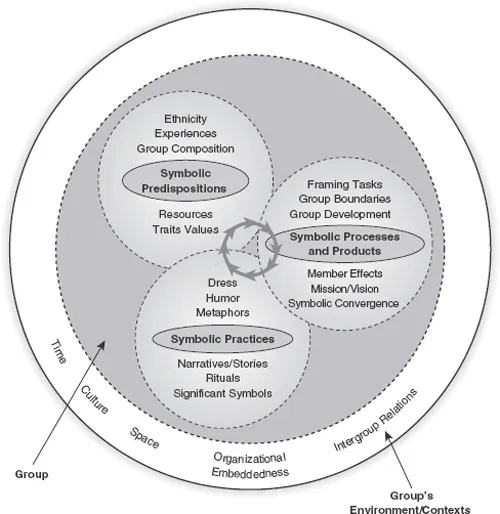
Frey and SunWolf offered a visual model that articulated the symbolic nature of group dynamics and the constructs of interest to this perspective, reproduced as Figure 1.1.13
As portrayed in this model, an S-I Perspective on groups focuses on three aspects of symbolic activities that occur within a group, each of which contains specific constructs of interest:
- symbolic predispositions,
- symbolic practices, and
- symbolic processes and products.
Symbolic predispositions are the tendencies a person may have to do something (that is, to act in a certain way), so symbolic predispositions include the ways in which people are initially inclined toward other people. As group members interact, the S-I Perspective suggests that they engage in symbolic practices (specific communication such as humor, metaphors, rituals, or stories). During symbolic practices, members create symbolic processes and products, which refer to both macrolevel group dynamics (group identity and culture) and the specific outcomes of group symbolic activity (strategies, activities, or decisions). Frey noted that the linking together of processes and products, as opposed to treating them as separate entities, highlights their recursive and reflexive relationship, arguing that group culture is both a process and a product that results from and influences symbolic practices.14
Figure 1.1 Symbolic-Interpretive Model of Group Predispositions, Practices, Processes, and Products
Source: Frey, L. R., & Sunwolf. (2005). The symbolic-interpretive perspective on group life. In M. S. Poole & A. Hollingshead (Eds.), Theories of small groups: Interdisciplinary perspectives (pp. 185–239, Figure 1). Thousand Oaks, CA: Sage. Reproduced with permission.
The S-I model demonstrates that these domains are not mutually exclusive (as visually indicated by overlapping circles) and that they influence one another (as indicated by bidirectional arrows between circles). For example, ethnic diversity in a group (a symbolic predisposition) may create dialectical tensions in the group (symbolic processes and products) that need to be managed through particular rituals (symbolic practices) that subsequently affect how the diversity of new and current members is perceived and interpreted.15 Symbolic predispositions, practices, processes, and products emerge and merge continually during group formation and, in fact, throughout the c...