In this timely book Irene Rubin focuses on how government tried and eventually succeeded in balancing the U.S. federal budget in 1998. With characteristic insight and a lively narrative, Rubin describes the successive efforts of Congress and the administration over seventeen years to shape a process that would encourage balance, as well as the reactions of federal agencies to the pressure.
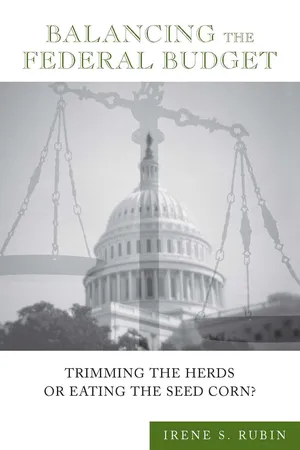
- 295 pages
- English
- ePUB (mobile friendly)
- Available on iOS & Android
eBook - ePub
About this book
Information
CHAPTER 1
1981–98: Balancing the Budget: What Have We Learned?
DEFICITS WERE A CHARACTERISTIC of U.S. budgeting for many years. As long as they were moderate in size, they caused no particular alarm or embarrassment, but major tax breaks, a deep recession, and a defense buildup in the early 1980s contributed to an embarrassing increase in the size of the federal deficit. By 1993 outgoing president George Bush issued a budget projection indicating that there would be a deficit of $327 billion that year, and he predicted that the deficit would be markedly higher near the end of the century. Huge deficits constrained budgeting, locking in old priorities and crowding out genuine choice.1 By the end of fiscal year 1998 President Clinton announced a budget surplus and it looked as if surpluses would continue for some time.
This book analyzes 17 years of efforts to balance the federal budget, from the early Reagan presidency in 1981 to the surplus budgets beginning in 1998. When appropriate to describe ongoing adaptations, the study is extended to 2000. Was balance achieved as a result of intentional efforts on the part of government officials who learned from trial and error how to regain budget balance? The historical record suggests that learning did take place but provides only hints about what may have been learned by whom. It was not immediately clear whether the federal government learned to set priorities or to make meaningful tradeoffs. The government curtailed growth in spending, but to what extent did it “eat the seed corn,” that is, consume its capital, in terms of knowledge, skills, and programs, or “trim the herds,” that is, cut back the deer population to what the land would bear, or, less metaphorically, reduce programs to a sustainable level, given the negotiated size of government and level of taxation? Cutback does not necessarily lead to better and more responsive government at lower costs; it may result in worse management and less responsive government at higher costs.
At the macro level, this book examines budget processes, revenue increases and decreases, and summit agreements that contribute to balanced budgets. At the micro level, it looks at the agencies’ responses to a continuing level of budget uncertainty; to budget and staffing cuts; to threats of termination or dismemberment; and to pressure to provide better, more responsive services more cheaply. The focus is on what was learned and not learned over 17 or more years.
The analysis takes place in the context of one overarching story. The president and Congress tried a number of times to balance the budget between 1981 and 1998, with some dramatic failures and, finally, with increasing success. Success was due in part to a long-term, booming economy that produced unexpected revenue, but it was also due to tax increases and to staffing and budget reductions. The budget process itself was changed several times in an effort to find a formula that would strengthen discipline. The changes in the budget process helped to bring about balance.
If the federal government did indeed learn to solve the policy problem of huge structural deficits in the budget, even if imperfectly and with the help of an expanding economy, then it may be able to learn to address other serious policy problems. If government has learned, then there must be mechanisms for learning that can be strengthened or weakened. This book addresses the question of learning exclusively in the context of balancing the budget, but the analysis has broader applicability because budget balancing shares features of many other policy problems.
WHY BALANCE THE BUDGET: DEFINING THE PROBLEM
The goal of a balanced budget is fundamentally a political one, not an economic or technical one. Its value was defined and redefined by governmental actors and nongovernmental organizations (NGOs) over the 17 or so years covered by this study. As one interviewee explained, there was no clear economic justification for why the deficit had to be brought down:
We [at OMB] used to say we had to bring down the deficit because it caused inflation … but then there was little inflation and there were still high deficits, so the argument faltered. We don’t say that any more. It is all political.2
Along similar lines, a former agency budget director argued,
The economists overemphasize the importance of the deficits. Other countries have much larger deficits with respect to GNP. The elimination of the deficit is more a matter of priorities for programs than economics.3
While some economists argued that the deficits did major harm to the economy, others argued that sharp, short-term declines in spending might put the economy into a tailspin. The fear of precipitating a recession by bringing down the deficit gradually dissipated with experience:
One thing that we have learned is that there is less reason to be concerned about the macro effect of restraints. The effects of deficit reduction are less than the economists thought. We can reduce the deficit by ½ percent or ¼ percent of the GDP without exaggerating cyclical swings. Monetary policy is more important than we thought [and deficit reduction less important].4
The economists were not able to provide a standard that said, this much deficit is okay, but that much is too much; nor were they able to say that the deficit could safely be reduced by this much but not that much. In the face of this lack of knowledge, there was not much agreement on how important it was to reduce the deficit or how fast it needed to be done. Many people believed that cutting so much money to balance the budget was wrongheaded and took resources away from more important problems. They recognized that budgetary balance was not just a technical goal, but also a political and symbolic one, laden with values and ideology, fraught with distributional and redistributional consequences.
Robert Eisner, an academic economist who often wrote on the deficit, argued that it was too low. At around 1 percent of GDP, the U.S. deficit was the lowest in the industrial world. He asked why we should not run deficits of 3 percent of GDP like other countries and suggested the range of benefits that would come from the additional spending:
Imagine what we could do in education, in health care, in infrastructure, in fighting crime, in moving people from welfare to work and bringing our frightening underclass into constructive roles in our society, if we thought not to eliminate that last one percentage point of deficit but to raise the deficit, say to the European target of 3 percent.
Eisner also sketched some potential negative consequences of further deficit reduction, including lower purchasing power, that might slow the economy.5
Senator Ted Kennedy, who argued that he favored a balanced budget, commented on the May 1997 presidential-congressional plan to balance the budget in terms of who was being helped and who was being hurt. He noted that cuts up to that point had fallen disproportionately on the poor and that the tax benefits in the new agreement benefited the very rich disproportionately. He also argued that the benefits to the rich would become more costly after the target year of 2002, possibly forcing additional spending cuts later, at the same time that Social Security and Medicare would be demanding more spending to meet the needs of an aging population.
That balancing the budget is a political goal rather than a technical problem best undertaken by economists is underscored by the fact that economists have not agreed on the importance of deficits or on the nature of their impacts on the economy, and they have also changed their arguments over time, as one or another claim has proven incorrect. Aaron Wildavsky, an academic who wrote on both budgeting and the role of policy analysts in influencing government, argued that economists were trying to influence the public policy debate, so that “otherwise trustworthy economists sometimes shade their arguments for effect in order to push the policy they desire. Excessive condemnation of the deficit has proceeded, in part, from such experts putting the matter too strongly for fear of otherwise being ignored by politicians, or in order to counter the minority of economists who dismiss the deficit’s importance.”6
Regardless of the actual economic consequences of a reduction or elimination of the deficit, eliminating the deficit was taken as a governmental goal. In the absence of technical standards, political policy preferences reigned. Different actors had different preferences. One factor that became relevant was the political payoff for deficit reduction:
If the deficit is too large and you reduce it, you are better off with [a] lower than [with a] higher deficit, moving in the right direction is positive. It is not irrelevant. But to the extent that the popular imagination has been captured by zero as a religious icon, when one is in a situation of a $220 billion deficit and one has to engage in substantial pain to go from $220 to 180 billion in the early 1980s, there is a sense in which policy makers would conclude there is not much gain for all that pain. In contrast, for the last couple of years, at the risk of sounding self serving, because of the 1993 actions of this administration, people could speak realistically about a balanced budget, there has been more in it for policy makers.7
Getting to zero became politically feasible after a major tax increase combined with continuing spending discipline. But zero was not everyone’s target. It was popular with the public but not with those who had been using the elimination of the deficit as a way of reducing public spending and the scope of governmental activities. For them, zero deficit would be a kind of stopping point when what they wanted was to keep going. They wanted to shift grounds to paying off the debt rather than stopping at zero deficit:
If zero is taken as bliss, one defines policy to get to zero. You can find yourself where people of extreme political stripe—zero isn’t good enough—doesn’t force the kind of change in government that they wanted. That is why the administrative proposal was so dangerous to them. If zero is the target, how can you go beyond zero? Balance cuts out from under you things that you really want to do.8
At the Committee for Economic Development, spurring faster economic growth was the target. Zero deficit was not the aim; the goal was a surplus:
This organization [Committee for Economic Development] supported a surplus, not balance, for macro-economic reasons. Trying to compensate for low savings by reducing the debt. No new debt. It would increase national savings by default.… It is important to move in that direction because of our low savings rate. Other countries have 4–5 times the rate of private savings.9
In short, the goal of balancing the budget was not a single goal on which all the key actors agreed. Some believed the budget should not be balanced if balance could be obtained only by burdening the poor. Some wished to merely reduce the size of the deficit; others wished to bring it to zero; while others wanted the government to run a surplus in order to pay off the national debt. Some wanted to appeal to citizens who believed that budgets should be balanced (the magic zero); others wished to cut back the size and intrusiveness of government and use the deficit as an excuse to do so; others were more interested in shifting the distributional burden of government so that the rich paid less for and the poor benefited less from governmental services. The technical decisions regarding how to bring about balance were made more complex by lack of agreement on what was to be accomplished, for whose benefit, and what the result of cutting the deficit would actually be:
The problem of the deficit is the plight of politics and polity. The numbers don’t drive this; politics are behind it. Party politics in this case. It is also bound up by interest group politics, unions, corporations, and ads to manipulate public opinion.
Mostly it is lip service to balance the budget, but there is no agreement on specifics, the numbers are close, but not the content. The Republicans insist on a tax cut, the Democrats won’t accept a tax cut.10
Mostly it is lip service to balance the budget, but there is no agreement on specifics, the numbers are close, but not the content. The Republicans insist on a tax cut, the Democrats won’t accept a tax cut.10
The subjectivity of the problem and lack of agreement on goals showed up distinctly in the nongovernmental organizations that clustered around the budget balance issue, trying to shape the public’s, the press’s, and the politicians’ views of the problems. These organizations put forward different positions on which taxes to maintain or to cut, which tax breaks to eliminate or maintain, which agencies and programs to eliminate or maintain, and the definition of balance itself. The Concord Coalition and the Committee for a Responsible Budget were deeply involved and primarily focused on budget balancing issues. Organizations such as the Committee for Economic Development and the Center for Budget and Policy Priorities had other goals, such as economic growth or support for the poor, that became entwined with issues of budget balance. Coalitions of community organizations lobbied against the Balanced Budget Amendment, though their real focus was elsewhere, on housing the homeless, creating jobs for the unemployed, and improving the quality of life in the inner cities.
The Concord Coalition was particularly interesting because it was a grass-roots organization trying to create an environment that would facilitate political agreement over the deficit. If it could reach and mobilize the public to make demands on politicians, it might make what was politically difficult less costly. The Committee for a Responsible Budget, though emphasizing legislative proposals to balance and otherwise reform the budget process, also maintained a grass-roots educational campaign to raise the awareness of citizens about the complex choices confronting decision makers.
There were interest groups operating at nearly every level to influence the public directly and the elected officials indirectly and to lobby politicians and shape the understanding of the issues in the press. For nearly every possible major choice, there were interest groups pro and con, making nearly every choice politically risk-laden.
Over time, there was a shift from balancing the budget through a combination of increased taxes and program cuts to cutting programs and not increasing taxes. Then pressure increased to actually cut taxes while trying to balance the budget. With such heavy emphasis on cutbacks, deciding how to allocate remaining resources became crucially important and triggered partisan quarreling. The breadth of effects of potential and actual budget cuts makes budget balancing a messy problem, not easily solved incrementally but almost impossible to deal with more globally.
While there is relatively little technical agreement on how the goal of balancing the budget is to be achieved, there is a widespread public expectation of an idealized solution. It is an example of a highly politicized goal, based on anticipated winners and losers. Because there is little agreement on the means but a general consensus that achieving the goal, variously defined, would be good, politicians sometimes indulge in symbolic politics, such as long-term agreements to balance the budget with the majority of the cuts set for future years or with the establishment of overall targets that would then be evaded by all parties. Such symbolic stances stretched out the time it took to learn how to solve the problem. The failure of such symbolic approaches ultimately made the elected officials look foolish, motivating more serious efforts to address the problem.
LEARNING HOW TO BALANCE THE BUDGET
In the 17-plus years of efforts to balance the budget, many changes occurred in policy and process. Weak laws resulted in embarrassing outcomes that in turn produced tighter and better legislation. The newer legislation was generally effective. One can infer from these developments that discipline was exercised and that learning occurred.
In the 1980s budgeters would probably have come to a different conclusion. Laws to reduce the deficit were routinely ignored, deficits continued to mount, and budget balancing seemed to be more a matter of the manipulation of symbols than an exercise in discipline. Many budgeteers described each major change in the budget process as an independent and somewhat startling event, making it nearly impossible to see if learning had occurred from one change to the next. But looking back from the late 1990s, it...
Table of contents
- Cover Page
- Title
- Copyright
- Contents
- Tables
- Preface
- Acknowledgments
- 1. 1981–98: Balancing the Budget: What Have We Learned?
- 2. What Happened and What Was Learned
- Part One. Eating the Seed Corn?
- Part Two. Trimming the Herds?
- Notes
- Index
Trusted by 375,005 students
Access to over 1.5 million titles for a fair monthly price.
Study more efficiently using our study tools.
Frequently asked questions
Yes, you can cancel anytime from the Subscription tab in your account settings on the Perlego website. Your subscription will stay active until the end of your current billing period. Learn how to cancel your subscription
No, books cannot be downloaded as external files, such as PDFs, for use outside of Perlego. However, you can download books within the Perlego app for offline reading on mobile or tablet. Learn how to download books offline
Perlego offers two plans: Essential and Complete
- Essential is ideal for learners and professionals who enjoy exploring a wide range of subjects. Access the Essential Library with 800,000+ trusted titles and best-sellers across business, personal growth, and the humanities. Includes unlimited reading time and Standard Read Aloud voice.
- Complete: Perfect for advanced learners and researchers needing full, unrestricted access. Unlock 1.5M+ books across hundreds of subjects, including academic and specialized titles. The Complete Plan also includes advanced features like Premium Read Aloud and Research Assistant.
We are an online textbook subscription service, where you can get access to an entire online library for less than the price of a single book per month. With over 1.5 million books across 990+ topics, we’ve got you covered! Learn about our mission
Look out for the read-aloud symbol on your next book to see if you can listen to it. The read-aloud tool reads text aloud for you, highlighting the text as it is being read. You can pause it, speed it up and slow it down. Learn more about Read Aloud
Yes! You can use the Perlego app on both iOS and Android devices to read anytime, anywhere — even offline. Perfect for commutes or when you’re on the go.
Please note we cannot support devices running on iOS 13 and Android 7 or earlier. Learn more about using the app
Please note we cannot support devices running on iOS 13 and Android 7 or earlier. Learn more about using the app
Yes, you can access Balancing the Federal Budget by Irene S. Rubin in PDF and/or ePUB format, as well as other popular books in Politics & International Relations & Public Affairs & Administration. We have over 1.5 million books available in our catalogue for you to explore.