- 376 pages
- English
- ePUB (mobile friendly)
- Available on iOS & Android
eBook - ePub
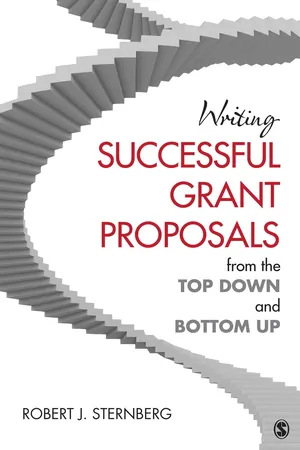
Writing Successful Grant Proposals from the Top Down and Bottom Up
About this book
This text provides comprehensive advice on how to build a successful grant proposal, from the top down and from the bottom up. Editor Robert J. Sternberg gathers editorial expertise from distinguished members of associations in the Federation of Associations of Behavioral and Brain Sciences, which includes some of the most successful grant applicants and grant givers in the field of brain and behavioral sciences. The chapter authors offer readers practical advice on planning, executing, submitting, and revising grant proposals in order to maximize their chances of success. Exploring both grant writers? and grant providers? perspectives, the text provides valuable insight into general strategies on how to write and submit proposals, as well as detailed information on the various types of proposals needed to reach particular research and teaching goals.
Information
PART I
General Information About Obtaining Grants

1
Securing a Research Grant
Robert J. Sternberg
When I started as an assistant professor in 1975, I was offered $5,000 in seed money from my university to start up my research. I had no extramural (outside) funding. A quarter century later, I had more than $6 million in extramural funding. But, there were some years that I seemed to have the golden touch in getting grants and other years in which everything I touched seem to turn to lead. Oddly, I never could predict which grant proposals would get funded, even after years of experience writing proposals.
That is the first lesson you need to learn about securing research grants. The grant-getting process is uncertain: One never knows which grant proposals will be funded, nor even how long one’s funding will last. It is not uncommon for budgets to be cut in midstream, leaving the principal investigator with expenses and commitments that were made in good faith but that no longer can be met. Worse, those multiyear projects can disappear with the drop of a hat if Congress decides, for one reason or another, not to budget certain funds or if a foundation decides that its interests have changed and your work is no longer of interest to them.
Although the funding landscape is fraught with booby traps, there are steps you can take to maximize your chances of avoiding those traps—of securing and maintaining your funding, at least to the extent possible. This chapter discusses some of those steps.
Before making suggestions, I should add that my comments are based on experiences (a) of my own in trying to get funded, (b) that my colleagues have had in seeking funding, (c) that I’ve had reviewing grants, and (d) of serving on a panel that funded research (sponsored by the Air Force Office of Scientific Research [AFOSR]). I hope my experiences are helpful. But, do not limit yourself to learning from my experience! Talk to others in your department or unit who are experienced in getting grants, and ask them for tips. You might even ask to see their old grant proposals, just to get a concrete sense of what successful proposals look like. Most important, read as much of this book as possible to learn from the diverse experiences of the chapter authors.
In the granting enterprise, to some extent, you “make your own luck.” First, let’s consider why you should apply for a grant. Next, let’s discuss the kinds of organizations that fund research. Then, let’s talk about the actual process of getting funded. Then, let’s consider techniques to maximize the chances of your getting funded. Finally, let’s consider how proposals are evaluated.
There are many different kinds of grants. Some grants fund research, but others instead fund travel, teaching, or development of particular commercial products. This chapter focuses on research grants. Other chapters in this volume focus on other aspects of grants.
Why Apply for a Research Grant?
Why should you apply for a research grant? There are several reasons.
First, it will provide you with funds to do your research. Even relatively inexpensive research costs something and having a research grant helps ensure that you can accomplish the research you would like to do. Even if you do relatively inexpensive research, having a grant means you will no longer have to rely on departmental funds or perhaps your own.
Second, research grants help support students. Many graduate students and postdoctoral fellows are supported partly or exclusively by research grants, and without such grants, some members of the next generation of researchers might never have the opportunity to be trained. Moreover, you are helping your department by investing your grant funds in students so that the department (or university) can invest in other things.
Third, a research grant can free you from responsibilities you may wish to delegate to others. For example, you may use the research grant to pay someone other than yourself to test participants or to prepare stimulus materials under your direction. Although there are fun parts of research, copying documents, coding data, and preparing each piece of research material are probably not among those fun activities but rather are ones you would rather delegate to others paid off grants.
Fourth, research grants can provide you with summer salary if your institution pays you for less than 12 months. Many universities do, in fact, pay salaries for less than 12 months. A research grant can provide one, two, or sometimes even three months of summer support, thus supplementing the researcher’s income. Of course, when you take summer salary, you are expected to work on the research during the time you are drawing the salary. Many investigators find that, as a result of teaching obligations, it is hard to devote the time they would wish to research during the nine or so months in which they are teaching. So having summer support can greatly accelerate one’s research enterprise while providing needed funds for living expenses.
Finally, obtaining a research grant marks you as a serious (and fundable!) scholar and can help you when it comes time for promotion and tenure decisions. At a major research institution, getting a grant may be a sine qua non for promotion or tenure. Even at an institution that emphasizes teaching, having a research grant can set you apart from your colleagues.
Thus, it makes sense to apply for a research grant as soon as one possibly can once one begins one’s career. Some scholars even apply during their postdoctoral years to get a head start on their research.
Who Funds Research and How Do They Fund It?
There are many different kinds of funding organizations. Some of these organizations are very specific in the kinds of research they fund, whereas others are more general. The main types of organizations that fund university research are universities, governmental organizations, nongovernmental organizations, foundations, and corporations. Much more detail is contained in subsequent chapters of this book.
Intramural (Internal) Grants
Universities often have limited funds to support the research of their own students and faculty members. These funds may be available to anyone who applies or may only be available to certain individuals, such as new faculty members, junior faculty members, or faculty members who have not succeeded in gaining external support. The funds are typically awarded on a competitive basis. Universities are often willing and eager to provide first small seed grants to new faculty, so be sure to check on the availability of funding from your own institution.
In my experience, universities are more likely to provide funds to early-career researchers than to later-career researchers, on the view that those in early career need some initial funding to kick-start their careers. However, there are various kinds of exceptions. For example, at my previous university, Tufts, my colleagues and I in the Office of the Dean of Arts and Sciences initiated a program to help senior faculty who had gotten off track in their research to get back on track again. At my current university, Oklahoma State, my colleagues and I in the Office of the Provost have initiated a program of funding for planning grants to support creative interdisciplinary research that helps to support the land-grant mission of the university. In sum, it always pays to check whether there are special intramural programs in your institution that will fund your research, no matter where you are in your career.
Extramural (External) Grants
Governmental Organizations
Governmental funding organizations are sponsored by national, state, and local governments. Examples of governmental organizations in the United States are the National Science Foundation (NSF), the National Institutes of Health (NIH), the United States Military (e.g., Army Research Institute, Office of Naval Research, and Air Force Office of Scientific Research), and the U.S. Department of Education (e.g., the Institute of Education Sciences [IES]). National organizations such as these have regular grant competitions and you can find out about these competitions either through your grants and contracts office or through the agencies’ websites. State and local governmental organizations may have research funds but may not have regular competitions for them.
Government grants are typically for 3 years, although they may be for less time (such as a year) or for more time (typically up to 5 years). It is important to realize that a commitment by the government to fund your research for a specified period of years does not guarantee you will actually get the funding you were promised. Many variables can intervene. The agency’s budget may be cut by the government, resulting in your budget’s being reduced or sometimes even eliminated. The agency may be dissatisfied with your progress and terminate your funding (which is relatively rare but does happen). Or, the agency may change its priorities and decide your project no longer fits its goals. You should thus be optimistic that commitments to you will be met, but you should by no means feel certain of it.
Most grants require progress reports at least once a year, and it behooves you to do such reports with the utmost of care and to put your research in the most positive light possible. Some agencies also conduct site visits: Members of a team come to the site of the research to evaluate the quality of the work. These visits also should be taken very seriously.
As you will learn in later chapters, governmental organizations have diverse programs. Some fund only research of a particular kind or in a particular area. Others are more wide ranging. Grants.gov is a source of information about a wide variety of governmental grants. Typically, there are many steps in submitting grant proposals to government agencies, so it behooves you to start the process of preparing the proposal early. The best way to start is to look on the appropriate website to see what is available and to determine what might be a good match to your own research. It is also an excellent idea to talk to a relevant program officer before you start writing to ascertain his or her views on the appropriateness of your ideas for the particular program he or she heads.
My best experience with a governmental grant was my first: I was funded by NSF my first year as an assistant professor, despite the fact that the grant proposal I wrote was anything but exemplary. I learned then that granting agencies often go out of their way to fund new investigators if they possibly can. My worst experience was with the U.S. Department of Education: We got all “excellent” ratings from outside reviewers, something that had never happened to me before. But, the program director turned down the grant because she thought it too similar to another proposal we had submitted that they had funded. We pointed out that the other grant proposal had not, in fact, been funded. After further investigation, she conceded this fact, but unwilling to admit she had made a mistake—an event not uncommon in life—she refused to reconsider.
Nongovernmental Organizations
Nongovernmental organizations are entities that are not tied to any one government or that are tied to multiple governments but that are run somewhat independently of these governments. Examples of nongovernmental organizations are the World Bank, North Atlantic Treaty Alliance, and World Health Organization. These organizations are less likely to have regular funding competitions, and you need to consult their websites or, if you have contacts, individuals within the organizations to find out about funding opportunities.
My best experience with a nongovernmental organization was funding that created a program for enhancing the intelligence of Venezuelan college students. The proposal was a real shot in the dark, and this grant gave me an opportunity to visit Venezuela several times in the early 1980s, to learn Spanish, and to write a book that I otherwise never would have written. My worst experience was with the same organization. When the political party in power was thrown out, I learned that the nongovernmental organization was not as nongovernmental as I had thought. The new president had campaigned on the silliness of programs to increase intelligence and indicated he would not support them if elected. When he was elected, the “nongovernmental” organization proved to be more “governmental” than we had thought and that was the end of the funding.
Foundations
Foundations are privately owned and operated, and typically are more targeted and mission-oriented than government in the particular kinds of research they will fund. Examples of foundations are the Spencer Foundation, the W. T. Grant Foundation, the John Templeton Foundation, the James McDonnell Foundation, and the MacArthur Foundation. There are hundreds of foundations that fund research, but the chances are that only a small number, if any, will fund the particular kind of research you want to do.
Foundations generally run with small staffs. This means that you need to rely heavily on website and other documents because their staff members often are already hard-pressed to meet all the demands on their time. Nevertheless, there are occasionally foundation officers who will be willing to talk to you about your grant proposal. The foundation website will probably indicate the level of assistance that is available.
My best experience with foundation funding was with a grant from the James S. McDonnell Foundation we had through the Partnership for Child Development, then at Oxford University. It enabled us to collaborate with other psychologists as well as epidemiologists, parasitologists, anthropologists, and economists on a project investigating the effects of parasitic illnesses on children’s cognitive abilities. The project enabled us to do research in parts of the world in which we never had imagined we would work—Jamaica, Kenya, Tanzania, Zambia, and other locations, collaborating with individuals who taught us lessons we never would have learned from our typical research. My worst experience with foundation funding was submitting a proposal and hearing—nothing. I just never got a response, despite my having cleared the proposal through the foundation office.
Corporations
Corporations generally are private entities. They may be for-profit or nonprofit. Corporations tend to be the most selective in the kinds of research they fund. Typically, they are interested in research that will improve sales of their products or services. You need to be especially careful in selecting corporations to which to apply for funding.
Sometimes corporations have rules regarding publication of data that render problematical the receipt of funding from them. For example, they may insist on reviewing potential publications before they are submitted, or they may have a nondisclosure policy that forbids publication at all. If the research does not go the way they hoped, they may lose interest in continuing funding of the research and may even hamper the research enterprise. It is therefore important to carefully check the terms to which you agree to make sure that the terms suit you as well as the corporation. Universities sometimes will not approve corporate-funded research if the corporation places too many constraints on publication of the data—for example, requiring approval of the corporation before any documents based on the research are published.
My best experience with corporate funding was when a large testing organization agreed to fund what was, to that time, what I considered to be the most important research project I had ever done—one that showed that tests of creative and practical thinking could double prediction of college freshman grade-point average over standardized test scores taken the senior year of high school. That experience became my worst, however, when the corporation cut off our funding immediately upon learning that supplementing its test with our test resulted in much better prediction (and also reduction in ethnic-group differences) relative to the use of its test alone.
When we apply for research funding, we often investigate funding organizations that we think other researchers are less likely to apply to. Organizations like NSF and NIH receive huge numbers of proposals, because their funding priorities meet the needs of so many researchers and because these organizations are so visible. Ask yourself whether there might be organizations interested in your research that are not as widely sought after.
The Need for Entrepreneurial Spirit
In the past, researchers could apply to the major funding organizations such as NSF and NIH and expect that if they had a reasonably good proposal, they would be funded. This was the case when I started my career. Moreover, my advisor, Gordon Bower, told me that when he started his career, anything that was even reasonably good had substantial probability of being funded. But, with the increase in the number of researchers in the field and the decreases in research budgets, many good or even excellent proposals fail to get funded. It therefore behooves you to think about places where your colleagues are less likely to apply and hence where you may have a better chance of funding.
Another issue you may have to face is that the areas of heaviest funding may not correspond to what you most want to investigate. I have faced this issue many times in my own career. You therefore may find yourself facing a choice of writing a proposal that is your dream research project, but without much hope of funding, or writing one for research that is not quite as high on your priority list but that is higher on the list of priorities for agencies that are providing funding.
Also, find out whether an organization requires a preproposal. A preproposal is a brief document, often as little as three to five pages, that describes the concept of the proposed research, how the research would be executed, and the rough budget for the research. Preproposals are commonly required by foundations and corporations, and by some governmental organizations as well (such as the military ones). Preproposals require a little extra work initially but often can end up saving you a lot of time later on. If the organization does not accept your preproposal, at least you have saved yourself the bother of having to write a full proposal, a process that typically is quite time-consuming.
Even if an organization does not request a preproposal, often, a program officer will be willing to chat with you or communicate by snail mail or e-mail regarding ideas you have. The program officer often can give you an idea of whether your idea sounds appropri...
Table of contents
- Cover
- Title page
- Copyright
- Contents
- Foreword
- Preface
- About the Contributors
- Part I: General Information About Obtaining Grants
- Part II: Applying for Grants from Specific Funding Agencies
- Part III: Collaborative Grant Proposals
- Part IV: Conclusion
- Author Index
- Subject Index
Trusted by 375,005 students
Access to over 1.5 million titles for a fair monthly price.
Study more efficiently using our study tools.
Frequently asked questions
Yes, you can cancel anytime from the Subscription tab in your account settings on the Perlego website. Your subscription will stay active until the end of your current billing period. Learn how to cancel your subscription
No, books cannot be downloaded as external files, such as PDFs, for use outside of Perlego. However, you can download books within the Perlego app for offline reading on mobile or tablet. Learn how to download books offline
Perlego offers two plans: Essential and Complete
- Essential is ideal for learners and professionals who enjoy exploring a wide range of subjects. Access the Essential Library with 800,000+ trusted titles and best-sellers across business, personal growth, and the humanities. Includes unlimited reading time and Standard Read Aloud voice.
- Complete: Perfect for advanced learners and researchers needing full, unrestricted access. Unlock 1.5M+ books across hundreds of subjects, including academic and specialized titles. The Complete Plan also includes advanced features like Premium Read Aloud and Research Assistant.
We are an online textbook subscription service, where you can get access to an entire online library for less than the price of a single book per month. With over 1.5 million books across 990+ topics, we’ve got you covered! Learn about our mission
Look out for the read-aloud symbol on your next book to see if you can listen to it. The read-aloud tool reads text aloud for you, highlighting the text as it is being read. You can pause it, speed it up and slow it down. Learn more about Read Aloud
Yes! You can use the Perlego app on both iOS and Android devices to read anytime, anywhere — even offline. Perfect for commutes or when you’re on the go.
Please note we cannot support devices running on iOS 13 and Android 7 or earlier. Learn more about using the app
Please note we cannot support devices running on iOS 13 and Android 7 or earlier. Learn more about using the app
Yes, you can access Writing Successful Grant Proposals from the Top Down and Bottom Up by Robert J. Sternberg in PDF and/or ePUB format, as well as other popular books in Psychology & History & Theory in Psychology. We have over 1.5 million books available in our catalogue for you to explore.