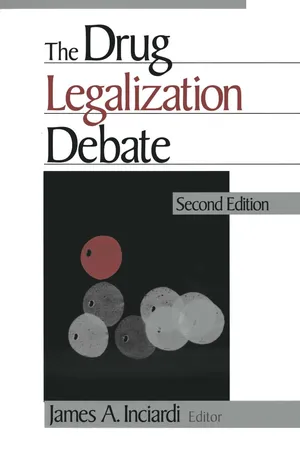
Retaining the focus and spirit of the widely adopted and acclaimed first edition, The Drug Legalization Debate, Second Edition, offers several alternatives and addresses the major issues involved in the continuing drug legalization debate. This volume delves into the history of drug use and abuse in America and the federal government?s approach to drug control—including deterrence, treatment, education, and prevention. Chapters confront topics such as the decriminalization of marijuana, the risk of the war on drugs, an enlightened legalization policy, and discussion of the ethical and legal dilemmas at stake. Updates of retained chapters and new chapters deal with drug use trends of the ?90s, including the use of cannabis as a wonder drug and a look at whether legalizing drugs would really reduce violent crime. In addition, the second edition features a substantive introduction and closes with Paul Stares? acclaimed piece titled "Drug Legalization: Time for a Real Debate." Students and professionals in substance abuse, criminology, sociology, psychology, and social work will find this book essential reading.
Concern over the use and abuse of illegal drugs remained critical throughout the 1990s. In fact, regardless of political affiliation and ideology, socioeconomic status and ethnicity, or geographical location and occupational status, most Americans continued to rank “drugs” among the major problems facing the nation for three reasons. The first was crack-cocaine and its relation to crime. Although both the use of crack and rates of violent crime had declined somewhat by the middle of the decade, the linkages between “drugs and crime” had long since become fixed in the mind of America. This was exacerbated by a continuing flow of media stories about drug abuse and the escalating numbers of drug-involved offenders coming to the attention of the police, courts, and prisons.
The second issue was the movement of heroin from the inner city to mainstream culture, and in particular, the increased visibility of heroin in popular culture. A number of celebrated rock groups were linked to heroin use, through a member’s overdose, arrest, or admission to treatment—Smashing Pumpkins, Red Hot Chili Peppers, and Nirvana to name but a few. Hollywood also played on heroin’s popularity in Trainspotting, Pulp Fiction, and Basketball Diaries. There was the fashion industry’s promotion of “heroin chic” images in magazines and on television and billboards. And then there was the death of actor River Phoenix from an overdose of heroin (in combination with cocaine and GHB).
Perhaps the most notable issue that kept drugs in the minds of the American population was the rise in drug use among the nation’s youth. In 1993, data from the University of Michigan’s annual Monitoring the Future study found significant increases in the use of certain drugs among high school seniors, 10th graders, and 8th graders. The use of marijuana in the previous year for all three groups had increased, as did the use of cigarettes in the previous 30 days. Other significant increases included inhalant use among 8th graders, LSD use among seniors, and stimulant use among seniors and 10th graders (Johnston, O’Malley, & Bachman, 1996). In the years hence, the Monitoring the Future study documented continuing increases in drug use among youths (Johnston et al., 1996; University of Michigan, 1997). Other national survey data reflected similar trends (Centers for Disease Control [CDC], 1998; Department of Health and Human Services [DHHS], 1998), and regional surveys of adolescent drug use tended to parallel the national trends (for example, see Martin et al., 1997; Terry & Pellens, 1998).
Throughout the 1990s, furthermore, both politicians and the public at large examined American drug policy, pondered its problematic effectiveness, and considered alternatives. New “solutions” were advocated, ranging from mandatory treatment for all drug-involved offenders and massive funding for anti-drug media messages, to legalizing some or all drugs of abuse. Within the context of these concerns, assessments, and proposals, it is the intention of this opening commentary to briefly review the American drug experience and to present the backdrop for the modern drug legalization debate.
The American Drug Experience
Drug abuse in the United States evolved within the broader context of the historical relationship between people and the psychoactive organic compounds in their immediate environments. Historians and archaeologists have noted that the use of alcohol is, for the most part, a human cultural universal. The chewing of coca and other psychoactive plants has existed in many societies for millennia. Marijuana and the opium poppy are indigenous to several regions of the world and have been used as intoxicants and in rituals likely since prehistoric times. The explosion of world trade following the European discovery of America brought local psychoactive plants—from tobacco and marijuana to coca and the opium poppy, and related techniques of distillation, refining, and crossbreeding—to the attention of world consumers. The American drug experience emerged, evolved, and endured within the framework of this worldwide trafficking of what was originally local psychopharmacological plants (see Courtwright, 1982; Inciardi, 1986, pp. 1-47; Terry & Pellens, 1928, pp. 53-60).
It began with the widespread use of opium in home remedies and over-the-counter patent medicines during the latter part of the 18th century, followed by the discovery of morphine, cocaine, heroin, and hypodermic needles during the ensuing 100-year period. By 1905 there were more than 28,000 pharmaceuticals containing psychoactive drugs readily available throughout the nation, sold in an unrestricted manner by physicians, over-the-counter from apothecaries, grocers, postmasters, and printers, from the tailgates of medicine show wagons as they traveled throughout rural and urban America, and through the mail by newspaper advertisements and catalog sales (Young, 1961, pp. 19–23). Although little data are available as to the number of people dependent on opiates and cocaine during these years, estimates of the addict population at the close of the 19th century ranged as high as 3 million (Morgan, 1974; Terry & Pellens, 1928, pp. 1-20). Regardless of the accuracy of the estimates, addiction had become so visible and widespread that the medical community, the media, and the public at large called for government restrictions on the availability of drugs.
With the passage of state and local anti-drug statutes at the turn of the 20th century, the Pure Food and Drug Act in 1906, the Harrison Narcotics Act in 1914, and subsequent federal and state legislation, combined with the social and economic upheavals of the Great Depression and World War II, as the United States approached mid-century, drug abuse had significantly receded. During the postwar era of expanded world trade, economic growth, and increased urbanization , however, the drug problem grew apace. In the 1950s, heroin addiction emerged in the inner cities at epidemic levels, particularly among youths. In the 1960s, drug abuse expanded from the cities to suburbia. As part of the social revolution of the decade, adolescents and young adults began to tune in, turn on, and drop out through a whole new catalog of drugs—marijuana, hashish, and LSD, plus newly synthesized prescription analgesics, stimulants, and sedatives. By the 1970s, the psychedelic revolution of the previous decade had run its course, but the heroin epidemic had endured, marijuana consumption continued to increase, cocaine reentered the drug scene after its half-century sojourn in the netherworlds of vice and the avant-garde, and Quaaludes and PCP became prominent as the new drugs of the moment. In the 1980s, most of the old drugs remained prominent, while new entries—designer drugs, ecstasy, and crack—staked out positions. In the 1990s, as noted above, heroin reemerged as the popularity of crack-cocaine faltered. At the same time, the use of powder-cocaine and other illegal drugs endured, and marijuana and tobacco use increased among youths.
America’s “War on Drugs”
Since the passage of the Harrison Act in 1914, the federal approach to drug abuse control has included a variety of avenues for reducing both the supply of, and the demand for, illicit drugs. At first, the supply-and-demand reduction strategies were grounded in the classic deterrence model: Through legislation and criminal penalties, individuals would be discouraged from using drugs; by setting an example of traffickers, the government could force potential dealers to seek out other economic pursuits. In time, other components were added: treatment for the user, education and prevention for the would-be user, and research to determine how best to develop and implement plans for enforcement, treatment, education, and prevention.
By the early 1970s, when it appeared that the war on drugs was winning few, if any, battles, new avenues for supply and demand reduction were added. There were the federal interdiction initiatives: Coast Guard, Customs, and Drug Enforcement Administration (DEA) operatives were charged with intercepting drug shipments coming to the United States from foreign ports; in the international sector, there were attempts to eradicate drug-yielding crops at their source. The foreign assistance initiatives also included crop substitution programs and training of Latin American military groups to fight the drug war on their local soil. On the surface, however, none of these strategies seemed to have much effect, and illicit drug use continued to spread.
The problems were many. Legislation and enforcement alone were not enough, and many education programs were of the “scare” variety and quickly lost credibility. Drug abuse treatment was available but not at the level that was needed, and during the 1980s the number of existing treatment slots was drastically reduced. The federal response was, for the most part, a more concerted assault on drugs, both legislative and technological.
By 1988, it had long since been decided by numerous observers that the 74 years of federal prohibition since the passage of the Harrison Act were not only a costly and abject failure but a totally doomed effort as well. It was argued that drug laws and drug enforcement had served mainly to create enormous profits for drug dealers and traffickers, overcrowded jails, police and other government corruption, a distorted foreign policy, predatory street crime carried on by users in search of the funds necessary to purchase black market drugs, and urban areas harassed by street-level drug dealers and terrorized by violent street gangs (McBride, Burgman-Habermehl, Alpert, & Chitwood, 1986; Rosenbaum, 1987; Trebach, 1987; Wisotsky, 1986).
The Drug Legalization Debate
Discussions about legalizing drugs in the United States go back to the early decades of the 20th century. The contemporary debate over the legalization of drugs, however, emerged in 1988. It began at a meeting of the U.S. Conference of Mayors when Baltimore’s Kurt L. Schmoke called for a national debate on American drug control strategies and the potential benefits of legalizing marijuana, heroin, cocaine, crack, and other illicit substances. Schmoke’s argument was that for generations the United States had been pursuing policies of prosecution and repression that resulted in little more than overcrowded courts and prisons, increased profits for drug traffickers, and higher rates of addiction (Schmoke, 1989).
The drug legalization debate received considerable attention in 1988 and 1989. Media coverage was extensive, and discussions of the futility of the “drug wars” became widespread in many academic circles. In the 1990s, however, the tenor of the drug debate began to change. A number of the more “hard core” legalizers softened their positions somewhat, advocating a “harm reduction” approach in favor of legalization. At the same time, many of those on the other side of the debate continued to oppose legalizing drugs but began to accept several aspects of the harm-reduction approach.
For those new to the drug policy debates, “harm reduction” is a concept that has been difficult to define with any degree of precision. For the most part, however, its essential feature is the attempt to ameliorate the adverse health, social, legal, and/or economic consequences associated with the use of mood-altering drugs. As such, harm reduction is neither a policy nor a program but, rather, a principle which suggests that managing drug misuse is more appropriate than attempting to stop it altogether. Within this context, harm reduction can mean different things to different people, groups, cultures, and nations. Most broadly, it can refer to any variety of policies and policy goals, including the following:
Advocacy for changes in drug policies— legalization, decriminalization, ending the drug prohibition, reduction of criminal sanctions for drug-related crimes, changes in drug paraphernalia laws
HIV/AIDS-related interventions— needle/syringe exchange programs, HIV prevention/intervention programs, bleach and condom distribution programs, referrals for HIV and other sexually transmitted disease (STD) testing; referrals for HIV and other STD medical care and management, referrals for HIV/AIDS-related psychological care and case management
Broader drug treatment options— methadone maintenance by primary care physicians, changes in methadone regulations, heroin substitution programs, new experimental treatments, treatment on demand
Drug abuse management for those who wish to continue using drugs— counseling and clinical case management programs that promote safer and more responsible drug use
Ancillary interventions— housing and other entitlements, healing centers, support and advocacy groups (Inciardi & Harrison, in press)
Currently, harm reduction per se is not officially a part of American drug policy, and in fact, the term itself has become so value-laden among many U.S. drug strategists and politi...
Table of contents
Cover Page
Title page
Copyright
Contents
1. American Drug Policy: The Continuing Debate
2. Alternative Perspectives on the Drug Policy Debate
3. Legalizing Drugs: Would It Really Reduce Violent Crime?
4. The Marijuana Legalization Debate: Is There a Middle Ground?
5. Cannabis, The Wonder Drug
6. Thinking About the Drug Policy Debate
7. Why the Drug War Will Never End
8. War Is Still Not the Answer
9. Commonsense Drug Policy
Index
About the Contributors
Trusted by 375,005 students
Access to over 1.5 million titles for a fair monthly price.
Study more efficiently using our study tools.
Frequently asked questions
Yes, you can cancel anytime from the Subscription tab in your account settings on the Perlego website. Your subscription will stay active until the end of your current billing period. Learn how to cancel your subscription
No, books cannot be downloaded as external files, such as PDFs, for use outside of Perlego. However, you can download books within the Perlego app for offline reading on mobile or tablet. Learn how to download books offline
Perlego offers two plans: Essential and Complete
Essential is ideal for learners and professionals who enjoy exploring a wide range of subjects. Access the Essential Library with 800,000+ trusted titles and best-sellers across business, personal growth, and the humanities. Includes unlimited reading time and Standard Read Aloud voice.
Complete: Perfect for advanced learners and researchers needing full, unrestricted access. Unlock 1.5M+ books across hundreds of subjects, including academic and specialized titles. The Complete Plan also includes advanced features like Premium Read Aloud and Research Assistant.
Both plans are available with monthly, semester, or annual billing cycles.
We are an online textbook subscription service, where you can get access to an entire online library for less than the price of a single book per month. With over 1.5 million books across 990+ topics, we’ve got you covered! Learn about our mission
Look out for the read-aloud symbol on your next book to see if you can listen to it. The read-aloud tool reads text aloud for you, highlighting the text as it is being read. You can pause it, speed it up and slow it down. Learn more about Read Aloud
Yes! You can use the Perlego app on both iOS and Android devices to read anytime, anywhere — even offline. Perfect for commutes or when you’re on the go. Please note we cannot support devices running on iOS 13 and Android 7 or earlier. Learn more about using the app
Yes, you can access The Drug Legalization Debate by James A. Inciardi in PDF and/or ePUB format, as well as other popular books in Social Sciences & Criminology. We have over 1.5 million books available in our catalogue for you to explore.