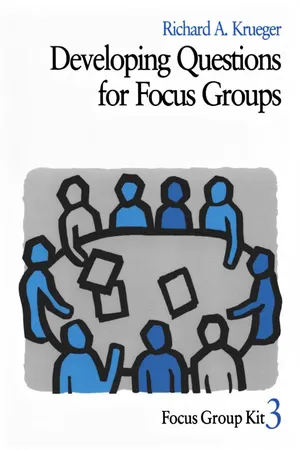
Struggling with focus groups questions? Asking the right questions is critical in focus group interviewing. Developing Questions in a Focus Group describes a practical process for identifying powerful themes and offers an easy-to-understand strategy for translating those themes into questions. Richard A. Krueger suggests ways of categorizing, phrasing, and sequencing focus group questions. Going beyond material presented in his earlier books, Krueger shares ideas for questions that get participants actively involved in the focus group interview by asking participants to make lists, create report cards, sort pictures, draw, cut and paste, or participate in a mini-debate. The results of these activities not only yield insightful information but are also interesting and fun. This book helps make the process of developing good questions doable by outlining a process and offering many examples. After reading this book, your focus groups will never be the same.
- 128 pages
- English
- ePUB (mobile friendly)
- Available on iOS & Android
eBook - ePub
Developing Questions for Focus Groups
About this book
Information
Part I
Thinking About Questions
Before actually writing the questions for a focus group interview, the researcher should consider several principles that have guided master moderators. These principles are the cornerstone of quality questions. Once these principles are considered, the researcher may wish to weigh the benefits and limitations of using a topic guide or a questioning route. The researcher should then think about the process to use in developing the questions.
VOLUME 3
1
Guiding Principles of Asking Questions
Overview
Conversational-Conversational-Conversational
Be Clear
Seek Help
Allow Sufficient Time
What Works Is Right
As you think about questions, keep several guiding principles in mind. These are the foundation of all that follows.
Conversational-Conversational-Conversational
The first principle is to ask questions in a conversational manner. Because the focus group is a social experience, conversational questions are essential to create and maintain an informal environment. But what makes one question conversational and another awkward often depends on the situation.
The wording of the questions should be direct, forthright, comfortable, and simple. Are the questions easy to ask, or do you stumble over words? It is critical that the language is appropriate for the intended audience. Furthermore, the meaning of the question must be clearly conveyed orally. Some questions are great when written but are confusing or stilted when asked orally. In addition, unneeded phrases at the beginning of a question can give confusing cues to the listener and distract from the intended purpose. The phrases or words intended to build the case for the question can also confuse the focus group participant or take the discussion off on a tangent. This occurs when the moderator offers lengthy background information on a question or uses a long segue from one topic to another.

Language Must be Natural and Conversational for the Intended Audience
Be Clear
Effective questions are clear, brief, and reasonable. Clear questions are usually short, one-dimensional, and jargon-free. Lengthy questions can be redundant or confusing to respondents. The risk of longer questions is that participants have a hard time distinguishing the core intent of the question. In general, you reduce clarity as the length of the question increases.
Another aspect of clarity is unidimensionality. The question should be limited to a single dimension. Moderators may inadvertently include words that they think are synonyms but that participants see as entirely different concepts. While the moderator means well, the participants get confused. For example, a question such as “In what ways was the program useful and practical?” may mean different things to different people. For some, “useful” and “practical” may be very different concepts.
At other times, moderators may add a second sentence or phrase that supposedly amplifies the question but in fact confuses the respondents by introducing another dimension, for example: “What is most important to you, that is, which topic should be acted upon first?” In this case, the moderator assumes that what is important should be acted upon first, but this may not be the view of participants.
A third aspect of clarity is wording. The words must be understandable to the participants. Acronyms, jargon, and technical language are deadly. Professionals are sometimes held captive by their language and inadvertently use technical terms or jargon confusing to lay audiences. Consequently, the questions should be reviewed by people similar to your target audience to make sure the language is clear.
I vividly remember a focus group question that bombed the first time it was used. It was an introductory question designed to get people talking. Instead, it got them confused. To the adult educators who developed the question, it seemed clear, but the participants felt differently. When the question was asked, “What was the most significant learning experience you’ve had in the past year?” the first person responded, “I have no idea what you are talking about!” The second person asked, “What is a significant learning experience?” The rest of the group was convinced that the moderator was an alien from another planet. The adult educators had loved the question, because this was the type of topic that they regularly think about, but to non-educators, it made no sense. Later we revised the question to read, “Tell us about something you learned last year that you found to be particularly enjoyable.” The revised question worked well, and participants eagerly offered their answers.
—Richard Krueger

A Question Thant Did’t Work
Seek Help
Help is needed in developing quality focus group questions. No matter how talented a researcher may be, one individual developing questions alone will always be at a disadvantage. To ensure quality focus group questions, the researcher needs to obtain feedback from others. Often, the researcher and the intended audience have major differences in language. Therefore, input from people like the participants and advice from other researchers should be actively sought and considered.
Allow Sufficient Time
Quality questions are not produced quickly. The amount of time needed is often underestimated by the researcher and undervalued by the project sponsor. When the research sponsor reviews the proposed questioning route, the questions can seem so sensible and straightforward that a person might assume that questions are easy to develop. In some studies, the questioning route may have gone through half a dozen revisions before being seen by the research sponsors and then another six revisions before being used in the first focus group. Revisions take time, and the researcher must allow sufficient time for quality questions to emerge.
What Works Is Right
There Is No One Right Way to Develop Questions. If It Works, It Is Right
A final guiding principle relates to finding out what is “right.” Sometimes we get questions concerning the “right” way to develop questions for focus groups.
Our experience has been that this is an impossible question to answer, because experts may not know what is “right.” Essentially, what is right is what works. Do the questions produce helpful results? If so, then they are right.
Several years ago, we were conducting focus groups with farmers around the state. Technical colleges wanted to find out why farmers weren’t attending their educational courses. I still remember reacting to a question that was suggested by a colleague. The suggested question was, “What would it take to get you to attend a training session at the area technical college ?” Our initial reaction to the question was negative. It seemed too speculative and hypothetical, and we had never asked this question before. Although we had doubts, we agreed to try the question in the first focus group and see what happened. The day after the focus group, the moderator and assistant were really excited because the question turned out to be one of the most beneficial ones in the discussion. Farmers understood what was asked, they could indicate what was needed, and the results were of great benefit. We later used the same question in a number of studies with similar positive results.
An Unexpectedly Valuable Question
With focus groups there is considerable interaction between moderator skills and effective questioning procedures. Some moderators can ask difficult questions while others asking these same questions find the participants cold and withdrawn. The moderator establishes a climate for communication, and participants develop a rapport based...
Table of contents
- Cover page
- Title
- Copyright
- Brief Table of Contents
- Detailed Table of Contents
- Acknowledgments
- Introduction to the Focus Group Kit
- About This Book
- Part I: Thinking About Questions
- Part II: The Art and Mechanics of Asking Good Questions
- Part III: Questions That Engage Participants
- Appendix: Examples of Questions
- References
- Index to This Volume
- Index to the Focus Group Kit
- About the Author
Trusted by 375,005 students
Access to over 1.5 million titles for a fair monthly price.
Study more efficiently using our study tools.
Frequently asked questions
Yes, you can cancel anytime from the Subscription tab in your account settings on the Perlego website. Your subscription will stay active until the end of your current billing period. Learn how to cancel your subscription
No, books cannot be downloaded as external files, such as PDFs, for use outside of Perlego. However, you can download books within the Perlego app for offline reading on mobile or tablet. Learn how to download books offline
Perlego offers two plans: Essential and Complete
- Essential is ideal for learners and professionals who enjoy exploring a wide range of subjects. Access the Essential Library with 800,000+ trusted titles and best-sellers across business, personal growth, and the humanities. Includes unlimited reading time and Standard Read Aloud voice.
- Complete: Perfect for advanced learners and researchers needing full, unrestricted access. Unlock 1.5M+ books across hundreds of subjects, including academic and specialized titles. The Complete Plan also includes advanced features like Premium Read Aloud and Research Assistant.
We are an online textbook subscription service, where you can get access to an entire online library for less than the price of a single book per month. With over 1.5 million books across 990+ topics, we’ve got you covered! Learn about our mission
Look out for the read-aloud symbol on your next book to see if you can listen to it. The read-aloud tool reads text aloud for you, highlighting the text as it is being read. You can pause it, speed it up and slow it down. Learn more about Read Aloud
Yes! You can use the Perlego app on both iOS and Android devices to read anytime, anywhere — even offline. Perfect for commutes or when you’re on the go.
Please note we cannot support devices running on iOS 13 and Android 7 or earlier. Learn more about using the app
Please note we cannot support devices running on iOS 13 and Android 7 or earlier. Learn more about using the app
Yes, you can access Developing Questions for Focus Groups by Richard A. Krueger in PDF and/or ePUB format, as well as other popular books in Social Sciences & Social Science Research & Methodology. We have over 1.5 million books available in our catalogue for you to explore.