- 333 pages
- English
- PDF
- Available on iOS & Android
eBook - PDF
About this book
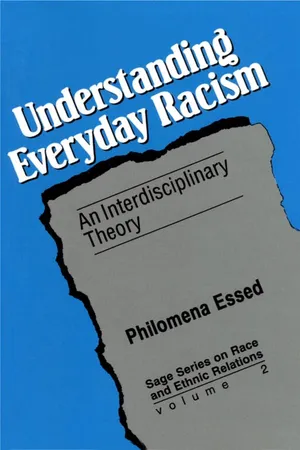
While there are numerous studies of racism and racial inequality at the macro-level of analysis, there has been little work done on the experience of everyday racism for black people. Philomena Essed?s brilliant work fills this gap. This landmark volume compares contemporary racism in the United States and the Netherlands through in-depth interview data from more than 2,000 experiences of black women. As an interdisciplinary analysis of gendered social constructions of racism, it breaks new ground. Essed problematizes and reinterprets many of the meanings and everyday practices that the majority of society has come to take for granted. She addresses crucial but largely neglected dimensions of racism: How is racism experienced in everyday situations? How do black women recognize covert expressions of racism? What knowledge of racism do black women have, and how is this knowledge acquired? How do they challenge racism in everyday life? To answer these questions, over two thousand experiences of black women are analyzed within a theoretical framework that integrates the disciplines of macro- and micro-sociology, social psychology, discourse analysis, race relations theory, and women?s studies. Samples include only black women with higher education. Many of their experiences of racism involve the "elite" among the dominant group. The book seriously challenges both the notion of Dutch tolerance and the idea that U.S. racism is a problem of the past. With this concept in mind, Understanding Everyday Racism is urgent reading. Essed?s volume represents a landmark in the study of race and ethnicity and will interest researchers, lecturers, students, and professionals of discourse analysis, policy and women?s studies, sociology, psychology, management, psychotherapy, and qualitative methodology. "Without getting bogged down in nit-picking about the definition of racism, the author has succeeded in presenting the true face of racism and has investigated the sociology and psychology of racism. A marvellously subtle and skillful report of everyday racism." --Counselling Psychology Quarterly "In this provocative book, Philomena Essed weaves insights from psychology, sociology, discourse analysis, and women?s studies into an original and important new theoretical framework. She combines a phenomenological approach of describing the experiences of individuals with a structural account of inequality." --Contemporary Psychology "Racism remains a contested concept in both popular and scholarly discourse. Typically unaware of the extent of institutionalized racism, whites generally deny that racism exists. People of color typically see things differently and interpret the dominant group perspective as insensitive and insincere. Philomena Essed?s groundbreaking volume, Understanding Everyday Racism tackles this ambiguity surrounding both popular and scholarly interpretations of racism and sheds considerable light on the difference between dominant and subordinate group views. . . . Essed?s volume makes an extremely important and unique contribution to our understanding of contemporary racism." --Contemporary Sociology
Information
71
Methodological
Questions
odology.
Therefore,
it
is
relevant
to
first
reconstruct
the
social
and
historical
context
of
Black
women’s
general
knowtedge
of
racism.
In-
formation
about
the
historical
context
can
be
inferred
from
the
begin-
ning
of
the
interviews.
The
interviews
with
U.S.
Black
women
began
with
a
question
about
the
civil
rights
movement
in
the
1960s.
The
purpose
was
to
gain
insight
into
more
general
perceptions
of
racial
is-
sues
and
racism.
The
Surinamese
women
were
asked
about
their
per-
ceptions
of
the
Dutch
before
their
migration
to
gain
insight
into
the
feelings,
attitudes,
and
opinions
the
women
had
about
the
Netherlands
and
the
Dutch
when
they
first
came
to
the
country.
In
the
next
chapter
we
will
see
how
Black
women
acquired
knowledge
of
racism
and
what
the
differences
are
in
the
general
knowledge
structure
of
Black
women
in
the
Netherlands
and
in
the
United
States.
N
O
T
E
1.
For
reasons
of
space
the
interview
guide
could
not
be
included
in
this
book.
Interested
readers
may
obtain
a
copy
upon
request.
Table of contents
- Cover
- Contents
- Foreword
- Preface
- Introduction
- Chapter 1 - Toward an Integration of Macro and Micro Dimensions of Racism
- Chapter 2 - Methodological Questions
- Chapter 3 - Knowledge and Comprehension of Everyday Racism
- Chapter 4 - Analyzing Accounts of Racism
- Chapter 5 - The Integration of Racism Into Everyday Life: The Story of Rosa N.
- Chapter 6 - The Structure of Everyday Racism
- Chapter 7 - Conclusions
- References
- Index
- About the Author
Trusted by 375,005 students
Access to over 1.5 million titles for a fair monthly price.
Study more efficiently using our study tools.
Frequently asked questions
Yes, you can cancel anytime from the Subscription tab in your account settings on the Perlego website. Your subscription will stay active until the end of your current billing period. Learn how to cancel your subscription
No, books cannot be downloaded as external files, such as PDFs, for use outside of Perlego. However, you can download books within the Perlego app for offline reading on mobile or tablet. Learn how to download books offline
Perlego offers two plans: Essential and Complete
- Essential is ideal for learners and professionals who enjoy exploring a wide range of subjects. Access the Essential Library with 800,000+ trusted titles and best-sellers across business, personal growth, and the humanities. Includes unlimited reading time and Standard Read Aloud voice.
- Complete: Perfect for advanced learners and researchers needing full, unrestricted access. Unlock 1.5M+ books across hundreds of subjects, including academic and specialized titles. The Complete Plan also includes advanced features like Premium Read Aloud and Research Assistant.
We are an online textbook subscription service, where you can get access to an entire online library for less than the price of a single book per month. With over 1.5 million books across 990+ topics, we’ve got you covered! Learn about our mission
Look out for the read-aloud symbol on your next book to see if you can listen to it. The read-aloud tool reads text aloud for you, highlighting the text as it is being read. You can pause it, speed it up and slow it down. Learn more about Read Aloud
Yes! You can use the Perlego app on both iOS and Android devices to read anytime, anywhere — even offline. Perfect for commutes or when you’re on the go.
Please note we cannot support devices running on iOS 13 and Android 7 or earlier. Learn more about using the app
Please note we cannot support devices running on iOS 13 and Android 7 or earlier. Learn more about using the app
Yes, you can access Understanding Everyday Racism by Philomena Essed in PDF and/or ePUB format, as well as other popular books in Sciences sociales & Études ethniques. We have over 1.5 million books available in our catalogue for you to explore.