"A fantastic book. . . .A major contribution! Stories of Transformative Leadership in the Human Services is an extraordinary book by two highly accomplished social work educators and consultants. Based on years of experience in the classroom and in the field,Steve Burghardt and Willie Tolliver blend their "best practices" into a pedagogically creative and lively text that students and human service professionals alike will find engaging and invaluable. Social service agencies and workers are under siege, especially now in our global economic crisis, but this book is guaranteed to help in the struggles ahead for a more humane and just social service practice."
—Robert Fisher, University of Connecticut, author of The People Shall Rule: ACORN, Community Organizing, and the Struggle for Economic Justice (Vanderbilt University Press, 2009.)
"A must read for directors, executives, funders, and board members! Given today?s economic climate, there may not be funds for the hiring of consultants. Read Stories of Transformative Leadership in the Human Services and engage as an organizational team in their activities instead. You, your staff and the culture of the organization will be transformed. As Ghandi said, "Be the change you want to see.? The paradigm that Burghardt and Tolliver introduce will have you do just that."
—Claudette C?Faison, Cofounder and President of NY Youth at Risk, Inc.
Certain to excite and inspire both students entering the human services field and seasoned non-profit professionals, Stories of Transformative Leadership in the Human Services: Why the Glass Is Always Full is the first full-length leadership book to focus on the unique challenges of the public and non-profit executive, manager, and educator. Written in a lively story-telling style, the book develops a leadership model for those who inspire without bonuses and seek a powerful legacy through people?s lives.
Authors Steve Burghardt and Willie Tolliver convey the stories of two social service agencies struggling to survive in a world of shrinking budgets, increasing needs, and lack of resources. While both agencies are run by hard-working managers, one is in constant crisis mode (racial tensions that simmer and boil over; professionals who end up exhausted and overeating after a crisis-filled day . . . every day), while the other, operating with no greater resources, lacks tension and turmoil as its managers respond to similar demands and client needs. Using real-life vignettes drawn from actual experiences, the stories distill important lessons and unfold in a powerful manner that will resonate with any professional asked to work harder . . . with a smaller budget. Questions woven through each story connect to the book?s more theoretical material on leadership, personal mastery, and community-building.
Steve Burghardt, MSW, PhD, and Willie Tolliver, MSW, DSW, are professor and associate professor of Social Work at the City University of New York (CUNY)—Hunter College School of Social Work and partners in the Leadership Transformation Group, LLC. Authors of numerous works on organizational change and strategic development, they are award-winning teachers of human behavior, policy, and community organization. They have worked with thousands of human service and educational staff on new models of leadership, personal well-being, spirituality, collaboration in times of crisis, and how to sustain conversations on race and oppression for lasting change at work and in one?s life.
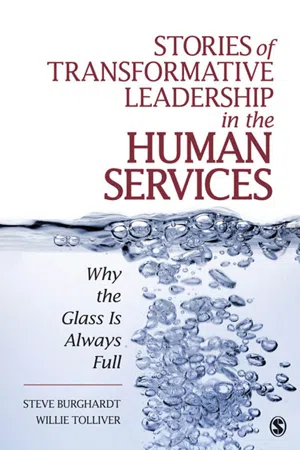
eBook - ePub
Stories of Transformative Leadership in the Human Services
Why the Glass Is Always Full
- 296 pages
- English
- ePUB (mobile friendly)
- Available on iOS & Android
eBook - ePub
Stories of Transformative Leadership in the Human Services
Why the Glass Is Always Full
About this book
Information
Publisher
SAGE Publications, IncYear
2009Print ISBN
9781412970174
9781412970167
Edition
1eBook ISBN
9781483343082

PART 1
The Depletion of Value
1
A BORING ASSIGNMENT
“This sounds about as exciting as watching grass grow,” muttered Nick Costello to himself. A stringer trying to catch on with one of the New York papers, he’d just gotten off the phone with Melissa Horowitz, the metropolitan editor at the Gotham Gazette.
“I want you to check out the Human Service Alliance,” she’d said. “Pete Morrissey, who runs one of the big social service agencies, has been after us for years to see life on the inside of their organizations. He’s complaining we don’t see how hard it is to keep things afloat. He says business models don’t fit what they have to deal with.”
There’d been a pause on the phone as she responded to one of her reporter’s queries. “We’ve heard that cutbacks are hitting agencies hard over the next 5 years, given this economic downturn. It can’t hurt to take a look at what they’re up to.”
“I’m happy to take your assignment, Ms. Horowitz, and I appreciate your call. But I don’t see the hook you’re looking for. There’s a story every month or so on what’s happening to the poor.”
Nick had hoped he didn’t sound indifferent, but it would be the kiss of death to his journalistic career if he turned in a 5,000-word article that had been written a hundred times before or, even worse, was boring.
The editor had laughed. “No, no, I don’t want that kind of ‘needed services for the poor’ piece. I’m after something different. This alliance isn’t some grass-roots operation doing their normal advocacy thing. It’s made up of executives; the players in social work, mental health, health; and even some educators. They’re trying to see if they can set up an operation like the National Association of Manufacturers. My contact said they’ve got to get people to see that what makes them tick isn’t the same as big business, even though they run operations that are just as large.
“If that’s what they want, then let’s find out how they really manage. Morrissey said he got his people to agree for us to look inside. Hell, his place had $50 million in contracts. That’s no fly-in-the-water storefront. So I want to see how they really run things, what’s so different between them and a profit-making company. You get to sit in on their meetings, see how they make decisions. I want to know the ‘who, what, how, and why’ of their management structure. Look at their decision making, how they work as a team when faced with hard decisions. See in what ways they do and don’t compare to GE or Microsoft”—she’d laughed again— “besides the money. It may take you awhile, but then we’ll know. Are you interested?”
“Of course I am,” Nick had responded untruthfully. “You said it may take awhile. Can I put in for per diem and expenses?”
Hearing the affirmative, he had relaxed a bit, as had the worry lines around his eyes. Freelance work had aged him since he’d hit 30 a few years ago. I may end up bored but not broke, he had thought.
Looking back 2 months later, Nick had to laugh at his reluctance. He’d had no idea at the time that the most boring assignment he’d ever been given would turn out to be one of his best.
2
HALF-EMPTY? HALF-FULL?
“Welcome to our world,” smiled Pete Morrissey, as he invited Nick Costello to sit in on an Alliance members’ breakfast meeting. Pete had debriefed Nick over the phone the day before on what the Alliance was up to. Its long-term goal was to raise enough money for both a lobbying firm in Washington and a significant advertising/public relations campaign that could make the Alliance’s nonprofit cause better known. From there it hoped to attract private and public support for its work. The breakfast group was a subcommittee of five members working on what kind of marketing campaign they wanted and how much it would cost.
A local gourmet coffee shop’s breakfast treats were neatly spiraled around the mahogany table in a small, attractive room off Pete’s executive suite. The shiny leather furniture had the worn, baggy creases of frequent use. Pete invited Nick to join the four others selecting from the bagels, muffins, and fruit in front of them. Nick decided to go last, making sure he didn’t take too much.
“We rotate these meetings at each of our places,” said Frank Churchland, extending a beefy hand whose grip gave iron a weakened meaning. “This way we share the costs, even when they’re small. As you’ll see, it all adds up.”
A large heavyset White man who ran one of the largest mental health facilities in the state, Frank took a pumpernickel bagel and lathered a generous amount of cream cheese on both slices.
“It’s not that we’re cheap, just that nonprofits have next to nothing in the way of extras in their budgets. If we buy bagels and cream cheese one time, it means there’s a little less for toner for the photocopy machine.”
Nick looked over at Frank and nodded. Please Lord, he thought, I hope this isn’t going to be a long whining session masquerading as a power breakfast.
Nick met the others in quick succession as coffee was poured into paper cups. Jorge Pacheco, a Puerto Rican leader of one of the city’s largest Catholic child welfare agencies, gripped his hand tightly and nodded warmly, his strong Indian features breaking into a smile. Jason Levy, the only man wearing a three-piece suit, was chief executive officer of a nonprofit hospital. His right hand holding a large bran muffin topped with jam, he used his left to squeeze Nick’s arm. They both laughed at the awkward moment, helping Nick relax. Last to greet him was a tall African American woman, Helen Jacques, whose skin was the color of mocha. The head of a medium-sized multiservice agency, she had taken a small plate of fruit and placed it next to a large cup of water. Smiling so much that her eyes seemed to crinkle, she made room for Nick at the table next to her.
Happily, Pete dispensed with formal introductions quickly and got down to business right away. “Melissa Horowitz agreed to let Mr. Costello sit in on our meetings with the proviso that he gets access to whatever he wants. They’re interested in telling our story as a comparison between how big business and big human service run things. It’s not going to be about what’s happening or not happening to our clients.”
“That’ll be easy,” replied Jorge quickly. “Big business sends their new managers to Harvard Business seminars once a year; we send ’em to Lobby Day in the state capital.”
He was referring to the annual trek that human service groups in every state make to their capitals regarding the yearly appropriations process. After weeks of preparation, midlevel human service professionals load buses at 5 a.m. with clients, line staff, and volunteers to meet legislators and their staff members to press their case for more funding. People arrive back home that evening around 8 p.m. Not a lot of work takes place the following day.
“Jorge’s making an important point, Nick. Human service people don’t have budgets for extras, whether it’s bagels and cream cheese or training seminars on quality systems improvements.”
Speaking deliberately, Jason pressed his fingertips together. “We can’t just take those items off as simple business expenses for tax purposes. Every dime is being monitored by some fiscal auditor who wants to know why this bagel’s 65 cents isn’t being spent on services for clients.”
Noticing the didactic turn things were taking, Pete interrupted the discussion. “I think Nick will figure these things out as we just go about our work.”
He looked over at the journalist. “How about we go through our agenda, and if there are any questions after each item, you can ask?”
Relieved, Nick quickly responded yes.
The group quickly got down to business. Jorge gave a brief report on Alliance members’ expertise in marketing. “Except for Jason and the folks with health care facilities, we’ve found that nobody in human services knows anything about marketing. Schools are public and not allowed to do that. Nobody in child welfare would be caught dead advertising. What are we supposed to say, ‘Come, leave your neglected child with us!’? Multiservice agencies report they have no budgets for marketing, either.”
He paused. “Specific programs like after-school or special needs groups spend a few hundred dollars on outreach. Flyers and posters, that kind of thing. No ‘Zoom-Zoom’ campaigns like Mazda has for its cars.
“So, we need to look to our health care providers for whatever expertise we have.”
Jorge paused for a second, seeming to remember something. He smiled mischievously at Helen. “Them and Helen, of course.”
The group collectively chuckled, surprising Nick. Obviously composed, Helen said nothing as she sipped her water. Nick made an extra note on his pad. What expertise did she have?
“The next agenda item is how much a 3-year campaign would cost.”
Pete, a man of quick movements whose hands were rarely still, had no problem moving the meeting along. His finger pointed to the paper in front of him and tapped it three times. Without his smile, the taps would have signaled irritation.
Jason sighed as he reviewed the papers in front of him. “Well, the teachers’ union spent $1.5 million on an advertising campaign for better salaries last year alone. Our hospital’s advertising budget averaged $700,000 per annum over the last 5 years.”
He looked over at Frank, who had his own sheet of paper in his hand. “Frank, what does a lobbyist cost?”
“A state lobbyist used by different trade groups can run between $300,000 up to a million a year for the private sector boys.”
He looked over at Nick. “We can’t charge members those kinds of union dues, and we can’t promise any shareholders it’s a worthwhile investment that’ll bring us a bigger market share and higher profits later. That Manufacturers trade group has 14,000 members. In this state we’re starting with 50.”
Pete interrupted. “Look, we went into this knowing we had a fight on our hands. Most of the American public thinks human services are where the slightly less intelligent serve slightly poorer people who ought to be out looking for a real job. Why do you think most Americans think the private sector looks so good? It’s because they’ve been fed a bill of goods on how mediocre we are.”
He looked at the rest of the group, his fingers tapping once again. “Given the situation we’re in, we have to approach our boards, engage in fundraising, and make this Alliance happen! America has to find out nonprofits and publics are worth it!”
Frank nodded in agreement, his silver hair falling onto his forehead. “I agree, I agree. But we’re in trouble. I was just stating what we know. We don’t have money to do things that companies can do. I know we’ve got to take this on, but I’m the pessimist in the group. I find pessimism keeps human services executives and educators in the real world.”
He dabbed a small piece of cream cheese from his upper lip as he looked over at Nick, who was busy taking notes. “Nick, let’s face it: A lofty mission statement doesn’t mean we have lots of money.”
Pete felt compelled to respond again, even though he was the chair. “I don’t think we disagree, Frank. I know we’ve got a crisis. But it’s a matter of perception. You’re saying the glass is half-empty and we’re losing drops every day. I’m saying we’re half-full and have to work even harder to keep it that way, getting a little more added to the glass.”
He paused again and looked at the group, fingers working the table. “Half-full sells a lot better than half-empty.”
Nick noticed others nodding in assent.
Helen raised her hand to speak. “Pete, you asked me to be a part of this work group because you said you respect what my agency is doing. So I’m here, even if we’re a quarter the size of everyone else around the table. We’re going through the same cuts, too. I’m not denying it can be difficult.”
She reached down and pushed her empty fruit plate away. “But difficult doesn’t mean there’s a problem.”
The men at the table began to look perplexed as she went on. Even Pete’s fingers took a break.
“To tell you the truth, we have a whole different way of talking about things that helps us day in and day out.”
Helen picked up her paper cup, now empty. Taking the silver carafe next to her, she poured just enough water for it to be at the midway point. “Half-full? Half-empty? To us, it’s neither. For us at South Bronx Multi-Services, the glass is always full.”
She took a long drink before placing the cup carefully in front of her, turning it around and around. “Even now.”
The men around the table became silent. Jorge looked toward Pete and then over at Jason, who was staring intently at Frank. It was eerily quiet. If playing cards had been on the table instead of bagels, an outsider might have thought it was the final draw in a game of Texas hold ’em, eve...
Table of contents
- Cover Page
- Title Page
- Copyright Page
- Contents
- Foreword
- Introduction
- Part I. The Depletion of Value
- Part II. Creating Abundance
- Part III. A Leadership Model of Personal and Organizational Transformation
- References and Books of Note
- Index
- About the Authors
Trusted by 375,005 students
Access to over 1.5 million titles for a fair monthly price.
Study more efficiently using our study tools.
Frequently asked questions
Yes, you can cancel anytime from the Subscription tab in your account settings on the Perlego website. Your subscription will stay active until the end of your current billing period. Learn how to cancel your subscription
No, books cannot be downloaded as external files, such as PDFs, for use outside of Perlego. However, you can download books within the Perlego app for offline reading on mobile or tablet. Learn how to download books offline
Perlego offers two plans: Essential and Complete
- Essential is ideal for learners and professionals who enjoy exploring a wide range of subjects. Access the Essential Library with 800,000+ trusted titles and best-sellers across business, personal growth, and the humanities. Includes unlimited reading time and Standard Read Aloud voice.
- Complete: Perfect for advanced learners and researchers needing full, unrestricted access. Unlock 1.5M+ books across hundreds of subjects, including academic and specialized titles. The Complete Plan also includes advanced features like Premium Read Aloud and Research Assistant.
We are an online textbook subscription service, where you can get access to an entire online library for less than the price of a single book per month. With over 1.5 million books across 990+ topics, we’ve got you covered! Learn about our mission
Look out for the read-aloud symbol on your next book to see if you can listen to it. The read-aloud tool reads text aloud for you, highlighting the text as it is being read. You can pause it, speed it up and slow it down. Learn more about Read Aloud
Yes! You can use the Perlego app on both iOS and Android devices to read anytime, anywhere — even offline. Perfect for commutes or when you’re on the go.
Please note we cannot support devices running on iOS 13 and Android 7 or earlier. Learn more about using the app
Please note we cannot support devices running on iOS 13 and Android 7 or earlier. Learn more about using the app
Yes, you can access Stories of Transformative Leadership in the Human Services by Steve Burghardt,Willie Tolliver in PDF and/or ePUB format, as well as other popular books in Social Sciences & Social Work. We have over 1.5 million books available in our catalogue for you to explore.