![]()
1
Introduction to Improving Formative Assessment Practice
We consider formative assessment to be the continuous process in which students and teachers engage to monitor learning and to inform future instruction. The research literature identifies the consistent and careful use of formative assessment to be an important factor for improving student learning. This book is for teachers who want to know more about formative assessment and who want to improve their own practice in this area. Readers will be at different stages in their practice, some more familiar with formative assessment than others, some more proficient than others. The purpose of the book is to help all teachers examine their practice—regardless of how proficient—and to find ways to make improvements.
This book has been written so that it can be used by an individual teacher who wants to pick it up and work through the chapters. However, we recognize that there is significant value in groups of teachers working together on their practice. Therefore, the approach is such that this book also can be used by a small, informal group of teachers, a whole department, and/or coaches or mentors working with individual teachers. In short, it can be used by anyone whose goal is to improve his or her formative assessment practice.
A reflective practitioner is someone who spends time critically examining his or her practice with the goal of improving it (Schon, 1983). In a world of ever-increasing demands on teachers, finding time for analysis and self-evaluation may be difficult. For a teacher who desires to improve her practice, there is the question of how to identify an area on which to focus. Should she examine her classroom discourse practice to ensure that she is fair in terms of the types of questions and expectations that she has of boys and girls alike? Should she look at her instruction to see to what extent she uses real-world and cross-curricular contexts in her instruction? Should she focus on her assessment practices? As the title of this book suggests, we consider the examination of formative assessment practices to be a valuable, ongoing exercise for teachers. However, rather than asking you to just accept our perspective, the next chapter articulates what we mean by formative assessment and the impact it can have on student learning—which, of course, is why we consider it to be an important topic for self-reflection and ongoing improvement.
In this chapter, we make several clear distinctions important for this book: between formative and summative assessment and between assessment and evaluation. We describe how evaluation of teaching practice can be part of ongoing professional development and how this self-evaluation process will unfold as the book progresses.
Formative and Summative Assessment
To make sense of the rest of what follows in this book, it is important to be clear about the distinction between formative and summative assessment. A teacher engages in assessment in a variety of ways, as captured by the following questions: What is the mood of students as they enter the classroom? How attentive do they seem today? What do they remember about this topic from yesterday or from last week? Are students ready for the upcoming test? How can students support each other in the learning process? Which students are ready for a new challenge? Which students need another opportunity to explore the topic from a different perspective? Some of these questions might be asked as part of the formative assessment process, while others would not. For example, while it is critical that a teacher assess and pay attention to students’ moods and levels of attention, those aspects are not directly parts of formative assessment. All the other questions could be asked as part of formative assessment. As noted in the introduction, we consider formative assessment to be a continuous process in which students and teachers engage to monitor learning and to inform future instruction. Formative assessment is an important part of instruction that has been shown to have a positive impact on student learning when used systematically and consistently.
Formative assessment is a continuous process in which students and teachers engage to monitor learning and to inform future instruction.
By contrast, summative assessment is the term usually given to assessments that “sum up” learning by measuring the amount of knowledge, skills, or abilities that someone has at a particular point in time (Glickman, Gordon, & Ross-Gordon, 2009). In school contexts, these assessments can be large-scale, high-stakes assessments—that is, assessments taken by all students in a particular grade, in a district or state, under standardized circumstances. Summative assessment can also refer to the measures that contribute to end-of-course or end-of-year grades given to students. While the reach of the assessments used to determine that grade may not extend beyond a particular school, once the grade has been given, there is rarely an opportunity to further influence it. Thus, summative assessments can be thought of as static measures with generally no further instructional opportunities to shape learning. Clearly, summative assessments are not something to be ignored; however, they are not the focus of this book.
We believe that while knowledge of formative assessment is important, competence or proficiency in formative assessment practices is really our goal for each teacher reading this book. For that reason, the book is built around opportunities for you to reflect on your practice, consider alternative approaches, and put them into practice in your own classroom, so that you develop competency in formative assessment practices, not just knowledge of formative assessment. The remainder of this chapter will introduce the self-evaluation process to provide a sense of what will follow in the rest of the book.
The Purpose of the Book
This book includes opportunities for you to reflect on your formative assessment practice, consider alternative approaches, and try them in your classrooms, so you can develop not only knowledge of formative assessment characteristics but also competency in formative assessment practices.
Evaluation and Formative Assessment
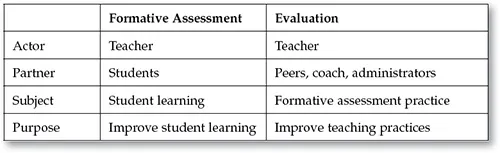
In this book we use the terms evaluation—and often self-evaluation—and formative assessment a great deal. In many contexts, assessment and evaluation are synonymous. For example, it is equally appropriate to talk about a fitness assessment or a fitness evaluation. However, to be as clear as possible in the book, we assigned different roles and meanings to these terms. Formative assessment, as defined previously, refers to the continuous process in which teachers and students engage to monitor learning and make appropriate adjustments. Evaluation, in this context, refers to the process in which a teacher examines an aspect of practice—in this instance, to examine formative assessment practices. In this book, evaluation always focuses on the teacher’s personal practices and accomplishments. For that reason, evaluation and self-evaluation are treated as synonymous. Table 1.1 illustrates how the actors, partners, and subjects differ.
| Table 1.1 | Distinguishing Between Formative Assessment and Evaluation |
As the table illustrates, formative assessment involves the teacher as the primary actor and students as partners. By contrast, while evaluation also involves the teacher as the primary actor, partners are more likely to be other adults with whom they can work, such as peer teachers, coaches, or administrators. The focus or subject of the two processes is also different. While formative assessment is focused on collecting evidence of the specifics of student learning, evaluation (in this book) is focused on the formative assessment practice itself. This distinction relates to the purpose of the two processes. Formative assessment seeks to directly improve student learning by more accurately tailoring learning opportunities to student needs. Evaluation in this context is conducted to improve teaching practices, which, in fact, then will affect student learning. While the next chapter focuses solely on formative assessment, the subsequent chapters focus more on evaluation of formative assessment practices.
Evaluation and Professional Development
In some recent writing about teacher professional development, the language shifts from the term “professional development” to “professional learning” (Darling-Hammond, Wei, Andree, Richardson, & Orphanos, 2009). We think this is an important recognition of the fact that changing teaching or formative assessment practices is an ongoing effort that requires learning and practice. More traditional professional development opportunities will have much less impact on practice.
Here our focus is on the teacher as a learner. We do not assume that teacher professional development can be guided only by external experts or prepackaged units of instruction. Rather, we assume that every school includes teachers or content coaches who have expertise in specific aspects of formative assessment or who are willing to explore and learn together. Furthermore, we believe that teachers can benefit from the expertise of their colleagues and that expertise can be developed collectively with appropriate resources and support.
This book invites you to engage in self-evaluation, plan for improvement, implement changes, and reevaluate your practice. It is based on a process of continuous improvement rather than on a series of individual training sessions. Support for continuous improvement exists close to the teacher’s classroom and is not dependent on funding, release time, or external consultants. However, we firmly believe that when teachers are working in a school where collaborative time is provided or teachers have opportunities to observe each other, the improvement process is much more effective.
In using the material in this book, you will be asked to build upon your strengths and identify your weaknesses through self-evaluation. We recommend that you work with a trusted colleague or a small group of colleagues in this process. We also realize, given the busy lives of teachers, that practitioners can benefit from a structured process for their self-evaluation and development. In pilot projects using the self-evaluation tools that we describe in later chapters, we found that teachers benefited from having more guidance and structure to help them in this process. You will notice that we provide questions at the end of the chapter for you to think about on your own, but also questions that you can address with a group of peers. Working with a colleague in a community of practice strengthens the learning of the entire group.
The Self-Evaluation Process
In the chapter that follows, we describe the formative assessment process as a cycle in which a teacher is continually asking a series of three questions (Wiliam, 2004): Where are my students headed? Where are they right now? How can I close the gap between where they are and where I want them to be? The formative assessment process is all about identifying learning goals for your students and then identifying where they are in relation to those goals. The gap-closing is achieved through timely, specific, corrective feedback; adjustments to instruction; and engaging peers in the support process. While these steps move students closer to the original learning goals, they also enable the teacher to establish new goals as learning progresses.
Students engaged in formative assessment also can ask these same questions: Where am I headed? Where am I right now? How can I close the gap between where I am and where I want to be? The three questions also have applicability in terms of your self-evaluation of how you implement formative assessment. You can ask yourself, Where am I going? Where am I now? How do I close the gap?
The Self-Evaluation Cycle
Where am I going? (Chapter 2)
Where am I now? (Chapters 3 and 4)
How do I close the gap? (Chapters 5 and 6)
Where Am I Going?
As a teacher who is about to embark on an evaluation of your own formative ...