![]()
1
Understanding Professional Learning Teams
School improvement is most surely and thoroughly achieved when teachers engage in frequent, continuous, and increasingly concrete and precise talk about teaching practice.
Judith Warren Little, 1991, p.12
FOCUS OF THIS CHAPTER
- What are professional learning teams (PLTs)?
- PLT inquiry cycle
- Sample timeline for one year
- PLTs versus committees
- Why have PLTs?
- Teacher collaboration influences student achievement.
- High-quality teaching makes a difference in student learning.
- Preservice training and classroom experience are not sufficient to develop high-quality teaching.
- Traditional professional development is often insufficient to improve teaching quality.
- Team-based professional learning improves teaching and learning.
- What are some features of effective professional development?
- What are some other models teachers use for collaboration?
DEFINING PROFESSIONAL LEARNING TEAMS
The need for teacher learning communities is now commonly accepted. These communities have multiple definitions with certain commonalities: teachers work collaboratively to reflect on their own practice, examine evidence about the relationship between practice and student outcomes, and make changes that improve teaching and learning for the particular students in their classes (McLaughlin & Talbert, 2006). Researchers and practitioners are now honing the definition of professional learning communities to provide more specificity and direction. In this publication, PLTs are defined as teams of four to six teachers from the same school, department, or grade level who come together to help each other improve student learning by changing classroom instruction. PLTs are goal oriented and maintain an unrelenting focus on student learning. PLTs assume that the needs of every student are not being fully met. This is not any one teacher’s fault; however, all teachers share collective responsibility to address the problem.
PLT members collaboratively learn and improve practices together by doing the following:
- Examining and analyzing disaggregated student achievement and classroom data—this information guides decisions and choices around instructional practices that focus on improving student learning
- Selecting a specific area of student need to investigate as a focus for changing practice
- Framing an inquiry question to guide the PLT’s work
- Investigating research-based strategies and best practices to increase their knowledge base and inform decisions about new practices to use in teaching their students
- Analyzing current teaching practices throughout the school to identify successful practices already in place as well as to understand schoolwide needs
- Determining specific areas for instructional change and trying out new strategies or honing existing practices that affect classroom learning
- Collecting classroom data to document activities and assess results
- Sharing personal practices and expertise through reflective dialogue, analysis of student work, and observing each other’s classroom practices
- Functioning effectively as a team by paying attention to collaboration and documenting team activities
- Sharing the focus and results of each team’s work with the greater school-wide community
Teachers in PLTs work together by doing the following:
- Meeting on a regular basis to support and learn from each other
- Sharing classroom practices with their colleagues
- Committing to improve their practice and supporting their colleagues in doing the same
- Seeking to improve their collaboration skills and applying them to effective PLTs and to the classroom
In PLTs, teams of teachers engage in activities to examine their current classroom practices and implement thoughtful change. PLTs work within their own content areas as well as school and district curriculum guidelines. The focus is on enhancing student learning and achievement by collaboratively examining and changing teaching practice. Ideally, the school staff is organized into small groups—PLTs—of four to six people, who “get to know and trust one another” (Jalongo, 1991, p. 73). Teams may be organized by grade level, content area, or specific interests that emerge from examining data. Interdisciplinary teams offer the opportunity for teachers to learn about different content areas and their specific ways of teaching. When teams collaborate to implement the same strategies in multiple content areas, students can benefit as they move from class to class or different grade levels as they bring an understanding of the process with them. The decision to form interdisciplinary teams or organize around some other appropriate factor, such as a department or common goal, should be made thoughtfully. Some schools also include vertical curriculum teams who meet less often but work together to assure articulation of goals and curricula from grade to grade in the entire school. Ultimately, “teams are not necessarily permanent… they must be organized around shifting needs and problems to solve” (Louis & Miles, 1990, p. 24). Changes in team composition also need to be made thoughtfully for the purpose of enhancing the focus on student learning.
[T]he hallmark of any successful organization is a shared sense among its members about what they are trying to accomplish.
Susan J. Rosenholtz, 1989, p. 13
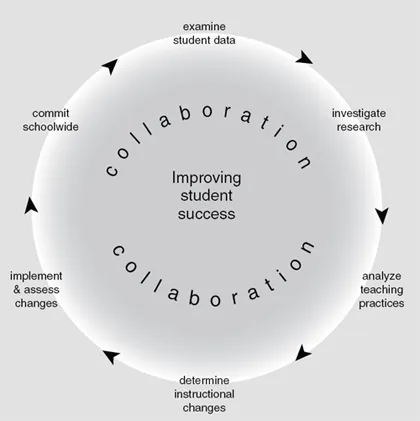
PLTs follow the process illustrated in Figure 1, PLT Inquiry Cycle on page 4. A full-page master of this cycle is included as Tool H-1 under Resources in the back of this book. An additional tool, H-2, includes the cycle with a brief explanation of each step.
For many schools, the first step in developing PLTs is a full-day workshop for the entire staff, ideally conducted in August before school starts. This workshop introduces the concept of PLTs and includes an examination of current achievement data to begin exploring what and how students are learning. Participants begin to identify specific student learning needs that will guide their inquiry. At this first meeting, teachers commonly form teams based on their interests. However, teams may also be formed based on content or grade level. Effective teamwork skills are introduced and reinforced in successive meetings.
After studying student data that relate to specific content and students, each team chooses to focus on a specific area of student need. Teachers then move to a critical examination of research and best practices. They also consider what and how teachers in their school are currently teaching. It is important to identify effective practices already in place that may be implemented by others as well as to understand schoolwide needs. Based on this information, each PLT chooses one or two new instructional strategies to try out in the classroom. The team decides how they will implement the practice or strategy and exactly what teachers will be doing in the classroom. They can collaboratively develop an implementation rubric so each team member is using the practice the same way. A crucial next step is deciding how to evaluate the effectiveness of each strategy by collecting and analyzing classroom data. At this point they may develop a common assessment so they can compare students’ progress in all classrooms trying out the strategy. Finally, if the strategy proves effective, information is shared with the entire staff and they are asked to consider adopting one or more successful practices. The cycle is then repeated.
Figure 1 PLT Inquiry Cycle
This inquiry cycle helps teachers and administrators develop a coherent vision of school change as they build a culture that values and uses data to inform decisions. At the same time, they increase clarity about desired outcomes and develop consistent accountability connected to student learning. When teachers start by examining schoolwide data and move to classroom-based data collection and analysis, their team inquiry is situated within a larger context of schoolwide inquiry. The teacher’s repertoire is strengthened by investigating and employing best practices and research-based strategies. All this contributes to the development of a culture of professional learning within the school. PLTs are an important vehicle used to support schools as they reculture to become professional learning communities. PLTs also alter school culture from one of teacher isolation to collaboration and transparency around what goes on in classrooms.
Note: Periodic, schoolwide sharing brings teams together as an overarching PLT. While we place emphasis on teams working individually to focus efforts on their specific students, schoolwide meetings are essential to viewing teams as part of the entire school system. In fact, it is important to share the process and outcomes with other schools and the central office—the larger districtwide system. As one assistant superintendent in the Spokane district framed it, “These are not just my students in my classroom; I am responsible for all students in the school and ultimately for all students in this district, in fact in the state of Washington.” In this way, improving student learning becomes an overarching goal or focus for the entire organization.
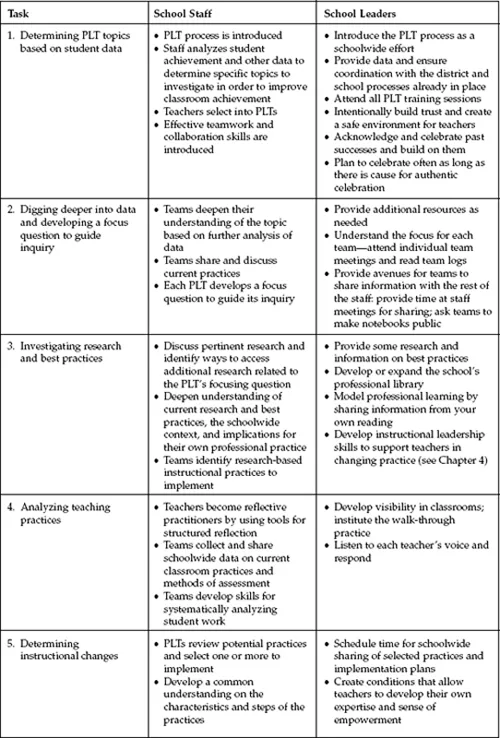
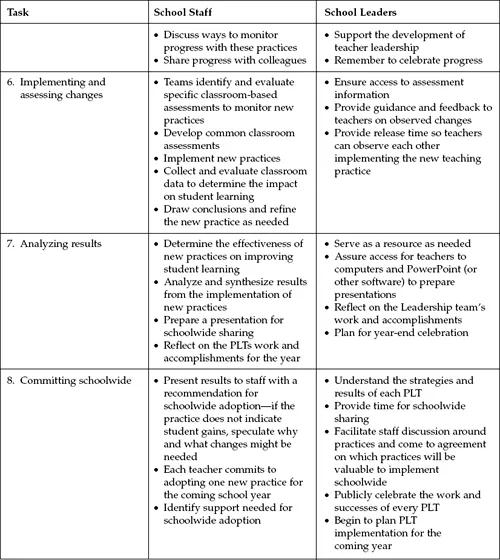
The schedule on pages 6 and 7 (Table 1) represents a suggested sequence for training and implementing PLTs during the first year. It includes both a description of the training and a column with suggestions for leaders to support PLT implementation. The timeline may vary with each school and is directly related to the amount of time available for PLTs to meet. Ideally, PLTs meet weekly or at least biweekly, and the process involves a series of workshops to train staff in the PLT tools and collaboration skills. In addition, teams meet individually between workshops to implement what they have learned.
PLTs vs. Committees
An important distinction needs to be made between PLTs and school committees. Both structures are important to the work of schools. However, PLTs focus directly on student learning and are aimed at improving students’ academic success. Committees are often formed to focus on specific topics or needs within the school. For instance, a committee may be formed to deal with school safety, dress codes, student-discipline issues, and develop new policies around student behavior. While these issues are important to the school and help establish an environment conducive to student learning, the immediate focus is not aimed at improving student learning. PLTs should be encouraged to keep student learning at the center of their work as a team. A committee may disband when its work is complete. PLTs, on the other hand, may shift membership but need to become institutionalized as a way of doing business in a school.
Teachers in professional learning communities are more likely to be consistently well informed, professionally renewed, and inspired so that they inspire students.
Shirley Hord, 1997, p. 30
THE NEED FOR PLTs
Individuals, groups, and schools engage in professional learning for a number of purposes: acquiring new skills, stimulating intellect, engendering a sense of renewal, building a common vision, developing new curricula, or establishing and institutionalizing policies and procedures. Leading Professional Learning Teams: A Startup Guide for Improving Instruction assumes that the primary purpose of PLTs is to support teachers in improving student learning by changing their instruction. Other outcomes such as developing a collaborative school culture and honing teachers’ leadership skills are additional benefits.
Table 1 Typical PLT Timeline for One Year
The research literature supports the positive link between team-based learning located in strong teacher learning communities and student achievement gains. Research is cited in subsequent sections addressing each of the following points:
- Professional learning communities do improve learning for students under certain conditions: when teachers collaborate as they reflect on their practice, examine the link between practice and student outcomes, and make changes in that practice to improve student learning.
- High-quality teaching is the most critical component for producing high-caliber learning in all students.
- Preservice education and classroom experience are linked to improved student learning; however, they are insufficient to maintain teachers’ success in a rapidly changing educational environment.
- The traditional methods for inservice education—coursework, institutes, formal workshops, and classroom experience—are important yet insufficient by themselves for creating schoolwide improvements in classroom practice and teacher quality.
- PLTs provide an organizing structure for professional development leading to schoolwide improvement in teacher practice and student learning.
Even the highest-quality professional development res...