eBook - ePub
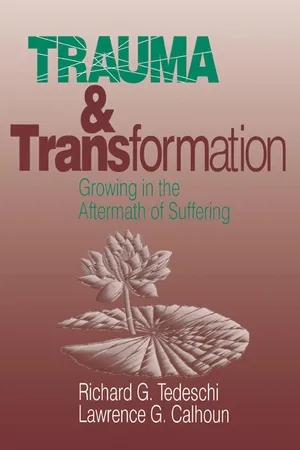
Trauma and Transformation
Growing in the Aftermath of Suffering
- 175 pages
- English
- ePUB (mobile friendly)
- Available on iOS & Android
eBook - ePub
Trauma and Transformation
Growing in the Aftermath of Suffering
About this book
There are a growing number of books on the market focusing on the history, symptomatology, and treatment of trauma and PTSD. This book provides something unique as its purpose is to highlight the ?personal positive growth or strengthening that often occurs in persons who have faced traumatic events.? As the book points out, this is a sadly neglected area in terms of research. . . . This book has something to offer to the layperson and those who have experienced a traumatic event as well as to the seasoned professional. It is written in an easily accessible style and, given the price of books these days, is also a good value for the money. --Gladeana McMahon in British Psychological Society Counseling Psychology Review "This is a useful book, especially for those involved with research on this important issue." --James Graves, M.D., in Readings: A Journal of Reviews and Commentary in Mental Health Unique in focusing on the positive outcomes of coping with crisis, this volume helps you to understand the process of growth after trauma and apply that knowledge to the counseling relationship. Sensitizing the reader to the pain experienced by people affected by trauma, the authors weave together literature from philosophy, religion, and psychology to form a model of active coping and transformation. An essentially cognitive framework gives conceptual context to the important changes in trauma survivors? belief systems that the authors examine and upon which they build. Case examples and quotations from literary and religious sources as well as from the authors? research and clinical work articulate the coping and growth process and cultivate compassion and understanding. At the same time, the authors? findings and analysis of important research encourage researchers to more closely examine this type of personal growth. This volume provides new information and perspectives invaluable to all those in the helping professions, in a variety of counseling settings, as well as researchers and students in clinical psychology, psychology, nursing, interpersonal violence, and family studies. "At last someone has assembled and integrated the extensive literature on coping with trauma. The authors provide a thoughtful and creative analysis of the process by which survivors of trauma experience personal growth. They propose their own model of coping that incorporates a wide range of personality variables, coping strategies, tasks, cognitive processes, and social support. Chockfull of engaging case examples and suggestions for researchers and therapists, this is a must read for anyone interested in the human dimensions of surviving trauma." --Raymond M. Berger, Professor (retired), California State University, Long Beach
Information
––– 1 | THE USES OF SUFFERING Religious and Psychological Roots |
But we also boast in our sufferings, knowing that suffering produces endurance, and endurance produces character, and character produces hope, and hope does not disappoint us.—Romans 5:5
Jerry is a 34-year-old paraplegic man who has been disabled for 8 years following an automobile accident. Most able-bodied people would assume that this was the most traumatic1 event of this man’s life. But Jerry sees it differently.
This was the one thing that happened in my life that I needed to have happen; it was probably the best thing that ever happened to me. On the outside looking in that’s pretty hard to swallow, I’m sure, but hey, that’s the way I view it. If I hadn’t experienced this and lived through it, I likely wouldn’t be here today because of my lifestyle previously—I was on a real self-destructive path. If I had it to do all over again, I would want it to happen the same way. I would not want it not to happen.
Jerry is certainly correct when he says this viewpoint is hard for most people to accept. But researchers are discovering that this is precisely the approach to life trauma that many people adopt. Even if they do not always state that, in hindsight, they are pleased the traumatic event occurred, many people at least view the aftermath of the event as something that has benefited them. Furthermore, the people who take this point of view feel that they have made a very satisfactory adjustment, and to the outside world they may even appear inspirational. For example, in her autobiography, Helen Keller speaks of her teacher’s dedication to her: “So I say my education was accomplished in the tragedy of my teacher’s life. She understood the void in my soul because her childhood had been so empty of joy” (Keller, 1968, p. 346).
We have been interested in learning more about these people and this remarkable process of strengthening that may occur when they confront tragedies in their lives. There is nothing new or remarkable in the assertion that psychological growth can be precipitated by the pain of unfortunate events. What we have found new and remarkable is how often this happens and how apparently ordinary people achieve extraordinary wisdom through their struggle with circumstances that are initially aversive in the extreme. We have also developed some principles that we believe explain the process by which the struggle is successfully resolved and this wisdom is attained. First, we will consider briefly some of the accumulated wisdom about trauma and suffering and how approaching these aspects of life in certain ways leads to the strength to persevere and insight into why it is worthwhile to do so.
Tragedy in Philosophy and Literature
From the time of the ancient Greeks to the present day, tragedy has been a dominant theme in great literary works. The enduring popularity of this literature has prompted authors, philosophers, and literary critics to ponder what continues to attract people to tragic themes, and somehow to enjoy observing the human struggle with the tragic through literature. Aristotle addresses the importance of this literature in his Poetics. He defines tragedy very broadly as sad or serious stories, but also describes the best kind, where a good but flawed man commits an immoral deed, only recognizing later what he has done (Kelly, 1993). The hero’s remorse provides a catharsis that is purifying, and perhaps therapeutic for the spectator (Aristotle, 1970). These tragic figures become their best selves, enlarged (Rorty, 1992). Hegel (Paolucci & Paolucci, 1962) wrote extensively on tragedy, which for him is the conflict and action of the tragic figure that produces his eventual suffering—mere suffering alone is not truly tragic. He also concluded that “reconciliation” with the gods is the best conclusion for tragedy. By witnessing the drama, the viewer is also transformed by the recognition of his or her connection to the tragic figures.
Of course, tragedy presented as art gives an aesthetic pleasure not gained in real-life tragedy. In the literature of tragedy, our pity for the hero is combined with admiration, whereas in life, we are likely only to pity those enduring tragedy (Raphael, 1960). When we consider the reactions of the involved audience for tragedy, we recognize that there is a felt knowledge that is gained through the “immediacy and physicality of tragic drama” (Berlin, 1981, p. 174), which is a reflection of life’s mystery. Confrontation with the mystery is what occurs in this involved audience and with the individual who is involved in the struggle of suffering. The hero is on the brink of the abyss—what is unknown and incomprehensible—and this is the situation confronted by those facing crises. When these crises occur, we are given the opportunity, and are forced, to confront the most threatening questions that are always there, but hidden. Berlin (1981) terms this the “secret cause”—what is behind the play and verified by our life experience.
Therefore, we have good reason to seek out the next best thing to real suffering, and that is its representation in a vivid, accessible form in tragic literature. Because people living through crisis cannot give an effective running commentary, the characters of drama, given words by the dramatist, overcome this limitation (Schier, 1983). If we ourselves suffer, we must find our own words for this experience and the way the experience illuminates life’s mystery, thus enabling us to benefit from it as the audience may benefit from the performance of tragedy. We can find some connection between what is learned by the readers of tragic literature and the victims of tragedy in life if we consider what can be learned from both these experiences.
Krook (1969) described four universal elements of tragedy that illuminate the relationship of tragedy as explored in literature to the focus of this book on individual growth as a result of trauma. The first element of tragedy is the act of shame or horror that precipitates the suffering. The precipitant may be set in motion by the tragic hero, intended or only imagined, although, according to Krook, in all cases these tragic circumstances arise from the fundamental nature of humans. Not all life crises can be subjects of such tragedy, according to these criteria. The second element of tragedy, suffering, is “properly tragic if and only if it generates knowledge, in the sense of insight into, understanding of, man’s fundamental nature or the fundamental human condition” (Krook, 1969, p. 8). This knowledge is the third element of tragedy. In turn, this knowledge is tragic to the extent that it provides an affirmation of the worthwhile nature of human life and the dignity of the human spirit. This affirmation is the final element of tragedy.
These final three elements are closely related to the consequences of the struggle in which people engage as they cope with life crises. Krook describes the knowledge gained as simple and self-explanatory, and it is felt intensely, genuinely, and sincerely. However, this knowledge may or may not be self-knowledge. It may instead be universal. Therefore, although the tragic hero may not gain knowledge, the readers or audience receive this knowledge through their “God’s-eye view” (Raphael, 1960). In Athenian tragedy, this universal knowledge was shared by the members of the community who attended the theater, so that traumatized soldiers could heal and all could cherish mortality and personal attachments in the face of the losses of war (Shay, 1994). This knowledge reveals things about life that produce a sense of affirmation in spite of the suffering. Again, we will see that this appears to be an important element in the individual experience of people who are traumatized by life events but who accomplish psychological growth.
What is ultimately affirmed for some people who grow through their trauma is that there is an objective, transcendent moral order that reaches beyond the individual and even humanity. According to Krook (1969), this illumination comes with the recognition and acceptance that suffering is necessary. In people suffering life crises, the events producing the suffering may not be viewed as necessary, but the suffering, the struggle, can be viewed as necessary to gain the valuable knowledge and affirmation that succeeds it. Hence, a person such as Jerry, described at the outset, can come to see the event and its consequent suffering as not only necessary but desirable. People show a persistent interest in literary tragedy and religious study indicating enduring concern with the most troubling issues of the human condition. But reading tragedy or attending a performance of it allows us to be in the position of learning the lessons without the pain, and in this way we have a very different experience from people who may be profoundly changed in a positive way by adversity. People experiencing crises have the good fortune to be put in a position in which their misfortune is a classroom for learning these things in the most intense, genuine way. Kierkegaard (1983) wrote that these experiences of crisis were necessary for full personal development. Schopenhauer (1942) sees boredom as the price to be paid if we somehow avoid pain. As Krook (1969) stated in referring to the literature of tragedy, the lessons reach beyond the individual and speak to the existential issues, providing an affirmation for living. But there are other viewpoints on this. For example, Nietzsche (1955) warns that “spiritual arrogance” (p. 220) can come from suffering deeply, when people believe that the knowledge gained through suffering is beyond that of the wisest people.
Religious Views of Suffering
There is a tradition in religious and philosophical writings that supports the notion that the greatest and wisest have suffered turmoil in their explorations of meaning that may be concealed in the most trying circumstances. Little (1989) points out that it is inconceivable to consider religion apart from suffering, and that each religion faces the difficulty of producing a consistent and satisfying explanation of it. He has provided a categorization scheme for the themes of suffering found in the Eastern and Western theological literature, including four types of legitimate suffering: retributive suffering, therapeutic suffering, pedagogical suffering, and vicarious suffering.
In considering Judaic and Christian explanations of suffering, Little sees all four types of legitimate suffering represented. Especially in the Old Testament and the rewards and punishments to come in the Last Judgment, the retributive notion of “an eye for an eye” is commonplace. But other themes of suffering are present in the Judeo-Christian tradition that can provide a vehicle for renewal. In a discussion of doxology, Brueggemann (1984) notes that the book of Psalms was written in a stylized fashion expressing continuing faith in the face of misery. He notes that the people of Israel do not try ad hoc to make faith affirmations out of private experience. Instead, in times of struggle, Israel returns to the traditional formulations that seem to have special credibility in difficult times. The Psalms continue to provide an alternative, “especially in a time of ‘subjective consciousness’ as ours, which wants always to find ‘meaning’ through personal feeling and inclination. Israel knew another way made available in this stylized speech” (Brueggemann, 1984, pp. 61-62).
In the rabbinic period, suffering was viewed as a test, and in the control of God. Indeed, it is one of the blessings bestowed by God to draw people close to Him. People are encouraged to look for suffering as an opportunity for advancement (Bowker, 1970), as well as a way of atonement. This understanding of suffering as a means of grace for all of the faithful allowed the Jews to endure persecution. In the trials of the biblical figure Job, painful experiences serve as messages from God. Adversity has been viewed as including messages that cause people to reflect on why they suffer. Sickness has been viewed as a type of suffering that removes people from material pursuits, so that time is available for quiet reflection. Moral lapses resulting in rejection from others can prompt people to reconsider their behavior and ponder eternal values (Singer, 1964).
Little’s (1989) categories of suffering can be seen in the Christian faith. The suffering of Christ, especially because it was undeserved, provides a counterpoint to retributive suffering. The events of Christ’s life, death, and resurrection cannot be erased by any experience of suffering, and this can have a healing or therapeutic effect for the sufferer. Whenever God’s will is made clearer as a result of suffering, a pedagogical element is present as well.
Every tribulation is a medicine or blessing in disguise, provided men accept and use it in the right spirit. This is so because God sends tribulation either to inspire us to repentance for past sin; or to prevent us from falling into potential sin; or to test our patience. (Miles, 1965, p. 25)
An important distinction is made by writers who note that life’s difficulties, although they may bring us closer to God and promote a struggle that fosters wisdom, are not the doing of God. We need to look honestly at these miseries. “Paul didn’t call his misery ‘a blessing in disguise.’ He didn’t spray it with perfume so as to make it smell like a rose. He says: ‘A thorn was given to me in the flesh, a messenger from Satan, to harass me from being too elated!’ ” (Hoyt, 1978, p. 76).
This distinction will be an important one that we will pursue later in this book as we discuss the possibility that some people create a perception of benefits that may allow them to transcend the continuing pain of their difficult life circumstance. Paul confronted his pain and was told by God, “My grace is sufficient for you, for my power is made perfect in weakness” (Hoyt, 1978, p. 77). These miseries have been viewed as necessary for spiritual growth. “It is not peace of mind that brings us to wholeness, but struggle and conflict, and spiritual enlightenment occurs only when a person has been through dark and disturbing trials of the soul” (Sanford, 1977, p. 20).
From this perspective, the spiritual growth that comes with suffering is reflected in the actions of the person and in the impact that a person can have on others. The experience of this struggle produces a wisdom and inspiration that could not otherwise be achieved. Suffering keeps us humble and patient, not knowing why we suffer until we know the will of God. Just as was evident in the descriptions of the value of tragic literature mentioned above, in the Christian perspective, the opportunity to suffer should be welcomed because it is the only path to wisdom and strength. If we don’t know suffering, we remain shallow. “Suffering, on the other hand, tends to plow up the surface of our lives to uncover the depths that provide greater strength of purpose and accomplishment. Only deeply plowed earth can yield bountiful harvests” (Graham, 1981, p. 27). Suffering is discipline that produces a deepening of the spiritual life. “Have you ever considered that steel is iron plus fire; soil is rock plus crushing; linen is flax plus the comb that separates, and the flail that pounds, and the shuttle that weaves!” (Graham, 1981, p. 85). Renewal is not possible without struggle in this perspective. To know life profoundly requires times of testing, and life involves continuous struggle.
New life is never a gift in a vacuum. It is wrought in profound and dangerous struggle as we bring to visibility the deep incongruity that marks our life. Our life is one in which all that is finally holy is violated, day by day. Yet, we dare hope for pastoral possibilities that move us beyond the wrenching, venomous indignation. (Brueggemann, 1984, p. 74)
There are three potential strengths that we must rely on to accomplish this: God, our will, and the lives of others. In relying on these strengths, we develop an “internal capacity to cope, or better still, to transform the tragic experiences into creative encounters with life” (Thomas, 1978, p. 20). Notice that a distinction is made between coping and transformation. This distinction will be part of our description of responses to trauma and is crucial to the thesis of this book: that some people do not merely cope with trauma, but are transformed by the struggle with it. In the writings about the Christian perspective on tragedy and suffering, the idea appears that “Christianity transmutes the tragedy of history into something which is not tragedy” (Niebuhr, 1937, p. 193). We can apply this to the individual’s history as well as human history. The person who is able to accomplish this transmutation of the tragedies of personal life comes to understand life in a more profound way. For Christians, this understanding comes through discipleship and identification with Christ, making suffering welcome.
Other great religions also view suffering as having salutary effects. Some elements of Islam contain the theme of welcoming suffering, particularly in the Shiite tradition. Consider a passion play in which the seventh-century martyr Husain, about to be killed, states: “Trials, afflictions, and pains, the thicker they fall on man, the better, dear sister, do they prepare him for his journey heavenward” (Bowker, 1970, pp. 131-132). Suffering is seen as instrumental in the purposes of God. In Buddhism, “essential to progress in wisdom is developing the understanding of the universality of suffering” (Little, 1989, p. 68). This is accomplished in the Buddhist tradition by confronting suffering directly, conquering suffering by embracing it. For example, Buddha’s Noble Truths are the way his teaching is organized around the issue of suffering. Suffering appears to be universal and inescapable, and the causes of this suffering must be removed by ethical and compassionate action. Therefore, suffering is to be approached rather than avoided. The self-immolation of Buddhist monks in Vietnam in 1963 used individual suffering to prove the importance of the message that Vietnam was suffering by saying it with the greatest sincerity and courage (Bowker, 1970).
Although Hinduism is often thought to be unconcerned with suffering in this life because of the emphasis on individual salvation, the issue of suffering plays a key role because it is viewed as a result of actions in former incarnations. The challenge in living then becomes the balancing of detachment and involvement in response to the suffering with which an individual is confronted in order to fulfill the duties appropriate to one’s stage of life and caste. A passage from the Mahabharata Santiparva states that “happiness and misery, prosperity and adversity, gain and loss, death and life, in their turn, wait upon all creatures. For this reason the wise man of tranquil self would neither be elated with joy nor be depressed with sorrow” (Bowker, 1970, p. 224). Cultivation of a...
Table of contents
- Cover Page
- Title
- Copyright
- Contents
- Preface
- 1. The Uses of Suffering: Religious and Psychological Roots
- 2. The Negative Consequences of Trauma
- 3. Psychological Growth From Trauma: Research Findings
- 4. Personality Characteristics and Successful Coping
- 5. Tasks and Cognitive Processes in Coping With Trauma
- 6. How Growth Happens: A Model for Coping With Trauma
- 7. Support and Intervention
- 8. Research Directions
- 9. Guideposts for People Challenged by Trauma
- Appendix: The Post Traumatic Growth Inventory
- References
- Index
- About the Authors
Trusted by 375,005 students
Access to over 1.5 million titles for a fair monthly price.
Study more efficiently using our study tools.
Frequently asked questions
Yes, you can cancel anytime from the Subscription tab in your account settings on the Perlego website. Your subscription will stay active until the end of your current billing period. Learn how to cancel your subscription
No, books cannot be downloaded as external files, such as PDFs, for use outside of Perlego. However, you can download books within the Perlego app for offline reading on mobile or tablet. Learn how to download books offline
Perlego offers two plans: Essential and Complete
- Essential is ideal for learners and professionals who enjoy exploring a wide range of subjects. Access the Essential Library with 800,000+ trusted titles and best-sellers across business, personal growth, and the humanities. Includes unlimited reading time and Standard Read Aloud voice.
- Complete: Perfect for advanced learners and researchers needing full, unrestricted access. Unlock 1.5M+ books across hundreds of subjects, including academic and specialized titles. The Complete Plan also includes advanced features like Premium Read Aloud and Research Assistant.
We are an online textbook subscription service, where you can get access to an entire online library for less than the price of a single book per month. With over 1.5 million books across 990+ topics, we’ve got you covered! Learn about our mission
Look out for the read-aloud symbol on your next book to see if you can listen to it. The read-aloud tool reads text aloud for you, highlighting the text as it is being read. You can pause it, speed it up and slow it down. Learn more about Read Aloud
Yes! You can use the Perlego app on both iOS and Android devices to read anytime, anywhere — even offline. Perfect for commutes or when you’re on the go.
Please note we cannot support devices running on iOS 13 and Android 7 or earlier. Learn more about using the app
Please note we cannot support devices running on iOS 13 and Android 7 or earlier. Learn more about using the app
Yes, you can access Trauma and Transformation by Richard G. Tedeschi,Lawrence G. Calhoun in PDF and/or ePUB format, as well as other popular books in Psychology & Clinical Psychology. We have over 1.5 million books available in our catalogue for you to explore.