![]()
1
Learning From Childhood to Adulthood
All learners are not alike. Learners at the same age do not have the same learning needs. Students from different age groups have unpredictable learning preferences that cannot be accommodated with a singular instructional approach. The system designed for education responds to this multifaceted learning crisis by varying instructional materials, curricula, classroom structure, and teaching strategies. Has the education system, however, done enough to respect and understand the learning requirements of each child or young adult? Realize that each learner possesses an unimaginably intricate human brain that is capable of modifying itself to respond to an ever-changing world. Each human brain is equipped with neurological richness through thoughts, plans, memories, and feelings. What is it that educators do not understand about student learning that could revolutionize schools into more effective learning environments? A place to begin is to study the learning organ, the human brain, beginning with an overview of its learning attributes.
In this chapter, issues of the brain are addressed, such as making a distinction between the terms brain and mind. Although the two words are frequently used as synonymous, each can be distinctly identified. The human brain is also described by an analysis of its physical attributes and its mental ability to remain open to learning throughout a human's lifetime. Mostly, it is known that the brain was designed for survival, but the attributes of learning through engagement and novelty are explored in many ways for their unique ability to incite and then to cement learning.
Learning itself can be somewhat mystifying. Most adult learners have not given much thought to how they learn. Children and young adults generally are untrained in practices that can help them to become better students. Specific sections of all but the last chapter address what students can be told about their brains and how they can take charge of how learning happens. The sections are identified by topic titles, such as, What can you tell your students about... Learners at any age have unique needs based on their physical and mental development. Characteristics of effective classrooms at primary through secondary schools are explored to discover how learning is maximized for the varying and unique needs of students in public, private, and charter schools.
ARE MIND AND BRAIN THE SAME?
Some people would say the terms the mind and the brain can be used interchangeably. For our purpose, which is to understand brain function and how students react and behave, they are not. The brain is referred to as part of the central nervous system, which is composed of the physiological structures in our heads and the spinal column with a system of nerves that spreads throughout the body. The brain is physically present. The mind differs in that it is consumed with thoughts, memories, feelings, and decisions that result from the chemical and electrical responses and connections within the brain. The workings of the mind are observed by the actions people take and the words they speak. While the brain allows an individual to speak, what is spoken can be attributed to the mind.
The mind as a complex structure is described by Steven Pinker (1997), a cognitive scientist who directs the Center for Cognitive Neuroscience at Massachusetts Institute of Technology.
The mind is a system of organs of computation, designed by natural selection to solve the kinds of problems our ancestors faced in their foraging way of life, in particular, understanding and outmaneuvering objects, animals, plants, and other people. (p. 21)
Rita Carter (1998), writing during the same time, refers to a map of the mind that cannot tell us all of its secrets. She provides a word of caution as we go about the work of exploring the brain: "The current vision of the brain provided by neuroscience is most likely no more complete or accurate than a sixteenth century map of the world" (p. 8).
Noted author and professor Robert Sylwester (2005) in his book How to Describe a Brain: An Educator's Handbook of Brain Terms and Cognitive Processes, as well as other authors (Berninger & Richards, 2002; Doidge, 2008; Lyon & Krasnegor, 2001; Wolf, 2007), do not provide a definitive response to the question of the mind as different from the human brain. However, the issue remains and is powerful enough for Schwartz and Begley (2003), a research professor of psychiatry and a science columnist, to write a book titled The Mind & the Brain: Neuroplasticity and the Power of Mental Force. It is interesting to note how these authors approach the brain-mind connection.
The explanatory gap has never been bridged. And the inescapable reason is this: a neural state is not a mental state. The mind is not the brain, though it depends on the material brain for its existence (as far as we know). (p. 29)
As the question of the use of mind and brain is far from being clear, another choice is to go to one who attempts to answer such sticky questions for children. In a book designed for inquisitive youngsters, 101 Questions Your Brain Couldn't Answer Until Now, author Hickman Brynie (1998) responds to the question, "What's the difference between brain and mind?" Instead of a response from the author, Hickman Brynie searched writings from brain experts Restak, Crick, Pert, and Sir John Eccles and found no conclusive statement. Is the mind an illusion? Is it the responses and behaviors that result from the functioning of the physical structures within the brain? Possibly, it so closely aligned with the chemical and electrical happenings of this magnificent organ, the brain, that it cannot be separated (Hickman Brynie, 1998). The mind and the brain work together and need one another. They appear to be distinctly different in how they function. The brain is a collection of the physical structures for processing sensory input. The mind with its behaviors, emotional responses, memories, and phenomenon of new ideas continually reacts to the perceptual processes of the brain. One could say humans are identified by three distinct parts, the brain and the mind, which are unique from but jointly in control of the third part, the body.
WHAT CAN YOU TELL YOUR STUDENTS ABOUT THE MIND AND THE BRAIN?
Some people use the words brain and mind like they are the same thing. However, we know the brain is a material thing (an organ), while the mind responds to what the brain is able to do (based upon chemical and electrical signals). You can see and touch the brain to know it exists, although you would need to have surgery to do so. You know the thoughts of the mind by listening to what you think and say and by looking at what you do.
SERIOUS BRAIN MATTERS—LEARNING ATTRIBUTES OF STUDENTS' BRAINS
There are many approaches to studying the human brain. One way is to view the structures that constitute this elegant living organ, which is the focus of Chapter 2 (see Figure 2.3). Science has given a specific name to the study of the anatomy of the human brain, neuroanatomy. It includes revealing the structures of the central nervous system (the brain and the spinal cord) and the peripheral nervous system (the nerves in the cranium and spinal cord), which carries information throughout the body (Pence & Justice, 2008).
A second approach is the study of neurophysiology, which gives insights into the ways brain structures work together as a complex unit. This particular type of study examines brain activity when a specific task needs to be processed. Educators want to know how the physical structures interlace and bind the brain with the mind and the body. Neurophysiology provides an understanding of how students learn and process information when the brain reacts to incoming seemingly senseless data and makes sense of these experiences and environments throughout life.
Plasticity and the Human Brain
What would life be like if the human brain stopped changing at adulthood? People could not meet and remember new friends, keep in mind events from day to day, or even know who they are through age-related changes. The body's 30,000 genes are assigned the awesome responsibility of developing the human brain, beginning at conception, and to finish the job as work orders culminate at adulthood. However, the brain continues to be capable of learning and changing throughout life. Genetically controlled, time-sensitive periods occur during childhood and during the young adult years. Ongoing changes during adulthood at the neuron and synapse level allow humans to continue learning and responding to new information and changes from their environments.
Young children learn at an amazing rate as they literally grow their brains from an approximate one pound structure at birth to a three pound organ by the time of adolescence. All of the brain's structures and capabilities are present at birth. What is not in place is an extensive, dense wiring system among the neurons within the brain's parts and the development of pathways among cognitive systems. The wiring between neurons and the firing of the neurons actualize human learning potential.
Careful observation of a baby during waking hours validates that the main job of a young child is to figure out the environment, experiment with words, and express needs and wants. Growth and connections are occurring at the neuron level. Everything a very young child sees, touches, hears, tastes, or focuses on translates into electrical and chemical activity in the infinitesimally tiny nerve cells of the brain. A sorting process strengthens and speeds the connections that are frequented. Other intermittent connections, which are not reinforced, atrophy and are eliminated. This process, which is called synaptic pruning, occurs during childhood and is enormous. Eliot (1999) estimates that children lose as many as 20 billion connections during the preschool years. This neural and synaptic loss is a good thing, resulting in clear, efficient lines of communication and connections for the complex workings of the youngster's brain. Strengthened pathways provide an appropriate and necessary knowledge base and learning systems for children to survive and thrive in their environments.
This level of growth and pruning cannot continue. At the onset of adolescence, the human brain is basically organized and connected with the foundation and framework for learning for the rest of the human's life. From that time, the brain's plasticity is more limited as the brain's organization is mostly complete, but the organ continues to add depth of connections to enrich memory for life's experiences. People continue to respond to environmental changes through an elaborate sorting, filing, and categorization system. Adults learn new ideas, concepts, or skills with ease when they connect the new learning to something they have previously mastered. Although adult brains are less plastic than children's brains, they are certainly more efficient and every bit as purposeful.
The Physical Appearance of the Brain
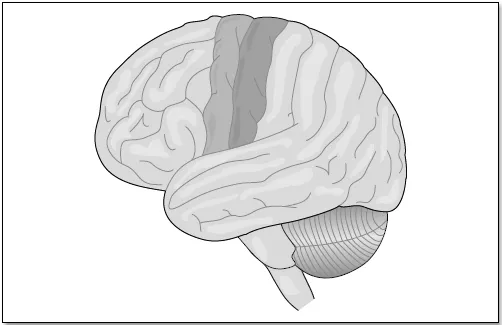
The brain itself is a physical mass that weighs approximately three pounds (see Figure 1.1). It is similar to the size of a coconut, and its shape can best be imagined as a half of a shelled walnut. The brain's consistency is like Jell-O, and its overall color would resemble partially cooked liver. It is also referred to as the cerebral cortex. Contrary to what is frequently said about the color of the brain, it is not all gray matter. The living brain has a massive network of blood vessels on the surface which give it more of a pinkish color with other layers of neuron bodies and connections appearing as gray or white areas. The brain demands at least one-fifth of the blood pumped by the heart, and from the blood it extracts oxygen, carbon dioxide, and glucose. Other unhealthy substances that may be circulating from other parts of the body are stopped by a blood-brain barrier. Gray matter extends through six layers of the cortex and is made up of hundreds of millions of neurons forming wispy-like columns. An axon is a long extended arm emanating from each neuron that reaches out for connections to other neurons to form networks of white matter. Collectively, the white substance is composed of myelin sheaths that feed, cover, and protect the axons and form the blood-brain barrier (Berninger & Richards, 2002). Neurons, which are microstructures in the brain's structures and systems, are specifically defined in the next chapter.
Figure 1.1 An adult human brain is a physical mass with a weight of approximately three pounds. Its plasticity for responding to the environment allows it to learn throughout a human's lifetime
WHAT CAN YOU TELL YOUR STUDENTS ABOUT THEIR BRAINS?
Our marvelous brains are only one pound at birth and grow to become the three pound brain adults have. All brains are protected from bumps and jolts by a skull, called the cranium, and brain fluid. A three-pound brain is about the size of a large coconut and looks like a half of a shelled walnut. Its color varies from gray to grayish pink to white. It is our hungriest organ and can demand as much as 20 to 25% of all the oxygen and food we have for our whole bodies. The brain is plastic, which means its connections can be changed, so you know how you should act and learn from what is happening around you. Even adult brains, although they are not growing in size, are able to change what they think and to learn new things.
LEARNING AT ANY AGE
While this book focuses on how the human brain develops to read, readers are curious about themselves as learners, as well. Understanding adults as learners provides the foundation for what students aspire to achieve for their thinking brains. Adults are challenged to think about how new information is learned.
They face new situations, such as being a newcomer to a group of people who already have a shared knowledge base, teaching a different grade level, or developing a teaching plan for a new subject. An even bigger challenge for teachers is to teach a familiar curriculum with totally new teaching methods and materials. Adults who are parents face continual challenges while their child advances developmentally. They may have to learn about the Jurassic period when the child become fascinated with dinosaurs or learn names and describe functions of large machinery as little boys become infatuated with construction. Older children gravitate toward technology, which does not appear to be child's play to parents (or even more unlikely, to grandparents) from the nontechnology generation. Or, parents need to learn the rules and nuances of various team activities as students participate in youth sports. Active adults are not immune from and must be open to continuous learning or relearning as the children with whom they interact develop their interests and become cognitively sophisticated.
What Do Adults Do to Learn?
New and strange situations place demands on the adult brain. It is challenged to make new connections or to go to memory's storage places for previous knowledge that may or may not be well developed. How do adults do it? Do they engage in research on the topic? Do they practice and rehearse new names or information...