eBook - ePub
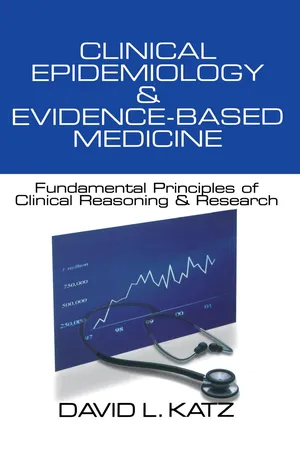
Clinical Epidemiology & Evidence-Based Medicine
Fundamental Principles of Clinical Reasoning & Research
- 320 pages
- English
- ePUB (mobile friendly)
- Available on iOS & Android
eBook - ePub
Clinical Epidemiology & Evidence-Based Medicine
Fundamental Principles of Clinical Reasoning & Research
About this book
The presentation is consistently excellent. One, the writing is lucid and organized in a way that should be very natural for the clinical reader. Two, the text requires no background in mathematics and uses a minimum of symbols. And, three, the methodological concepts and clinical issues are well integrated through a number of carefully prepared and comprehensive examples. Greg Samsa, Associate Director, Duke Center for Clinical Health Policy Research If a patient is older or younger than, sicker or healthier than, taller or shorter than or simply different from the subjects of a study, do the results pertain? Clinical Epidemiology & Evidence-based Medicine is a resource for all health-care workers involved in applying evidence to the care of their patients. Using clinical examples and citing liberally from the peer-reviewed literature, the book shows how statistical principles can improve medical decisions. Plus, as Katz shows how probability, risk and alternatives are fundamental considerations in all clinical decisions, he demonstrates the intuitive basis for using clinical epidemiolgy as a science underlying medical decisions. After reading this text, the practitioner should be better able to access, interpret, and apply evidence to patient care as well as better understand and control the process of medical decision making.
Information
Publisher
SAGE Publications, IncYear
2001Print ISBN
9780761919391
9780761919384
Edition
1eBook ISBN
9781506319650
Section II
PRINCIPLES OF CLINICAL RESEARCH
The artful interpretation of published studies is essential to the application of medical advances to individual patient care. Extensive advice on using the medical literature is available. The Users’ Guides series in the Journal of the American Medical Association is a particularly noteworthy example (see Text Sources at the end of this book). Section II provides an overview of the considerations a clinician might have when reading and interpreting studies in the medical literature. Emphasis will be placed on the hypotheses tested in medical studies, the designs of the studies, and the statistics used to report results.
An important prerequisite to interpreting the specifics of a study and gauging its relevance to patient care is a simple, generalizable approach. For a busy clinician, the effectiveness of any aid in the interpretation of an article should be judged as much on the basis of efficiency as reliability. An approach that will help the clinician understand a study and use it efficiently is to answer four basic questions about it: what, why, how, and in whom?
The basic worth of a study is captured in its hypothesis. Knowing quickly what hypothesis is being tested allows a quick assessment of how much, if any, time should be invested in the article. The next question, why was the particular hypothesis asserted and tested, lends further support to the initial decision. Not all hypotheses are tested to change clinical practice. Knowing what question a study is designed to answer and why the question was posed is usually a sufficient basis for the clinician to determine if the study is worth the time it would take to read.
But these answers are not sufficient to determine if the study, once read, provides any basis for changing clinical practice. A first step toward that goal is reached by asking how the study tested the hypothesis of interest. The chapters in this section characterize the relative strengths and weaknesses of various study designs. These characteristics are the arbiters of evidence; hypotheses tested with varying methodologic rigor provide evidence of varying authority. A change in clinical practice on the basis of provocative but as yet inconclusive evidence might be misguided.
The ultimate clinical goal in reading the medical literature is to apply study results to the care of individual patients. This cannot be done before asking in whom were the study results achieved? To the extent that study subjects mimic the characteristics of a patient, results are more likely to apply. The opposite is also true; a patient not meeting eligibility criteria for a study cannot reliably be presumed to respond comparably to those subjects that did.
While the answers to what, why, how, and in whom go a long way toward providing a fundamental understanding of a study, the answers are potentially diverse and themselves raise additional and progressively subtler questions. It is hoped that the content of this section will help the clinician add sophistication to efficiency when he or she interprets and applies the medical literature to practice.
6
Hypothesis Testing 1
Principles
INTRODUCTION
Virtually all research is founded on the generation and testing of hypotheses. The interpretation of research requires an appreciation for the methods, performance, and pitfalls of hypothesis testing. While many aspects of hypothesis testing are quantitative and statistical, many salient principles are basic and conceptual. The characteristics of associative relationships, and the subtleties in establishing causality, are germane to the process of hypothesis testing. This material is relevant to the clinician not only because of its importance in interpreting the literature, but because the processes of clinical care are similarly dependent on the generation and testing of hypotheses. The generation of a differential diagnosis, and its ultimate reduction to a single diagnosis, or the estimation of prognosis, rely on hypotheses cast in terms of probability, alternative, and risk. These hypotheses are asserted and tested in the context of the history, physical examination, and subsequent testing and treatment. A refined appreciation for methods of hypothesis testing is therefore equally pertinent to the interpretation of the medical literature, and the clinical context in which that evidence is applied.
Medical investigation, and consequently the medical literature in which it is reported, is all about hypothesis testing. Beliefs or predictions about the actions of drugs or procedures, or the effects of exposures, are compared between groups to look for the differences that provide evidence of an association. The detection of a sufficiently robust association supports or even confirms the hypothesis.
The progress of medical science is dependent on the generation and testing of hypotheses. Only those hypotheses that are generated can be tested, which means that science is bounded and paced only by imagination and curiosity, and to some extent, bias. Beliefs about what is likely to be true in the absence of evidence represent biases, or prejudices. Yet such beliefs are the source of all hypotheses in medical science. If no one believed something to be true, it would not be a promising line of research. If corroborating evidence were already available, there would be little point in further study. Thus, scientific progress requires both curiosity and bias.
Of potential comfort to clinicians is the fact that clinical progress is achieved in much the same manner. Each new patient’s story is judged in the context of all that has come before. Hypotheses generated about diagnosis, prognosis, and management are based in part on bias. Sometimes the bias is mediated by prior clinical experience. For example, a male patient with chest pain in the practice of a cardiologist in the US is presumed to be at risk for coronary disease because so many of his predecessors have had the condition. A male patient with chest pain in the practice of a pediatrician in a rural area in Tibet does not induce the same considerations. Yet it might be that the former patient does not have angina pectoris, while the latter patient, suffering an extreme familial dyslipidemia, does. Our biases can lead us astray but, because they are the product of what is usually true, they are more likely to guide us than misguide us.
It is because our biases (and by extension our hypotheses) about patients can misguide us that they generally need to be tested. The quantitative principles governing the process by which we test such hypotheses have been discussed in earlier chapters. But underlying the process of hypothesis testing in patient care is the evidence base informing clinical decisions. Evidence is the result when the bias leading to hypothesis generation is replaced with the results of hypothesis testing.
What one would hope to produce by testing hypotheses is ironclad evidence of causality, that exposure leads to disease or intervention to cure. However, causality is very difficult to establish. Koch’s postulates, summarized in Table 6.1, are widely invoked as the acid tests of causality and are especially relevant to infectious disease. A more generalizable set of conditions for causality is Mill’s canons,1 which state that causality is supported by associations that are1
- strong—the difference in effect mediated by the putative cause is large
- consistent—the effect is seen most/much of the time when the putative cause is present
- specific—the effect is generally not seen when the putative cause is absent
- biologically plausible—the effect relates to the putative cause in a manner consistent with current understanding of mechanism and natural history
- dose-responsive—the magnitude or risk of the effect appears to vary with the magnitude of the putative cause
| TABLE 6.1 | Koch’s Postulates |
| Association: it is always found with the disease | Distribution: is capable of explaining the manifestations of disease |
| Isolation: can be isolated and cultured and is distinct | Susceptibility: can produce the disease in susceptible individuals |
There are several varieties of causality. A necessary cause must be present for the effect to occur. Exposure to mycobacterium tuberculosis is a necessary cause of tuberculosis. A sufficient cause will lead inevitably to the effect; decapitation is a sufficient cause of death. A necessary cause may or may not be sufficient to produce the effect. A sufficient cause may or may not be necessary.
Because causality is difficult to establish, there are preliminary standards of evidence that tend to come first. Because these standards of evidence are generated through the process of hypothesis testing, an appreciation for the mechanics of the process is fundamental to evidence-based practice. The key steps involved in hypothesis testing are summarized in Table 6.2.
| TABLE 6.2 | The Key Steps in Hypothesis Testing |
| Step in Hypothesis Testing | Description |
| Assert an association | Hypothesis generation generally requires some belief about a probable association in the absence of definitive evidence |
| Measure the magnitude (strength) of the outcome effect of interest by comparing outcome... |
Table of contents
- Cover page
- Dedication
- Title
- Copyright
- Contents
- Preface
- Acknowledgments
- Section I: Principles of Clinical Reasoning
- Section II: Principles of Clinical Research
- Section III: From Research to Reasoning: The Application of Evidence in Clinical Practice
- Appendices
- Glossary
- Text Sources
- Epilogue
- Index
- About the Author
Trusted by 375,005 students
Access to over 1.5 million titles for a fair monthly price.
Study more efficiently using our study tools.
Frequently asked questions
Yes, you can cancel anytime from the Subscription tab in your account settings on the Perlego website. Your subscription will stay active until the end of your current billing period. Learn how to cancel your subscription
No, books cannot be downloaded as external files, such as PDFs, for use outside of Perlego. However, you can download books within the Perlego app for offline reading on mobile or tablet. Learn how to download books offline
We are an online textbook subscription service, where you can get access to an entire online library for less than the price of a single book per month. With over 1.5 million books across 990+ topics, we’ve got you covered! Learn about our mission
Look out for the read-aloud symbol on your next book to see if you can listen to it. The read-aloud tool reads text aloud for you, highlighting the text as it is being read. You can pause it, speed it up and slow it down. Learn more about Read Aloud
Yes! You can use the Perlego app on both iOS and Android devices to read anytime, anywhere — even offline. Perfect for commutes or when you’re on the go.
Please note we cannot support devices running on iOS 13 and Android 7 or earlier. Learn more about using the app
Please note we cannot support devices running on iOS 13 and Android 7 or earlier. Learn more about using the app
Yes, you can access Clinical Epidemiology & Evidence-Based Medicine by David L. Katz in PDF and/or ePUB format, as well as other popular books in Psychology & History & Theory in Psychology. We have over 1.5 million books available in our catalogue for you to explore.