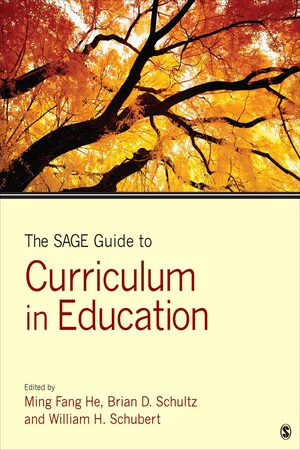
The SAGE Guide to Curriculum in Education integrates, summarizes, and explains, in highly accessible form, foundational knowledge and information about the field of curriculum with brief, simply written overviews for people outside of or new to the field of education. This Guide supports study, research, and instruction, with content that permits quick access to basic information, accompanied by references to more in-depth presentations in other published sources. This Guide lies between the sophistication of a handbook and the brevity of an encyclopedia. It addresses the ties between and controversies over public debate, policy making, university scholarship, and school practice. While tracing complex traditions, trajectories, and evolutions of curriculum scholarship, the Guide illuminates how curriculum ideas, issues, perspectives, and possibilities can be translated into public debate, school practice, policy making, and life of the general public focusing on the aims of education for a better human condition. 55 topical chapters are organized into four parts: Subject Matter as Curriculum, Teachers as Curriculum, Students as Curriculum, and Milieu as Curriculum based upon the conceptualization of curriculum commonplaces by Joseph J. Schwab: subject matter, teachers, learners, and milieu. The Guide highlights and explicates how the four commonplaces are interdependent and interconnected in the decision-making processes that involve local and state school boards and government agencies, educational institutions, and curriculum stakeholders at all levels that address the central curriculum questions: What is worthwhile? What is worth knowing, needing, experiencing, doing, being, becoming, overcoming, sharing, contributing, wondering, and imagining? The Guide benefits undergraduate and graduate students, curriculum professors, teachers, teacher educators, parents, educational leaders, policy makers, media writers, public intellectuals, and other educational workers.
Key Features:
Each chapter inspires readers to understand why the particular topic is a cutting edge curriculum topic; what are the pressing issues and contemporary concerns about the topic; what historical, social, political, economic, geographical, cultural, linguistic, ecological, etc. contexts surrounding the topic area; how the topic, relevant practical and policy ramifications, and contextual embodiment can be understood by theoretical perspectives; and how forms of inquiry and modes of representation or expression in the topic area are crucial to develop understanding for and make impact on practice, policy, context, and theory.
Further readings and resources are provided for readers to explore topics in more details.
eBook - ePub
The SAGE Guide to Curriculum in Education
- 552 pages
- English
- ePUB (mobile friendly)
- Available on iOS & Android
eBook - ePub
The SAGE Guide to Curriculum in Education
About this book
Information
Part I Subject matter as curriculum
INTERLUDE
Introducing Part I: Subject Matter as Curriculum
Subject matter is one important dimension or commonplace of
curriculum; however, it cannot be comprehended in any full sense without
perceiving its interrelationship and interdependence with the other three
commonplaces (teachers, learners or students, and milieu). The
interdependence among commonplaces, which is in constant flux, necessitates
that educators continuously rebalance the relationship among the
commonplaces through ongoing deliberation. Thus, those involved in any
educational situation must ask: How do the subject matter and the teachers
influence one another? How do the subject matter and the students affect one
another? How does the milieu or environment (broadly conceived) have mutual
influence with the subject matter? Additionally, how does any given subject
matter influence any other? It is necessary, too, to realize that answers to
these questions and others that flow from them are never final but always in
the making.
Thus, it is important to consider how several subject matters at play affect
one another. Some of the subject matters discussed in the chapters in Part I
would usually be categorized as content areas such as mathematics, science,
literacy or reading or language arts, social studies, physical education,
and the arts. Others would be categorized as more process-oriented such as
media, currere, multiculturalism, and popular culture. The apparent
juxtaposition of these is reminiscent of Louise
Berman’s (1968) insightful work titled New Priorities in
Curriculum, which in an earlier era dealt with a similar issue. She
suggested that curriculum should have new process-oriented subject matters
of eight: perceiving, communicating, loving,
knowing, decision making, patterning,
creating, and valuing. After presenting a chapter on each,
Berman suggested for those who needed a means for transitioning from the
traditional to the progressive (process-oriented) subjects that a chart be
used (p. 181) in which these processes were set in an 8 × 5 matrix
crisscrossed with five traditional subjects: mathematics, social studies,
English, art, and science. Thus, teachers could see how each of the
processes could be taught in each of the traditional subjects. Similarly,
you might ask how the less familiar subject matters treated in chapters in
Part I could facilitate the subjects you teach.
Reference
(1968). New priorities in the curriculum. Columbus, OH: Merrill.
1 Deciding Aims and Purposes of Subject Matter
When non-education specialists are asked what comes to mind when they think of the term curriculum, they almost always state subject matter first. Subject matter is one of the most important commonplaces in curriculum making identified by Joseph Schwab (1970): teachers, learners, subject matter, and milieu. To many non-specialists, in fact, curriculum is often nothing other than subject matter logically arranged. Discussing curriculum without attention to subject matter seems nonsensical to most people.
At times during the past century, however, subject matter was devalued to such an extent that discussions about curriculum often ignored subject matter altogether. Without a proper sense of curricular balance, subject matter can be (and has been) overtaken by one or more of the other commonplaces. This chapter is dedicated to the aims and purposes of subject matter not just because the achievement of curricular balance is important but also because subject matter always plays a crucial role in curriculum making.
Although subject matter has received equal importance as other curricular commonplaces in the United States and the rest of the world, the late 20th century saw a rise in attention to subject matter above the other commonplaces. These developments necessitated a broader discussion about how key curriculum scholars in the past answered questions about the aims and purposes of subject matter.
A focus on three main philosophies, represented by three key figures who have guided the way most people think about the role of subject matter in curriculum making, illuminates contemporary curriculum trends and their origins. Although there is an overlap among these three philosophies, they can roughly be categorized by the terms essentialist, romantic, and humanist. Other synoptic texts have addressed these thinkers as well, often with slightly different terms or emphases, all of which provide a more lengthy treatment than this one chapter would allow (Eisner, 1985; Null, 2011; Schubert, 1986; Smith, Stanley, & Shores, 1957; Taba, 1962; Tanner & Tanner, 1975). In exploring the views on subject matter presented through the three philosophies included in this chapter, each section addresses two primary questions about the aims and purposes of subject matter within curriculum: When designing a curriculum, is subject matter a means or an end? If subject matter is a means, what is the larger end that it serves?
The three figures discussed in this chapter are William Chandler Bagley, from an essentialist perspective; William Heard Kilpatrick, representing a romantic view; and William Torrey Harris, who upholds a humanist philosophy. Each takes a unique and historically significant position with regard to the role of subject matter in curriculum making, and each has descendants throughout the 20th century to the present time in the 21st century. Bagley served as a professor of educational psychology and teacher education at Columbia University’s Teachers College from 1917 to 1939; Kilpatrick also taught educational philosophy at Columbia’s Teachers College from 1909 to 1937; and Harris wrote numerous books and articles on educational philosophy and also served as U.S. Commissioner of Education from 1896 to 1906. The views of these three figures provide significant insight into the role of subject matter in curriculum making, not just because their work had great influence but also because their views differed in significant ways.
Subject Matter as a Means or as an End
Any discussion of curriculum must attend to the question of purpose. With its etymological roots tracing back to the notion of running a race, the term curriculum presupposes an end. At different times in history, each of Schwab’s (1970) aforementioned commonplaces has been elevated as the “one true end” that different people concluded must (or should) serve as the focal point around which all of the others must revolve. The stand of subject matter is no different.
Bagley never failed to emphasize subject matter. He was no simple thinker who ignored the complexities involved in curriculum making, but he wrote and taught during a time when he believed that educational philosophy had followed a path that devalued subject matter. He predicted serious consequences for American education as a result of the direction educational philosophy had taken during the early 20th century. He argued that certain followers of John Dewey, primarily Kilpatrick, who was Dewey’s protégé at Columbia, had become so enamored with the new educational psychology of the time that they had replaced an emphasis on subject matter with a wholesale worshipping of the individual interests of children.
Bagley’s emphasis on scientific knowledge led him to disagree with what became known as the progressive education movement. Bagley’s strong scientific background grew from his time as a PhD student in psychology at Cornell University. At the same time that writers such as Dewey, G. Stanley Hall, and Kilpatrick were beginning to think about the implications of child psychology in teaching, learning, and curriculum, Bagley began to emphasize the role of quality teacher education. He argued that the United States’ effort to provide a high-quality curriculum to all young people could not be successful unless higher education institutions made teacher education one of their highest priorities. Much like curriculum for elementary and high schools, Bagley believed that programs for teacher preparation should prioritize subject matter. He wanted to prepare teachers to have a deep knowledge in the subject matter they taught and to have the capacity to connect this subject matter to students who came from a wide variety of backgrounds. Graduates of these teacher preparation programs should take pride in providing curricula that put students in touch with the core bodies of knowledge that held democracy together. In a famous essay, Bagley (1938/2010) made the point this way:
Democracy demands a community of culture. Educationally this means that each generation be placed in possession of a common core of ideas, meanings, understandings, and ideals representing the most precious elements of the human heritage. (p. 562)
As Bagley witnessed a shift in educational philosophy that prioritized individual interests of children (and simultaneously made subject matter a tool instead of an end), he became increasingly concerned that students would have no access to the cultural power that comes with knowledge of subjects such as mathematics and literature. To Bagley, knowledge and power were synonymous.
To address the problem that had arisen from what Bagley viewed as an artificial separation between “subject matter” and “methods of teaching,” he coined the phrase “professionalized subject matter.” What he meant was something similar to Lee Shulman’s (1987) conception of pedagogical content knowledge, which remains prevalent today. To Bagley (1928), pro...
Table of contents
- Cover
- Half Title
- Editorial Board
- Title Page
- Copyright Page
- BRIEF CONTENTS
- Contents
- About the Editors
- Acknowledgments
- Acknowledgements
- Prelude
- Publisher Note
- Part I Subject matter as curriculum
- 1 Deciding Aims and Purposes of Subject Matter
- 2 Subject Matter as Experience
- 3 Subject Matters of Literacy
- 4 Subject Matters of Science, Technology, Engineering, and Mathematics
- 5 Subject Matters of Social Studies
- 6 Subject Matters of the Arts
- 7 Subject Matters of Humanities
- 8 Subject Matters of Language, Culture, Identity, and Power
- 9 Subject Matters of Physical Education
- 10 Organization and Sequencing of Subject Matters
- 11 Subject Matters of Digital Technology and Computing Science Curriculum
- 12 Integrated, Holistic, and Core Subject Matters
- 13 Currere as Subject Matter
- 14 Multicultural Currere as Subject Matter
- 15 Critical Race/Feminist Currere
- 16 Curriculum Imagination as Subject Matter
- 17 Popular Culture as Subject Matter
- 18 Critical Media Literacy in the Digital Age
- Part II Teachers as Curriculum
- 19 Teacher as Curriculum
- 20 Teachers as Activists
- 21 Teachers and Pedagogy for Communal Well-Being
- 22 Teacher Bashing And Teacher Deskilling
- 23 High-Stakes Testing and the Evaluation of Teachers
- 24 Teachers as Cultural Workers
- 25 Teacher Education Curriculum
- 26 Culturally Relevant Pedagogy
- 27 Black Teachers as Curriculum Texts in Urban Schools
- 28 Teachers as Improvisational Artists
- Part III Students as Curriculum
- 29 Students as Curriculum
- 30 Students’ Experiences as Curriculum
- 31 Immigrant Students’ experience as Curriculum
- 32 Learning From and With Culturally and Linguistically Diverse Students
- 33 Learning From/With Multicultural Children’s Literature
- 34 Students and (Dis)Ability
- 35 Students as Critical Citizens/Educated Subjects but Not as Commodities/Tested Objects
- 36 Learning for Creative, Associated, Joyful, and Worthwhile Living
- Part IV Milieu as Curriculum
- 37 The Neglected Historical Milieu
- 38 The Biographical and Documentary Milieu
- 39 Curriculum and the Policy Milieu
- 40 The Parental, Familial, and Communal Milieu
- 41 The Technological Milieu
- 42 The Moral and Spiritual Milieu: Humanistic Alternatives to the Competitive Milieu
- 43 The Gender, Sexuality, and Queer Milieu
- 44 The Womanist/Black Feminist Milieu
- 45 The Socioeconomic Class Milieu
- 46 The Corporate–Military–Governmental Milieu
- 47 The Youth Cultural Milieu
- 48 Deschooling, Homeschooling, and Unschooling in the Alternative School Milieu
- 49 Geographical Milieu
- 50 Popular Cultural Milieu Illustrated Through a Hip-Hop Culturally Values-Driven Pedagogy
- 51 Browning the Curriculum: A Project of Unsettlement
- 52 Ecological Milieu
- 53 Global, Transnational, and Local Curriculum
- 54 Indigenous Land and Decolonizing Curriculum
- 55 The Multicultural, Multilingual, and Multiracial Milieu
- Appendix
- References
- Appendix
- References
- Index
Trusted by 375,005 students
Access to over 1.5 million titles for a fair monthly price.
Study more efficiently using our study tools.
Frequently asked questions
Yes, you can cancel anytime from the Subscription tab in your account settings on the Perlego website. Your subscription will stay active until the end of your current billing period. Learn how to cancel your subscription
No, books cannot be downloaded as external files, such as PDFs, for use outside of Perlego. However, you can download books within the Perlego app for offline reading on mobile or tablet. Learn how to download books offline
Perlego offers two plans: Essential and Complete
- Essential is ideal for learners and professionals who enjoy exploring a wide range of subjects. Access the Essential Library with 800,000+ trusted titles and best-sellers across business, personal growth, and the humanities. Includes unlimited reading time and Standard Read Aloud voice.
- Complete: Perfect for advanced learners and researchers needing full, unrestricted access. Unlock 1.5M+ books across hundreds of subjects, including academic and specialized titles. The Complete Plan also includes advanced features like Premium Read Aloud and Research Assistant.
We are an online textbook subscription service, where you can get access to an entire online library for less than the price of a single book per month. With over 1.5 million books across 990+ topics, we’ve got you covered! Learn about our mission
Look out for the read-aloud symbol on your next book to see if you can listen to it. The read-aloud tool reads text aloud for you, highlighting the text as it is being read. You can pause it, speed it up and slow it down. Learn more about Read Aloud
Yes! You can use the Perlego app on both iOS and Android devices to read anytime, anywhere — even offline. Perfect for commutes or when you’re on the go.
Please note we cannot support devices running on iOS 13 and Android 7 or earlier. Learn more about using the app
Please note we cannot support devices running on iOS 13 and Android 7 or earlier. Learn more about using the app
Yes, you can access The SAGE Guide to Curriculum in Education by Ming Fang He,Brian D. Schultz,William H. Schubert, Ming Fang He, Brian D. Schultz, William H. Schubert in PDF and/or ePUB format, as well as other popular books in Education & Education General. We have over 1.5 million books available in our catalogue for you to explore.