![]()
Appendix 1—Principal Responsibilities
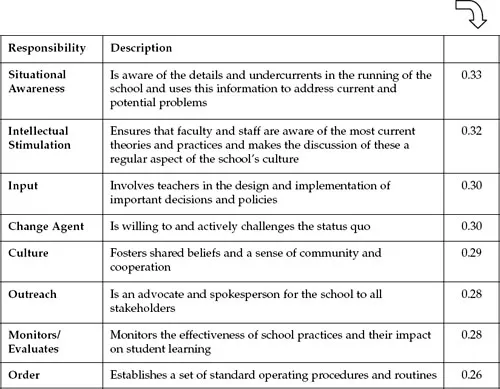
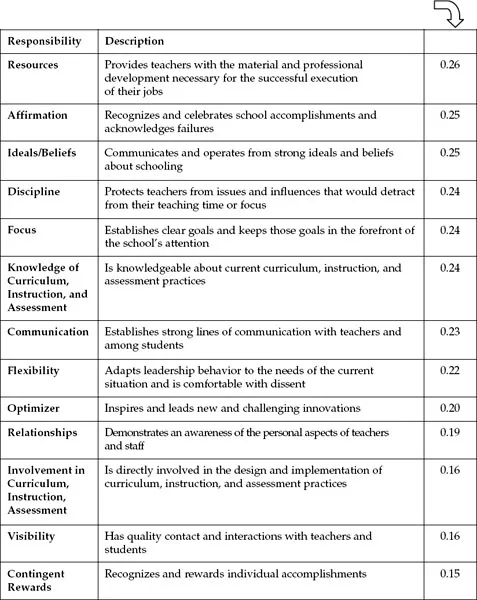
The following 21 principal responsibilities are identified in School Leadership That Works, by Marzano, Waters, and McNulty (2005). Note that the responsibilities are presented here in descending order according to the value of the third column: correlation to positive impact on student achievement.
SOURCE: From School Leadership That Works: From Research to Results, by R. J. Marzano, T. Waters, and B. A. McNulty, 2005, Alexandria, VA: Association for Supervision and Curriculum Development. Copyright 2005 by McREL. Reprinted with permission.
![]()
Appendix 2—Currencies
CURRENCIES FREQUENTLY VALUED IN ORGANIZATIONS
| Inspiration-Related |
| Vision |
Being involved in a task that has larger significance for unit, organization, customers, or society |
| Excellence |
Having a chance to do important things really well |
| Moral/Ethical Correctness |
Doing what is “right” by a higher standard than efficiency |
| Task-Related |
| New Resources |
Obtaining money, budget increases, personnel, space, and so forth |
| Challenge/Learning |
Doing tasks that increase skills and abilities |
| Assistance |
Getting help with existing projects or unwanted tasks |
| Task Support |
Receiving overt or subtle backing or actual assistance with implementation |
| Rapid Response |
Quicker response time |
| Information |
Access to organizational as well as technical knowledge |
| Position-Related |
| Recognition |
Acknowledgment of effort, accomplishment, or abilities |
| Visibility |
The chance to be known by higher-ups or significant others in the organization |
| Reputation |
Being seen as competent, committed |
| Insiderness/Importance |
A sense of centrality, of “belonging” |
| Contacts |
Opportunities for linking with others |
| Relationship-Related |
| Understanding |
Having concerns and issues listened to |
| Acceptance/Inclusion |
Closeness and friendship |
| Personal Support |
Personal and emotional backing |
| Personal-Related |
| Gratitude |
Appreciation or expression of indebtedness |
| Ownership/Involvement |
Ownership of and influence over important tasks |
| Self-Concept |
Affirmation of one’s values, self-esteem, and identity |
| Comfort |
Avoidance of hassles |
SOURCE: From Influence Without Authority (p. 79), by A. R. Cohen and D. L. Bradford, 2005, New York: John Wiley & Sons. Copyright 2005 by John Wiley & Sons. Reprinted with permission.
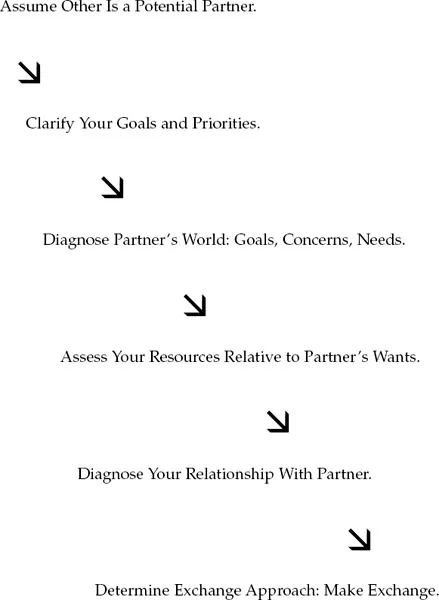
THE COHEN-BRADFORD MODEL OF INFLUENCE THROUGH EXCHANGE
The Law of Reciprocity: Everyone who does anything for anyone else expects to be paid back eventually in one form or another.
SOURCE: From Influence Without Authority (p. 46), by A. R. Cohen and D. L. Bradford, 2005, New York: John Wiley & Sons. Copyright 2005 by John Wiley & Sons. Reprinted with permission.
![]()
Appendix 3—Project Charter Sample
Prepared By: Date:
Sponsor ____ (who is paying for this?) (name and signature)
Project Leader (name and signature)
Section 1—Background Information
Project Name/Number:
State the name of your project and project accounting number (if appropriate).
Project Objectives:
State the objective(s) of the project in clear, measurable terms using action verbs as specifically as possible—What output will this project produce? What major product or service will it deliver?
Clients:
State the name(s) of your main client/requester—Who will benefit from this (assuming it’s not the sponsor)?
Other Critical Stakeholders:
State the name(s) of others (people, roles, groups) who have a vested interest, can impede/propel the project, withhold/offer support (political or resource), will experience a profound change by its output, and so on.
Project Problem or Opportunity:
State the major challenge (problem or opportunity) that requires the establishment of the project—Why should we do this? What rationale supports this project?
Value Proposition:
How will this increase revenue, avoid costs, and/or improve services? Why will our organization deem this a “win”?
Project Scope:
State what the project will and will not include (include both in-scope and out-of-scope lists).
Project Constraints, Assumptions, and Concerns:
List all known constraints and assumptions made on the project as well as any known or anticipated concerns. Concerns might include the need for availability of certain people to participate, potential conflicts with other projects, absolutely inflexible deadlines, legal mandates and potential penalties, and so on.
Project Timing:
State your best macrolevel guess as to when the project will terminate (e.g., end of month or quarter, year-end. Document the actual schedule in the Project Plan.
Areas/Disciplines/Departments/Functions Involved:
Identify other groups (beyond the project team) that will warrant consideration, involvement, or partnership during the project.
Section 2—Supplemental Information
Project Leader:
State your perception of the project leader’s authority on this project as far as staff responsibility, money authorization and management, and direct or indirect accountabilities.
Proje...